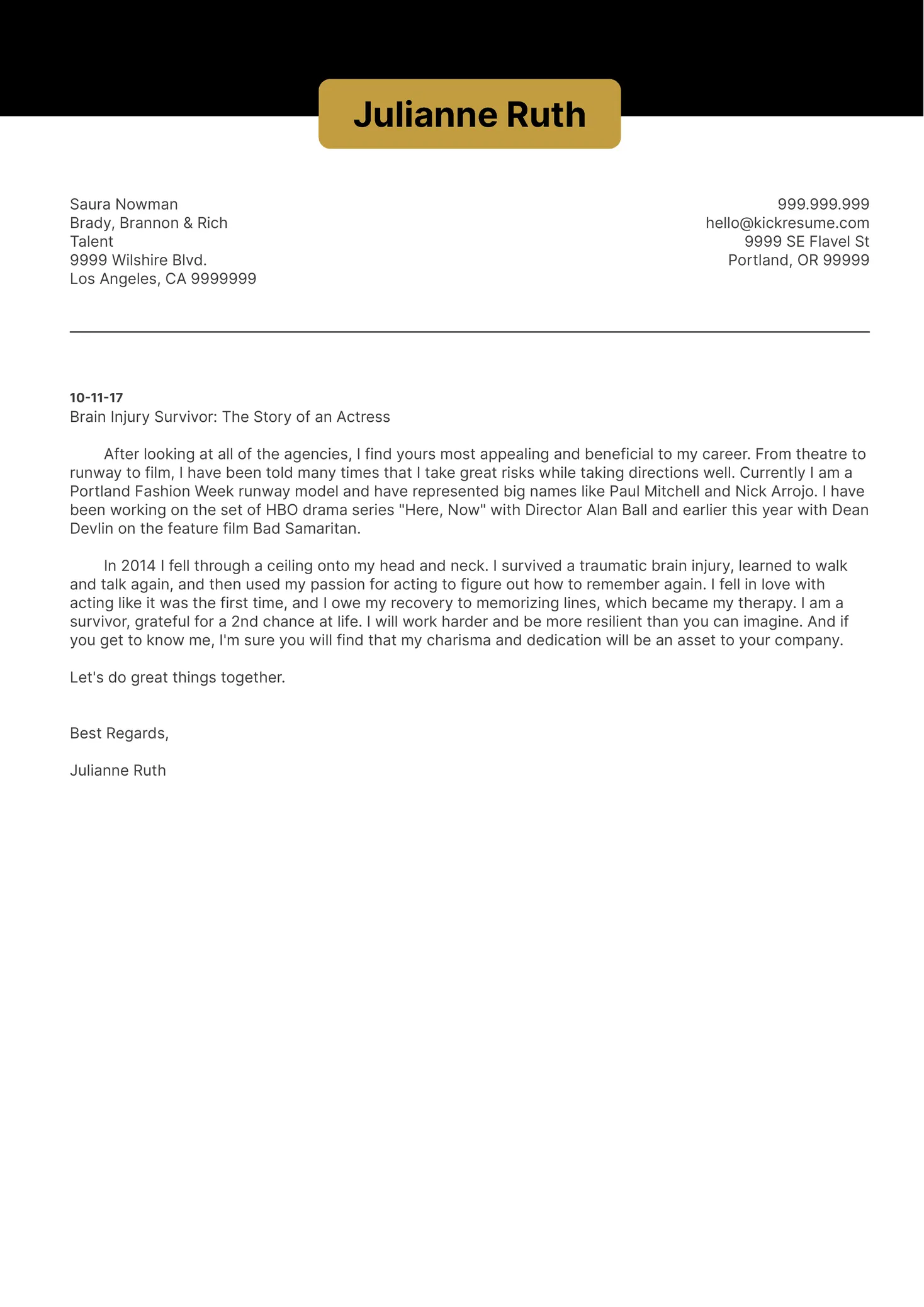
What is an Actor’s Cover Letter
An actor’s cover letter is a crucial document that accompanies your resume and headshot when applying for roles or seeking representation. It serves as your first impression, allowing you to introduce yourself, highlight your relevant experience and skills, and express your enthusiasm for the specific opportunity. Unlike a resume, which is a concise summary of your qualifications, a cover letter allows you to showcase your personality, passion, and unique selling points as an actor. It is a personalized message addressed to the casting director, agent, or producer, demonstrating why you are the ideal candidate for the role or why they should consider representing you. A well-crafted cover letter can significantly increase your chances of getting noticed and securing an audition or meeting.
Importance of a Cover Letter for Actors
In the competitive world of acting, a cover letter is not just optional; it’s essential. It’s your chance to go beyond the basic facts presented in your resume and make a compelling case for why you deserve the opportunity. The cover letter provides a platform to showcase your unique personality, passion for acting, and understanding of the specific project or role. Without one, you risk being perceived as unenthusiastic or, worse, overlooked. It demonstrates professionalism and attention to detail, traits highly valued in the industry. By taking the time to craft a thoughtful and personalized cover letter, you show that you’re serious about your career and willing to go the extra mile. This can make a significant difference in the eyes of casting directors, agents, and other industry professionals.
Why a Cover Letter is Crucial

A cover letter provides the opportunity to connect with the casting director or agent on a personal level. It is a chance to express your genuine interest in the role or representation, which a resume cannot convey. A well-written letter can also demonstrate your understanding of the project’s requirements, your ability to interpret the character, and your suitability for the role. It allows you to highlight specific aspects of your experience that align with the project’s needs. Moreover, a cover letter showcases your communication skills, attention to detail, and overall professionalism, all of which are critical for success in the acting industry. It’s your chance to make a memorable first impression and leave the recipient wanting to learn more about you.
Standing Out from the Crowd
In an industry saturated with talent, a cover letter can be the key to standing out. By tailoring your letter to each specific opportunity, you demonstrate that you’ve done your research and are genuinely interested in the project. Highlighting your unique qualities and experiences that align with the role’s requirements can make you memorable. A well-crafted cover letter can differentiate you from the countless other actors vying for the same opportunity. This means showcasing your personality, your specific skills, and what makes you unique. By crafting a compelling narrative that captures the casting director’s attention, you significantly increase your chances of getting noticed and securing an audition or meeting. This personalized approach can turn a simple application into a memorable introduction.
Key Elements of an Actor’s Cover Letter
Contact Information and Greeting

Begin your cover letter with your full name, contact information (phone number, email address), and the date. If you’re submitting to a specific casting director or agent, find their name and address the letter to them directly. Use a professional greeting, such as “Dear Mr./Ms. [Last Name],” if you know their name. If you’re unsure of the name, a general greeting like “To Whom It May Concern” is acceptable, but try to find a name if possible. This demonstrates attention to detail and respect for the recipient. Ensure all contact details are accurate and up-to-date. Also, ensure your email address is professional (e.g., [firstname.lastname@email.com]) and not a casual or informal one.
Personal Introduction and Objective
Start your letter with a brief introduction that states your name and what you’re applying for (e.g., the role of [character name] in [project title] or representation by [agency name]). Clearly state your objective and what you hope to achieve with this letter. This section sets the tone for the rest of your letter and immediately grabs the reader’s attention. Briefly mention your key qualifications or skills that make you a good fit for the role or agency. Keep this section concise and focused, providing just enough information to pique the reader’s interest. This sets the stage for the more detailed information that will follow in the subsequent sections, guiding the reader through the rest of your letter.
Highlighting Relevant Experience
Selectively highlight your relevant experience, focusing on roles or projects that align with the opportunity. Mention the project title, your role, and the year. Briefly describe your responsibilities and achievements in each role, emphasizing how they relate to the requirements of the current opportunity. Use strong action verbs to describe your accomplishments (e.g., “Played,” “Performed,” “Portrayed”). Quantify your achievements whenever possible (e.g., “Performed to over 1000 audience members.”). Tailor this section to the specific role or agency, ensuring that the experiences you highlight are the most relevant and impressive. Showcase a range of experience to demonstrate your versatility as an actor, while remaining focused on relevant examples.
Showcasing Skills and Training

List your relevant skills, such as specific acting techniques (e.g., Method acting, Meisner technique), vocal training, dance, combat skills, or any other special abilities that are relevant to the role. Mention any training you’ve received from reputable acting schools, coaches, or workshops. Include any awards, certifications, or recognitions you’ve received. Demonstrate that you are a well-rounded and skilled actor by showcasing a variety of skills and training. Highlight skills that directly align with the requirements of the role or the agency’s focus. This section provides concrete evidence of your capabilities and demonstrates your commitment to the craft of acting. Be specific and provide details to support your claims.
Mentioning Specific Projects or Roles
If applying for a specific role, mention the character name and your understanding of the character’s traits and motivations. Explain why you are a good fit for the role, based on your experience and skills. Showcase that you’ve done your research on the project and understand the story. Mention any specific scenes or aspects of the project that excite you. If you are applying for representation, mention any agents or agencies you admire and why you believe you would be a good fit for their roster. Demonstrate your passion for the specific project and highlight your understanding of the director’s vision or the agency’s style. This personalized approach demonstrates your commitment and enhances your chances of success.
Demonstrating Enthusiasm and Professionalism
Throughout your cover letter, express your enthusiasm for the opportunity. Use positive and energetic language to convey your passion for acting and your interest in the project or agency. Maintain a professional tone throughout the letter. Ensure that your writing style is clear, concise, and free of slang or overly casual language. Show your respect for the recipient by using proper grammar, punctuation, and formatting. Proofread the letter carefully to avoid any typos or errors. Demonstrate your commitment to the industry by presenting yourself as a polished and professional actor. A positive attitude and attention to detail can make a significant difference.
The Closing and Call to Action

In your closing paragraph, thank the recipient for their time and consideration. Reiterate your interest in the role or representation and express your availability for an audition or meeting. Provide your contact information again to make it easy for the recipient to reach you. Use a professional closing, such as “Sincerely,” or “Best regards.” Your call to action should be clear and concise, making it easy for the recipient to know what you want them to do next. This could be a request for an audition or a meeting, or a simple statement of your availability. Ensure you leave a lasting positive impression.
Formatting and Style for Actors
Font and Layout Considerations
Choose a clean and professional font, such as Times New Roman, Arial, or Calibri. Use a font size between 10 and 12 points for readability. Maintain consistent formatting throughout your cover letter. Use single spacing and leave a space between paragraphs. Keep your margins at 1 inch on all sides. Ensure that the letter is well-organized, with clear headings and subheadings to guide the reader. Avoid using excessive bolding, underlining, or italics. Present a polished and professional appearance that is easy on the eyes. The goal is to create a document that is both visually appealing and easy to read, making it easier for the recipient to focus on the content.
Proofreading and Editing

Proofread your cover letter carefully for any grammatical errors, spelling mistakes, or typos. Consider having a trusted friend, colleague, or mentor review your letter for clarity and accuracy. Check for any awkward phrasing or repetitive sentences. Ensure that your letter flows logically and that your message is clear and concise. Pay close attention to detail. A well-proofread letter demonstrates your professionalism and attention to detail, which are essential qualities for an actor. This step is essential to make sure that your application is taken seriously. Avoid any errors to leave a strong impression on the recipient.
Tips for Tailoring Your Letter
Researching the Casting Director or Agent
Before writing your cover letter, research the casting director or agent. Learn about their previous projects, the types of actors they represent, and their preferences. Use this information to tailor your letter to their specific needs and interests. This demonstrates your commitment and knowledge of the industry. Look them up on IMDb, LinkedIn, or other industry resources. By tailoring your letter to their specific interests, you show that you’ve done your homework and are genuinely interested in the opportunity. This personalized approach can significantly increase your chances of getting noticed and making a positive impression.
Customizing for the Specific Role

Carefully review the casting brief or job description for the role you’re applying for. Identify the specific requirements, skills, and qualities the casting director is looking for. Customize your cover letter to highlight your experience, skills, and training that align with these requirements. Emphasize your understanding of the character and the project. This shows that you are a good fit for the role. Avoid using a generic cover letter. Tailor your letter to each specific opportunity, addressing the needs and requirements of the role. By demonstrating your understanding of the project’s needs, you significantly increase your chances of being selected for an audition.
Adding a Personal Touch
Include a personal touch in your cover letter to make it more memorable. Share your passion for acting and explain what draws you to the specific project or agency. Highlight your unique qualities and personality. Avoid being overly formal or generic. Show your personality. This makes your cover letter stand out and shows that you are a real person. Adding a personal touch creates a connection with the recipient, making them more likely to remember you. By sharing your enthusiasm and personality, you differentiate yourself from other applicants and increase your chances of getting noticed.
Common Mistakes to Avoid
Generic Letters
Avoid sending generic cover letters that could be used for any role or agency. Tailor your letter to each specific opportunity. Generic letters suggest a lack of effort and interest. Spend the time to personalize your letter, mentioning specific details about the project, the casting director, or the agency. Doing so shows that you’ve done your research and are genuinely interested in the opportunity. Customizing the letter for each application demonstrates a commitment to the project and a desire to be part of it.
Typos and Grammatical Errors
Typos and grammatical errors can damage your credibility and make a negative impression. Proofread your cover letter carefully. Have a friend or colleague review your letter for any mistakes. Errors suggest a lack of attention to detail and professionalism. Before submitting your cover letter, carefully review it multiple times. This demonstrates respect for the recipient and increases the likelihood that your application will be taken seriously. Proofreading is essential.
Lack of Specificity
Avoid vague statements and generalities. Provide specific examples of your experience, skills, and training. Offer concrete evidence to support your claims. A lack of specificity can make your cover letter less compelling. Use detailed descriptions of your roles, projects, and accomplishments. Quantify your achievements whenever possible (e.g., “Played the lead role in a production seen by over 500 audience members.”). Provide the reader with clear and specific information.
Cover Letter Examples for Actors
Example 1 Stage Actor
Dear [Casting Director Name],
I am writing to express my enthusiastic interest in the role of [Character Name] in [Play Title], as advertised on [Platform]. Having been captivated by the play’s profound narrative and [Playwright]’s remarkable vision, I am confident my skills and passion align with the role’s demands.
For the past five years, I have dedicated myself to stage acting. I played the role of [Role Name] in [Play Name] at the [Theater Name], where I received positive reviews for my portrayal. In my previous performance as [Role Name] in [Play Name], I honed my skills in physical theatre and character development.
I have trained under [Teacher/School Name], where I have developed proficiency in [Specific Skills]. I am also adept at accents, having mastered [Accents]. I am a strong ensemble player and dedicated to the collaborative process. My resume details my experience further. I have attached my headshot and resume for your consideration. Thank you for your time, and I look forward to the opportunity to audition.
Sincerely, [Your Name]
Example 2 Film Actor
Dear [Agent/Casting Director Name],
I am eager to submit my application for the film [Film Name]. Having seen the film’s preview, I was immediately drawn to the role of [Character Name] and I believe my experience suits the role.
My most recent on-screen experience was in [Film Title], where I played the role of [Character Name], and [another movie title]. Over the last few years, I have developed the skills in on-camera acting. I am skilled at delivering natural, believable performances, and I am known for my ability to take direction and collaborate effectively with the cast and crew. I recently completed a workshop with [Acting Coach Name] where I learned [Skills].
I am available for an audition at your earliest convenience and am confident that I can bring [Character Name] to life. Thank you for considering me for this role.
Best regards, [Your Name]
Example 3 Commercial Actor
Dear [Casting Director Name],
I am writing to express my interest in the commercial for [Product/Brand] advertised on [Platform]. With my extensive experience in commercial work, and my dedication to capturing audiences, I am confident in my ability to contribute significantly to this project.
I have performed in several commercials, most recently for [Brand Name], where I gained a wide variety of experience. I possess a strong understanding of what makes an effective commercial actor. I am skilled in various acting techniques, including [Skills]. I can take direction well, and I have a positive attitude and strong work ethic. I am reliable, and I always come prepared for the shoot. I have attached my headshot and resume for your consideration. I am available for auditions at your earliest convenience.
Thank you for your time.
Sincerely, [Your Name]
Conclusion
Writing a compelling cover letter is a vital skill for any actor seeking roles or representation. It’s your chance to make a great first impression and stand out from the competition. By following these guidelines and tailoring your letter to each opportunity, you can significantly increase your chances of success in the competitive world of acting. Remember to highlight your skills, experience, and passion. Always express enthusiasm and maintain a professional tone. Good luck with your acting career!