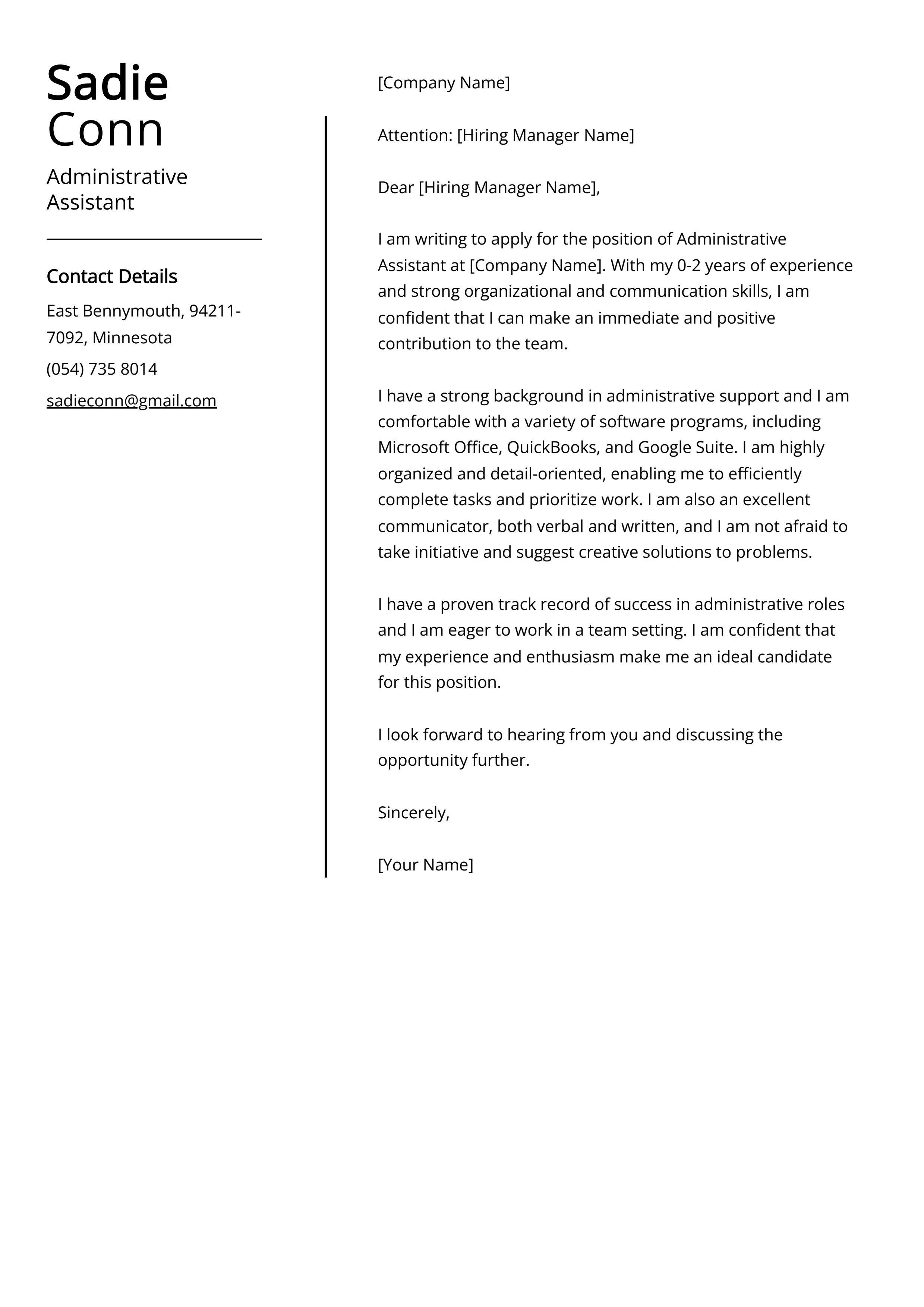
What is an Assistant Cover Letter?
An assistant cover letter is a crucial document accompanying your resume when applying for an assistant position. It serves as your first introduction to a potential employer, offering an opportunity to showcase your personality, skills, and enthusiasm for the role. Unlike a resume, which provides a summary of your experience, a cover letter allows you to elaborate on your qualifications, explain why you’re a great fit for the specific job, and demonstrate your written communication skills. It’s your chance to stand out from other applicants and make a memorable impression. The cover letter should be tailored to the specific job and the company you are applying to. General or generic cover letters will not make a good impression. The more personalized the letter is, the better your chances are of getting an interview.
Key Components of a Winning Cover Letter
A compelling assistant cover letter is made up of several key components that work together to create a persuasive argument for your candidacy. These components work together to give the reader the best idea of who you are, and what you could do for the company. The first, and often most critical, part is the opening paragraph, which should immediately grab the reader’s attention by stating the position you’re applying for and expressing your interest. Following this is a section where you highlight your relevant skills and experiences, providing specific examples of your achievements. You should then demonstrate your understanding of the company and the role, explaining why you’re a good fit. Close with a call to action, encouraging the employer to contact you for an interview and reaffirming your interest in the position. All components should be well-written, clearly formatted, and free of errors.
Contact Information and Salutation

Your cover letter should begin with your contact information at the top, including your name, phone number, email address, and optionally, your LinkedIn profile URL. This ensures the hiring manager can easily reach you. Following your contact information, start with a professional salutation. Avoid generic greetings like ‘To Whom It May Concern.’ If possible, address the hiring manager by name, which shows you’ve done your research and are genuinely interested in the position. Researching the company and the role will also allow you to tailor the rest of your letter to the company’s needs. If you can’t find a specific name, use a professional greeting such as ‘Dear Hiring Manager’ or ‘Dear [Department] Team’.
Highlighting Your Skills and Experience
The body of your cover letter should effectively highlight your relevant skills and experience. Review the job description carefully and identify the key skills and qualifications the employer is seeking. Then, provide specific examples of how you’ve demonstrated those skills in previous roles. Don’t just list skills; provide context. For example, instead of saying ‘Proficient in Microsoft Office,’ you could say ‘Utilized Microsoft Office Suite to create and manage reports, presentations, and correspondence, streamlining office workflows and improving communication.’ Quantify your achievements whenever possible. Using numbers and metrics allows you to demonstrate your impact and value to the company. For example, say ‘Reduced data entry errors by 15% by implementing a new quality control process.’
Tailoring Your Letter to the Job
One of the most important things is to tailor your cover letter to each specific job application. Generic cover letters rarely impress hiring managers. Tailoring your letter demonstrates that you’ve taken the time to understand the role and the company’s needs, which makes your application far more compelling. Review the job description carefully and identify the key requirements. Then, use your cover letter to explain how your skills and experience align with those requirements. If the job description emphasizes communication skills, provide examples of your excellent written and verbal communication abilities. If it focuses on organizational skills, showcase your experience in managing schedules, coordinating meetings, and handling multiple tasks. Be specific and avoid vague statements. Refer to the company’s website and social media channels to learn more about its mission, values, and culture. This will help you tailor your letter to demonstrate that you are a good fit for the company.
Addressing the Employer’s Needs

When writing your cover letter, it’s important to focus on what you can offer the employer, rather than simply listing your qualifications. Address the employer’s needs directly by explaining how your skills and experience can help them achieve their goals. Research the company to understand its current challenges and priorities, and then highlight the skills and experience that will make a difference. For example, if the company is focused on improving customer satisfaction, you might emphasize your experience in providing excellent customer service and resolving issues effectively. If the company is expanding its operations, highlight your experience in managing projects and supporting growth initiatives. By demonstrating that you understand the employer’s needs and can provide effective solutions, you’ll significantly increase your chances of getting an interview.
Showcasing Your Achievements
Instead of just listing your job duties, use your cover letter to showcase your achievements. Focus on the positive results you have achieved in previous roles. Describe the specific actions you took, the challenges you faced, and the outcomes you achieved. Use the STAR method (Situation, Task, Action, Result) to structure your responses. For example, instead of saying ‘Managed office correspondence,’ you could say ‘In my previous role, I managed all office correspondence, implemented a new filing system, and reduced the time spent on document retrieval by 20%.’ Quantify your achievements whenever possible by using numbers and metrics. This demonstrates your impact and value to potential employers. Highlighting your achievements helps you stand out from the competition and gives the hiring manager a clearer picture of your capabilities and your potential contributions.
Expressing Your Enthusiasm
Your cover letter is the perfect place to express your enthusiasm for the assistant position and the company. Show the hiring manager that you are genuinely interested in the role and that you’ve researched the company and its mission. Explain why you’re excited about the opportunity and what aspects of the role or the company resonate with you. Be specific about what attracts you to the position. For example, you might mention a particular project you’re excited about, a company value that aligns with your own, or the opportunity to learn new skills. This helps demonstrate that you are not just looking for any job, but the right job for you. Remember, your enthusiasm can be contagious. Your cover letter is a key opportunity to make a strong first impression and increase your chances of getting an interview.
Formatting and Proofreading

The formatting and proofreading of your cover letter are just as important as the content. A well-formatted letter demonstrates professionalism and attention to detail. Use a professional font such as Times New Roman, Arial, or Calibri, and keep the font size between 10 and 12 points. Ensure your letter is well-structured with clear paragraphs, proper spacing, and consistent formatting. Proofread your cover letter carefully for any grammatical errors, spelling mistakes, and typos. Errors can undermine your credibility and make a negative impression on the hiring manager. It’s best to use a spell checker and grammar checker to avoid such mistakes. However, always read the document carefully. Consider asking a friend, family member, or career advisor to proofread your cover letter. Fresh eyes can often catch errors that you might miss. A polished and error-free cover letter reflects your professionalism and attention to detail, improving your chances of securing an interview.
Call to Action and Closing
Your cover letter should end with a clear call to action. Thank the hiring manager for their time and consideration, and express your interest in an interview. Make it easy for them to take the next step by providing your contact information again. Include your phone number and email address. Be confident and enthusiastic in your closing statement, reiterating your interest in the position and your belief that you are a good fit. The closing should be concise and professional. Avoid generic phrases such as ‘Thank you for your time.’ Instead, try something like ‘I am eager to learn more about this opportunity and discuss how my skills and experience can benefit your team. I look forward to hearing from you soon.’ End the cover letter with a professional closing such as ‘Sincerely,’ ‘Best regards,’ or ‘Yours sincerely,’ followed by your full name. A strong call to action and a professional closing ensure that you leave a lasting positive impression on the hiring manager.