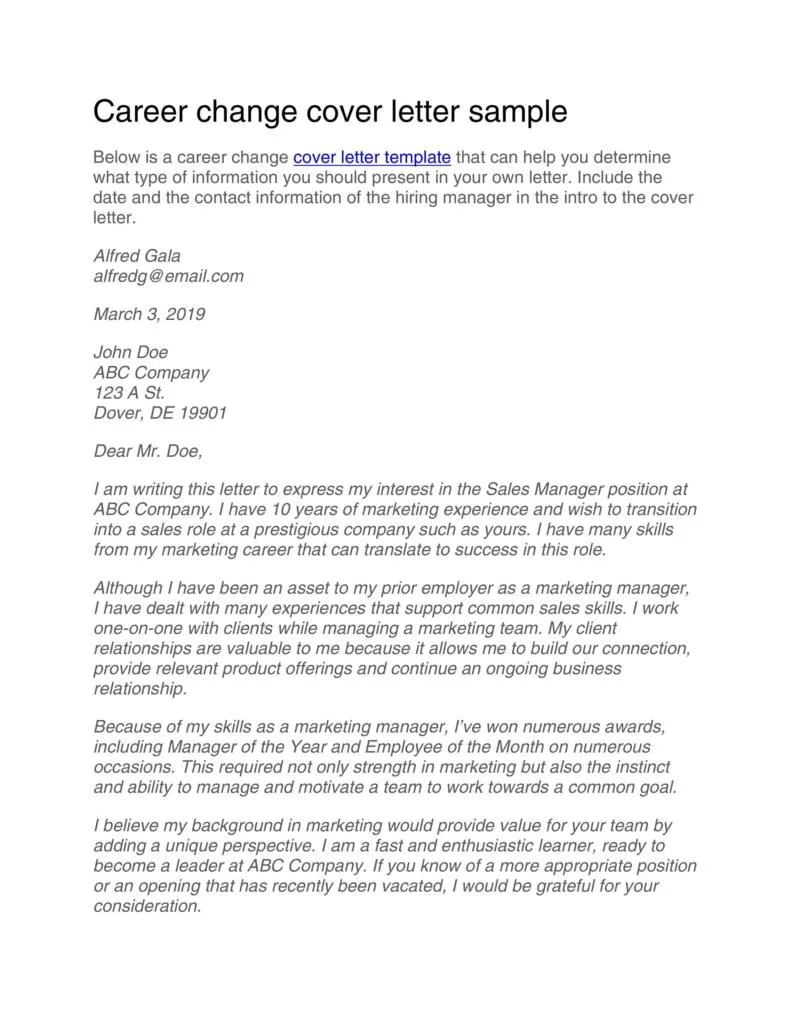
Understanding the Importance of a Career Change Cover Letter
A career change cover letter is not just another piece of paper; it’s your key to unlocking new opportunities. It serves as your first impression and allows you to tell your story in a way that a resume cannot. It bridges the gap between your past experience and your desired future, demonstrating why you’re a great fit for the role, even if your background isn’t a perfect match. This is especially crucial when you’re pivoting to a new field, as it requires you to convince potential employers that your skills and experiences are valuable and relevant, despite your career shift. The cover letter provides a platform to showcase your motivations and highlight transferable skills, which are critical for a successful career change. Without a well-crafted cover letter, your application might get overlooked, as it’s the first step in selling yourself and your capabilities.
Highlighting Transferable Skills
One of the most effective strategies for a career change cover letter is emphasizing your transferable skills. These are the skills you’ve acquired in previous roles that are relevant to the job you’re applying for, regardless of the industry. These could include communication, problem-solving, leadership, project management, or technical skills. Identify skills mentioned in the job description and find examples from your previous experiences where you demonstrated them. For instance, if the job requires project management skills, and you previously managed projects, describe how you managed these projects, the challenges you overcame, and the results you achieved. It’s about connecting the dots, demonstrating how your past experiences have equipped you with the skills necessary for success in your new field. This helps to convince the employer that you are capable of performing the job despite not having direct experience.
Identifying Your Target Audience and Tailoring Your Letter

Before you start writing, research the company and the specific role you’re applying for. Understand the company’s values, culture, and what they are looking for in a candidate. Tailor your cover letter to address the specific needs and requirements outlined in the job description. Use keywords from the job posting to demonstrate that you understand what the employer is looking for. Explain how your skills and experiences align with the job’s requirements. For example, if the company values innovation, share examples of your innovative thinking and how you’ve used it in the past. This demonstrates that you’ve taken the time to understand their needs and are genuinely interested in the role. This also makes your cover letter more engaging and increases your chances of getting noticed. Customization shows employers you’re not just sending out generic applications but are genuinely interested in their company and the specific opportunity.
Showcasing Your Enthusiasm and Motivation
A career change cover letter is your chance to express your passion for the new field and your motivation for making a career shift. Explain why you’re interested in the role and what excites you about the opportunity. Show that you have researched the company and its mission, and that you are aligned with their goals. This can be done by describing your interest in the industry, the company’s work, or the specific role. Share your enthusiasm for the work and your commitment to learning and growing in the new field. Demonstrating your enthusiasm will make the employer more likely to see your potential and be willing to give you a chance, even if you lack direct experience. Avoid sounding generic. Be specific about what drives your interest, and make your cover letter personal and memorable.
Quantifying Achievements and Results
Whenever possible, quantify your achievements. Use numbers and data to demonstrate the impact you’ve made in your previous roles. This adds credibility and makes your claims more convincing. Instead of saying you ‘improved customer service,’ state that you ‘reduced customer complaints by 20%’. If you managed projects, mention the budget, timeline, and outcomes. Use numbers to highlight accomplishments and provide concrete evidence of your skills. Quantifying your achievements helps employers see the value you bring and understand your capabilities. It also helps distinguish your cover letter from others by providing tangible proof of your abilities. Employers are more impressed by facts and figures than general statements, and it helps make your cover letter more impactful and memorable. For instance, you could say that you ‘increased sales by 15% in six months’.
Formatting and Structure of a Career Change Cover Letter

Header and Contact Information
Your cover letter should start with a professional header that includes your name, contact information (phone number, email, and possibly a LinkedIn profile URL), and the date. Ensure that your contact information is accurate and up-to-date. Consider including the hiring manager’s name (if known) and the company’s address. A clear and well-formatted header sets a professional tone and makes it easy for the employer to reach you. The header is the first thing the employer sees, so it’s important to make a good first impression. Check for typos and ensure that your contact information is easy to read and understand. The header must be aligned with the top margin of the page for a professional look.
Professional Salutation
Use a professional salutation such as ‘Dear Mr./Ms./Mx. [Last Name]’ if you know the hiring manager’s name. If you don’t know the name, use a general salutation like ‘Dear Hiring Manager’ or ‘Dear [Company Name] Team’. Avoid overly casual greetings like ‘Hi’ or ‘Hello’. The salutation sets the tone for the rest of the letter, so it’s important to be respectful and professional. Researching the hiring manager’s name shows that you’ve put in the effort to personalize your application. If you’re unsure of the gender-neutral title, using the full name is a safe approach. Make sure the salutation aligns with the company’s culture and professional standards.
Opening Paragraph

In the opening paragraph, state the position you are applying for and how you found the job. Briefly mention your background and why you’re making a career change. Capture the reader’s attention with a compelling statement about your enthusiasm for the role. State your intention to transition to the new field and emphasize your interest in the company. This paragraph is the hook that grabs the hiring manager’s attention, so make it concise and engaging. Clearly state your intention to apply for the position and what makes you suitable for the role, even if you are changing careers. This sets the stage for the rest of the letter and highlights your purpose for applying. A good opening makes the hiring manager want to read more, so craft it carefully.
Body Paragraphs Focus on Skills and Experience
The body of your letter should elaborate on your skills and experiences. Focus on transferable skills, and provide examples from your previous roles that demonstrate how you have applied those skills. Address the specific requirements of the job description and show how your skills align with their needs. Structure your paragraphs logically, using bullet points if necessary, and use action verbs to describe your accomplishments. Provide concrete examples of your accomplishments that showcase your skills. Each paragraph should focus on a key aspect of your suitability for the role. This section is where you sell yourself and persuade the employer that you are the right person for the job. Make sure the information is relevant to the job description.
Closing Paragraph and Call to Action
In the closing paragraph, summarize your key qualifications and reiterate your enthusiasm for the opportunity. Thank the hiring manager for their time and consideration, and include a call to action. Request an interview or indicate your willingness to discuss your qualifications further. Make your call to action clear and concise. Show your interest in the next steps. End with a professional closing such as ‘Sincerely’ or ‘Best regards’, followed by your name. Make the closing paragraph impactful, leave a positive impression on the hiring manager, and state that you are ready for an interview.
Formatting Tips and Tricks

Use a professional font such as Arial, Calibri, or Times New Roman. Ensure the font size is readable (11-12 points). Keep your cover letter concise, ideally no more than one page. Use clear and concise language, and avoid jargon. Use bullet points to highlight key accomplishments or skills. Proofread your letter carefully for grammar and spelling errors. Proper formatting and a professional appearance make your cover letter easy to read and enhance its impact. A well-formatted cover letter shows that you pay attention to detail and take pride in your work, both essential qualities for any role. Maintain consistency throughout the document, use a professional font size, and ensure the text is properly aligned and spaced.
Proofreading and Editing for a Polished Cover Letter
Reviewing for Grammar and Spelling Errors
Thoroughly proofread your cover letter for any grammatical and spelling errors. These errors can create a negative impression and damage your credibility. Use spell-check and grammar-check tools, but don’t rely on them entirely. Read the letter aloud to catch errors that the software might miss. Pay attention to punctuation, sentence structure, and word choice. Errors can make your letter appear unprofessional and may lead to immediate rejection. Before submitting your cover letter, double-check every detail, including the company name and the hiring manager’s name. Poor grammar and spelling errors can be a major turn-off for recruiters and hiring managers, and make your application seem less professional.
Ensuring Readability and Clarity

Ensure your cover letter is easy to read and understand. Use clear and concise language, and avoid using jargon or overly complex sentences. Break up long paragraphs into smaller, more manageable chunks. Use active voice to make your writing more engaging. The letter should flow logically from one point to the next. Your goal is to make it easy for the hiring manager to grasp your key qualifications and the value you bring to the company. Clarity is paramount. A well-written and easy-to-read cover letter is more likely to get noticed. Use a good structure, spacing, and formatting to ensure readability. A clear and concise letter ensures that the employer quickly understands your strengths and what makes you a good fit for the job.
Seeking Feedback from Others
Ask friends, family, or career advisors to review your cover letter. Fresh eyes can often catch errors or areas that need improvement that you might have missed. Get feedback on the content, clarity, and overall impact of your letter. They can also provide insights on whether your letter effectively showcases your transferable skills and expresses your enthusiasm. Consider asking people in your target industry to review your letter, as they can offer valuable insights and suggestions. Their feedback can help you refine your cover letter and improve your chances of getting an interview. Constructive criticism can highlight weak points. Use feedback to improve and strengthen your cover letter.
Examples of Career Change Cover Letters
Example 1 Tech Industry

Consider an example of a cover letter for someone transitioning from a marketing role to a software developer position in the tech industry. The letter should focus on transferable skills such as problem-solving, communication, and project management. It should highlight relevant experiences, such as managing digital marketing campaigns, which required analytical skills similar to those needed in software development. The cover letter could mention the candidate’s passion for coding and their self-taught skills, with examples of projects they’ve worked on. It’s essential to showcase the candidate’s interest in tech and how their marketing background has equipped them to contribute to the tech company. Use the language of the technology industry, and emphasize analytical and problem-solving skills. Show how the marketing background enhances the skills needed for software development.
Example 2 Healthcare Industry
If a person is transitioning from a customer service role to a healthcare position, the cover letter should highlight skills like empathy, communication, and attention to detail. Emphasize the candidate’s experience in interacting with customers, resolving issues, and providing support. Mention any volunteer work or relevant certifications. The letter should explain how the candidate’s customer service skills translate into providing excellent patient care, building rapport, and understanding patient needs. Show the candidate’s compassion, understanding of healthcare needs, and passion for helping others. Explain how the candidate’s customer service background relates to healthcare and patient support. Highlight skills like communication, empathy, and problem-solving to highlight why the customer service skills are valuable for healthcare.
Example 3 Marketing Industry
For someone transitioning from a teaching role to a marketing position, the cover letter should highlight skills such as communication, presentation, and the ability to create engaging content. Mention the candidate’s experience creating lesson plans and presenting information to students. Provide examples of marketing campaigns and content creation. The cover letter should show how teaching skills relate to creating marketing content, conducting market research, and engaging with target audiences. The candidate must demonstrate how their ability to communicate effectively, build relationships, and create compelling content is valuable for marketing. They must include relevant skills, highlighting how those relate to the job description and marketing needs. This involves leveraging the candidate’s expertise to enhance the marketing department.
Common Mistakes to Avoid
Generic Letters
Avoid using a generic cover letter template. Generic letters lack the specific details that make your application stand out. Tailor each cover letter to the specific job and company. Research the company and the role and customize your letter to address their needs and requirements. Demonstrate that you have taken the time to understand their values and objectives. Avoid sending out a mass email with the same message to every company. Always customize each cover letter. Use the company’s name and demonstrate your interest. Showing that you have taken the time to learn about the company and the position increases your chances of getting noticed. Make sure the tone is consistent and aligns with the company culture.
Focusing Solely on Past Roles
Do not focus solely on your past roles, especially when making a career change. Focus on your transferable skills and how they relate to the new role. Explain why you are making the career change and what you are excited about the new opportunity. Highlight skills mentioned in the job description, and provide specific examples from your previous experiences. Instead of just listing job duties, highlight the achievements that show your ability to perform the job. Avoid spending too much time talking about jobs that aren’t relevant to the position. Connect the dots between your past experience and your new desired career. Use your cover letter to provide a narrative that showcases your capabilities.
Negative Language
Avoid using negative language. Do not criticize your former employers or badmouth your previous roles. Focus on your positive qualities and what you can bring to the new position. Use positive language to showcase your skills and accomplishments. Frame your career change as a positive step towards your goals and aspirations. Avoid phrases like ‘I didn’t like my previous job’ or ‘I want to escape my current situation.’ Instead, phrase your transition as a proactive choice, and focus on what you can achieve in your new role. The best approach is to highlight your enthusiasm and what excites you about the new opportunity. Always portray yourself in a positive light, showing your commitment to the new role.
Ignoring the Job Description
Carefully read the job description and address all the requirements. Tailor your cover letter to the specific needs of the role. Use the same keywords and phrases from the job description to demonstrate that you are a good fit. Make sure you address any specific skills or experiences that the employer is looking for. Use the job description as a guide. Show the employer that you understand the role. Always read the job description. Address the key requirements to demonstrate you match the job requirements. Show that you’ve put in the effort to research the position and the company. Match your skills with the job responsibilities. Ignoring the job description signals that you haven’t put in the effort to understand what the employer wants. The employer may not consider your application if you don’t demonstrate how your skills align with the job.