5 Proven Tips for a Standout Cover Letter
In the competitive job market, a well-crafted cover letter is your key to unlocking the door to your dream career. A cover letter isn’t just a formality it’s your first impression, your chance to captivate a potential employer, and showcase your personality, skills, and enthusiasm. This article will delve into five powerful, proven tips that will help your cover letter stand out from the crowd and significantly increase your chances of getting an interview. By implementing these strategies, you’ll transform your cover letter from a generic document into a compelling narrative that highlights your unique value proposition.
Research the Company
Before you even start writing, thorough research is paramount. A generic cover letter, one that could be sent to any company, is a red flag for recruiters. Demonstrate genuine interest by researching the company’s mission, values, recent projects, and industry standing. Tailor your cover letter to reflect your understanding of their needs and how your skills align. This shows that you’re not just applying for any job; you’re specifically interested in their organization. Visit the company’s website, read recent news articles, and explore their social media presence. Understand their culture, their target audience, and their current challenges. This will allow you to craft a cover letter that speaks directly to their needs and demonstrates that you’ve done your homework. This will help you to stand out from the crowd.
Show, Don’t Just Tell

Rather than simply listing your skills, illustrate them with specific examples. Instead of stating you’re a ’team player,’ describe a situation where you successfully collaborated on a project, highlighting your contribution and the positive outcome. This approach transforms your cover letter into a compelling narrative, demonstrating your abilities in action. Use the STAR method (Situation, Task, Action, Result) to structure your examples. For instance, you might describe a situation (S), the task you were assigned (T), the actions you took (A), and the positive result you achieved (R). This provides concrete evidence of your skills, making your claims far more credible. Remember, employers are looking for what you’ve done, not just what you say you can do.
Tailor Your Letter
Each job application deserves a unique cover letter. Don’t recycle the same letter for every position; customize it to match the specific requirements and keywords of each job description. Address the letter to the hiring manager by name, if possible (research on LinkedIn can help). Highlight the skills and experiences that are most relevant to the role. Review the job description carefully, identify the key requirements, and then directly address how your qualifications align. This level of personalization demonstrates your genuine interest in the specific opportunity and increases your chances of making a positive impression. The effort you put into tailoring your cover letter will show that you are serious about the position and have taken the time to understand what the employer is looking for.
Quantify Your Accomplishments
Use numbers and data to back up your claims. Instead of saying you ‘increased sales,’ state that you ‘increased sales by 15% in six months.’ Quantifiable achievements make your accomplishments more impactful and provide concrete evidence of your value. Include metrics whenever possible. This could include the number of projects you managed, the budget you oversaw, or the number of clients you served. Quantifying your accomplishments makes your cover letter more credible and allows employers to understand the tangible impact you can make. Numbers capture attention and demonstrate results more effectively than vague statements. This helps you make a strong case for why you are the best candidate for the job.
Proofread Meticulously

Typos, grammatical errors, and poor formatting can immediately disqualify you. Proofread your cover letter multiple times. Use spell-check, grammar-check tools, and, most importantly, have a friend or colleague review it. A polished, error-free cover letter demonstrates professionalism and attention to detail. Read the letter aloud to catch any awkward phrasing or inconsistencies. Ensure your contact information is accurate and up-to-date. Before sending your cover letter, make sure that you have reviewed it carefully and the quality is top-notch. Errors give a bad impression, and you want to stand out for your skills and experience, not for your mistakes.
Formatting your cover letter
Choose a Professional Font
Your font choice sets the tone for your cover letter. Opt for a professional, easy-to-read font such as Times New Roman, Arial, Calibri, or Helvetica. Keep the font size between 10 and 12 points. Avoid overly decorative or unusual fonts, as they can distract from the content. A clean and professional font ensures that your cover letter is easy to read and conveys a sense of professionalism. Use consistent formatting throughout the document, including headings, subheadings, and bullet points. Consistent formatting makes your cover letter look organized and helps the reader navigate the information easily. Choose a font that is easy to read on screen, especially for remote application processes.
Keep it Concise

Your cover letter should be concise and focused. Aim for one page, or at most, a page and a half. Recruiters often have limited time, so get to the point quickly and highlight your most relevant qualifications. Avoid unnecessary details or lengthy paragraphs. Focus on the information that is most relevant to the job and that demonstrates your value. Use clear and concise language. Avoid jargon and overly complex sentence structures. Get to the point without being overly verbose. Keep your cover letter focused and tailored to the specific job and requirements. This approach will improve the chances of your cover letter being read and reviewed thoroughly. The reader should quickly grasp your main points and see the value you bring.
Use Proper Structure
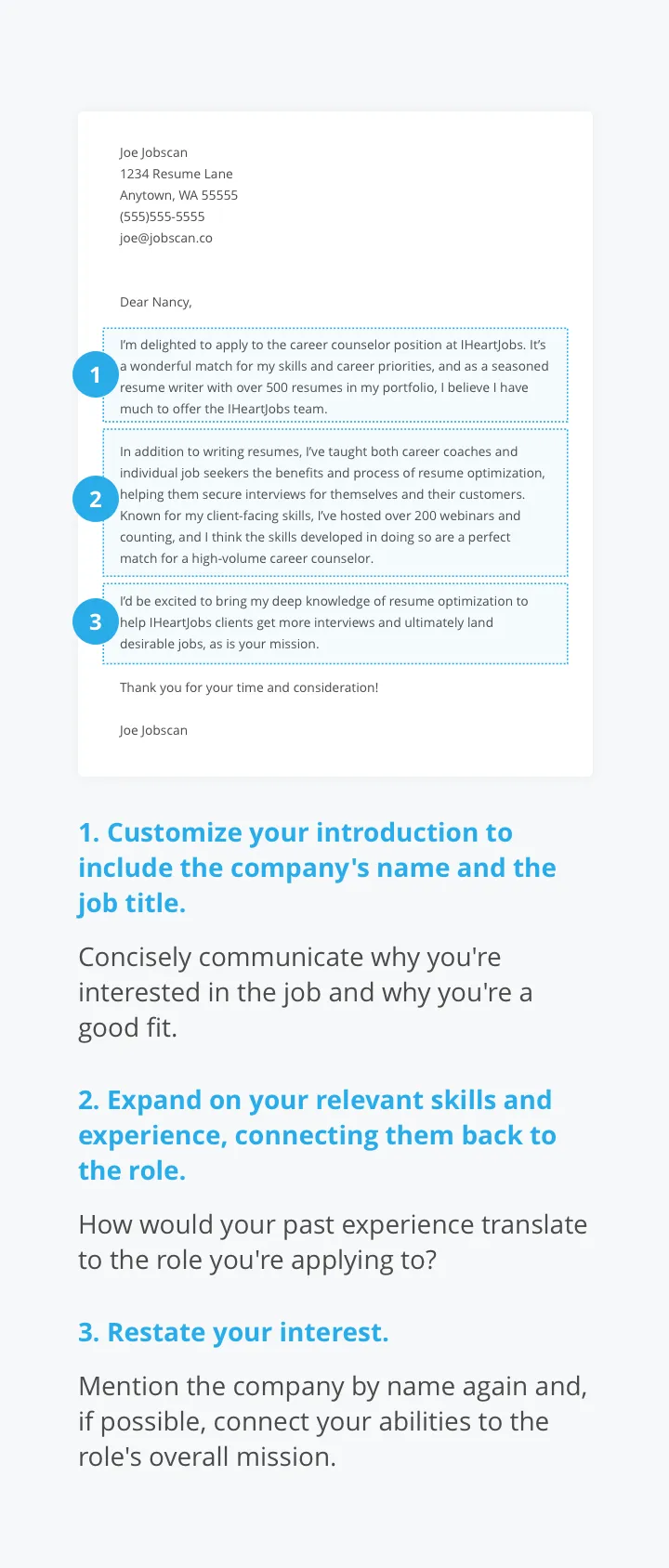
Structure your cover letter with a clear and logical flow. Use an opening paragraph to state the position you’re applying for and express your enthusiasm. Include a middle section (or two) to highlight your relevant skills and experience, using specific examples. End with a strong closing paragraph that reiterates your interest and includes a call to action. Use headings and subheadings to organize the information and make it easy to read. Proper structure makes your cover letter more engaging and professional. This structure will help you present your qualifications effectively and showcase why you are the best candidate. A well-structured cover letter makes it easier for the hiring manager to find the information they need.
Writing your cover letter
Open With Impact

Your opening paragraph is your first chance to grab the reader’s attention. Avoid generic openings like, ‘I am writing to apply for…’ Instead, start with a strong statement that highlights your most relevant skills or experience. Show enthusiasm for the opportunity and mention where you saw the job posting. You might also mention a connection you have to the company, if any. Open your cover letter with an attention-grabbing statement. If possible, try to immediately connect your background with the company’s needs. Start with something specific and related to the job requirements and make the reader want to learn more. This will make your opening stand out and make a positive first impression.
Highlight Relevant Skills
Carefully review the job description and identify the key skills and qualifications the employer is seeking. In your cover letter, highlight those skills and provide specific examples of how you have demonstrated them in the past. Use keywords from the job description to show that you meet the requirements. Tailor your language to match the tone and style of the company. Make sure your skills are clearly displayed and easy to find. Provide evidence to back up your claims, by using examples that showcase your abilities. Your goal is to demonstrate that your skills and experience align with the employer’s needs.
Express Enthusiasm and Fit
Show genuine enthusiasm for the opportunity and the company. Explain why you are interested in the position and what attracts you to their organization. Demonstrate that you have researched the company and understand their mission, values, and culture. Highlight how your values align with theirs. Show the reader that you want to be part of their team. Explain why you believe you would be a good fit for the company and the role. Be specific and show a genuine interest in the opportunity. Showing that you’re a good fit, both in skills and personality, can make you stand out. Your enthusiasm for the role should be clear from the very first sentence.
End with a Strong Call to Action

End your cover letter with a clear call to action. Thank the reader for their time and consideration. State your interest in an interview, and let them know how you can be reached. Provide your contact information again, to make it easy for them to get in touch. Express your enthusiasm for the opportunity and reiterate your interest. It’s also beneficial to indicate your availability for an interview. A strong call to action shows your enthusiasm and makes it easy for the reader to take the next step. Encourage the employer to reach out to you. This final step could be the final push to get you the job.