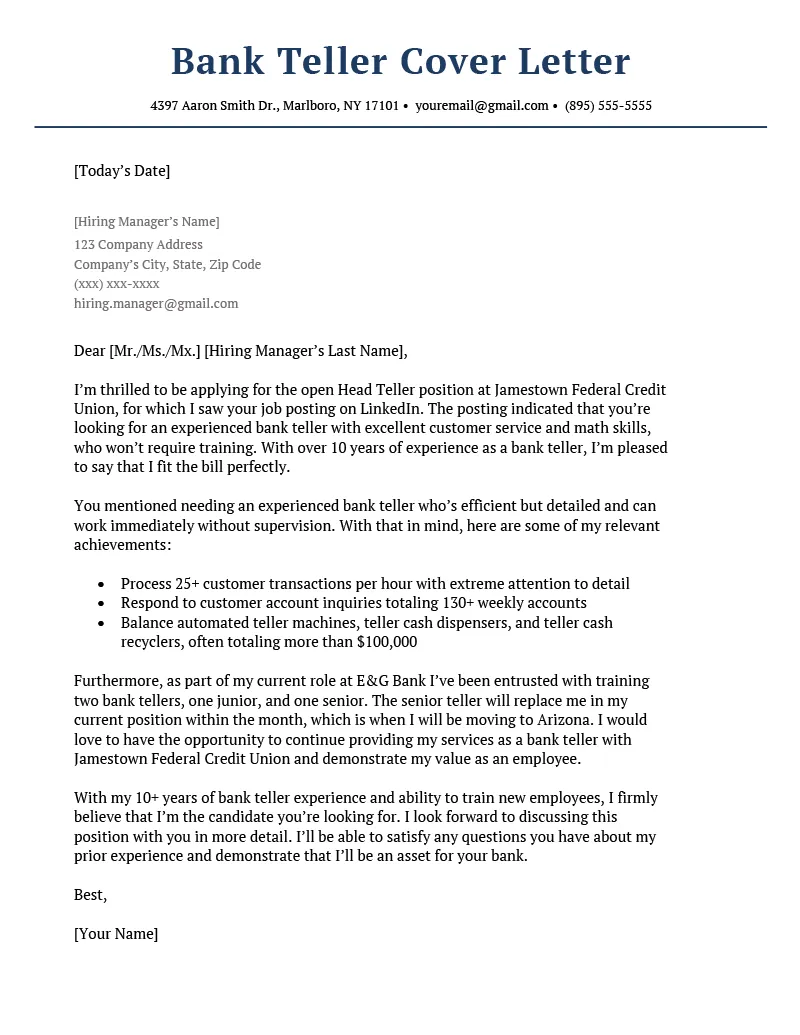
Understanding the Importance of a Cover Letter for Banks
In the competitive landscape of banking, a well-crafted cover letter can be your golden ticket to landing your dream job. It’s often the first impression you make on a potential employer, setting the stage for your entire application. Banks, known for their meticulous approach, place significant emphasis on cover letters. These letters provide an opportunity to showcase not only your qualifications but also your personality, passion, and understanding of the banking industry. A cover letter is not merely a formality; it’s a strategic tool designed to differentiate you from other applicants and highlight why you are the perfect fit for the role and the bank. Neglecting this crucial element can significantly diminish your chances of being considered, making it essential to master the art of cover letter writing to truly impress.
Why a Cover Letter Matters to Banks
Banks are discerning institutions, and the cover letter serves as a window into your professionalism, communication skills, and attention to detail. A well-written cover letter indicates that you have taken the time to understand the bank’s values, the specific role, and how your skills align. It demonstrates your initiative and your genuine interest in the position. The cover letter is more than just a summary of your resume; it allows you to expand on your experiences, explain any gaps in your employment history, and express your motivation for joining the bank. It showcases your personality and communication style, offering insights into how you might fit within the bank’s culture. Furthermore, it allows you to address specific requirements or qualifications outlined in the job description, ensuring that you highlight the most relevant aspects of your experience.
Banks seek candidates who are not only qualified but also possess strong interpersonal skills and a proactive attitude. A well-written cover letter gives you the opportunity to highlight these soft skills, providing a glimpse into your character and work ethic. It also helps you to express your passion for the banking industry and demonstrate your understanding of the bank’s mission and values. By effectively conveying these qualities, you increase your chances of standing out from the crowd and making a lasting impression on the hiring manager. A cover letter is essential because it adds a personal touch to your application, setting you apart from generic candidates and signaling your sincere interest in joining the bank.
How Cover Letters Influence Hiring Decisions

Hiring managers in banks use cover letters as a critical screening tool to assess candidates before even looking at their resumes. The cover letter provides an initial impression, revealing whether the candidate has taken the time to understand the role and the bank itself. A strong, well-targeted cover letter immediately captures attention and encourages the hiring manager to delve deeper into the applicant’s qualifications. Conversely, a poorly written or generic cover letter can lead to immediate rejection. Banks carefully analyze cover letters for specific keywords, relevant experience, and a demonstrated understanding of the bank’s operations. A well-crafted letter will emphasize your skills and experiences that align directly with the job requirements, making it easier for the hiring manager to see you as a good fit.
Moreover, a cover letter serves as a test of your communication skills. Banks need employees who can effectively communicate with clients, colleagues, and management. The cover letter provides a sample of your writing style, grammar, and ability to convey information clearly and concisely. The tone of the cover letter can also reveal your personality and professionalism, signaling whether you would be a good cultural fit for the bank. Hiring decisions are often based on a holistic assessment of the candidate, and the cover letter plays a significant role in this process. By demonstrating your understanding of the bank, the role, and your ability to communicate effectively, you increase your chances of moving to the next stage of the hiring process.
Key Components of a Bank-Specific Cover Letter
Contact Information and Formal Greeting
Start with your full contact information – name, address, phone number, and email address – at the top of the letter. Then, address the hiring manager by name, if possible. Research the bank to identify the appropriate person, such as the hiring manager or the head of the department you’re applying to. Use a formal greeting like “Dear Mr./Ms./Mx. [Last Name]”. If you’re unsure of the hiring manager’s name, use a professional greeting like “Dear Hiring Manager”. Avoid generic greetings like “To Whom It May Concern,” as these can make your letter feel impersonal. This attention to detail sets a professional tone from the beginning and shows that you have put in the effort to tailor your application.
Highlighting Relevant Skills and Experience

Carefully review the job description and identify the key skills and experiences the bank is seeking. Then, use your cover letter to highlight how your qualifications align with their requirements. Provide specific examples of your achievements, using the STAR method (Situation, Task, Action, Result) to demonstrate your skills. For example, if the job description mentions customer service skills, you could describe a situation where you successfully resolved a customer issue, the task you were assigned, the actions you took, and the positive result. Ensure that you tailor each example to the specific needs of the role you’re applying for, demonstrating your understanding of the role and your ability to excel in it.
Quantifying Achievements to Impress
Whenever possible, quantify your achievements to showcase your impact. Instead of saying “Improved customer satisfaction,” state “Improved customer satisfaction by 15% through implementing a new feedback system.” Using numbers provides concrete evidence of your accomplishments and makes your cover letter more compelling. Include statistics, percentages, and dollar amounts to make your accomplishments more impactful and memorable. This approach demonstrates your ability to make a tangible difference in previous roles, which will impress the hiring manager and set you apart from other candidates. Banks value candidates who can drive measurable results, so quantify your achievements whenever possible to illustrate your value.
Demonstrating Knowledge of the Bank and Role
Banks want to hire candidates who understand their business and the specific role they’re applying for. Before writing your cover letter, research the bank thoroughly. Learn about its mission, values, services, and recent achievements. Mention specific initiatives or projects that resonate with you and explain why you are drawn to the bank. In your cover letter, mention the specific role you are applying for and elaborate on how your skills and experience align with the job requirements. Provide a concise overview of your qualifications and highlight why you believe you are a great fit for the role, showcasing your understanding of the banking industry and your alignment with the bank’s goals.
Expressing Enthusiasm and a Strong Closing

Conclude your cover letter by expressing your enthusiasm for the opportunity and reiterating your interest in the position. Show genuine excitement and passion for the role and the bank. Thank the hiring manager for their time and consideration. End your letter with a strong call to action. For example, you could say, “I am eager to discuss my qualifications in more detail and welcome the opportunity to speak with you.” Use a professional closing such as “Sincerely” or “Respectfully” followed by your name. A well-crafted closing leaves a positive impression and reinforces your interest, increasing your chances of being contacted for an interview.
Formatting and Presentation Best Practices
The format and presentation of your cover letter are just as important as its content. A well-formatted letter shows that you pay attention to detail and take pride in your work. Use a professional font, such as Times New Roman, Arial, or Calibri, with a font size between 10 and 12 points. Maintain consistent formatting throughout the document. Use clear, concise language, and keep paragraphs brief and easy to read. Avoid large blocks of text; instead, break up your writing into shorter paragraphs with clear headings and bullet points, if appropriate. This makes your letter more accessible and helps the reader quickly grasp the key information.
Font Selection and Readability
Choose a font that is easy to read and professional in appearance. Avoid overly decorative or unusual fonts that might distract the reader. Times New Roman, Arial, and Calibri are popular choices for their readability and classic look. Ensure that the font size is appropriate; typically, 10-12 points is ideal for body text. Use bolding, italics, and headings strategically to emphasize key points and improve the flow of the document. Maintain consistent spacing and margins throughout the letter to create a polished, professional appearance. A well-formatted cover letter demonstrates your attention to detail and respect for the reader’s time.
Proofreading and Error-Checking

Proofreading is crucial for ensuring your cover letter is free of errors. Typos and grammatical mistakes can undermine your credibility and make you seem unprofessional. Carefully review your cover letter for any spelling, grammar, and punctuation errors. Read it aloud to catch any awkward phrasing or sentence structure. If possible, have a friend or family member review your letter as a fresh pair of eyes can often spot mistakes you may have missed. Use spell-check and grammar-check tools, but don’t rely on them entirely. Always double-check the accuracy of any names, dates, and other specific details. A polished, error-free cover letter leaves a positive impression and shows the hiring manager that you are detail-oriented and take your application seriously.
Tailoring Your Cover Letter to the Bank
A generic cover letter that could apply to any bank is unlikely to impress. Instead, you must tailor your cover letter to each specific bank and role you apply for. Research the bank thoroughly to understand its culture, values, and recent activities. This information will allow you to customize your letter, demonstrating your genuine interest and understanding. Review the job description carefully and identify the key skills and experiences the bank is seeking. Then, customize your letter to highlight how your qualifications align with their specific requirements. Reference the bank’s mission, values, and any recent news or initiatives that resonate with you. This level of personalization shows that you’ve invested time and effort into understanding the bank and its needs.
Researching the Bank’s Culture and Values
Before writing your cover letter, take the time to research the bank’s culture and values. Visit the bank’s website and review its mission statement, values, and any recent news or initiatives. Look for information about its corporate social responsibility efforts, employee benefits, and awards. Explore the bank’s social media profiles to get a sense of its brand and communication style. This research will give you insights into the bank’s priorities and the kind of employees they seek. Incorporate relevant information into your cover letter, demonstrating your understanding of the bank’s culture and values. For example, if the bank emphasizes community involvement, mention your volunteer experience or any community projects you have supported.
Customizing Your Letter for the Specific Role

Each job application requires a unique cover letter. Review the job description carefully and identify the key skills, experiences, and qualifications the bank is seeking. Customize your cover letter to address these specific requirements. Highlight the experiences and skills from your resume that are most relevant to the role. Provide specific examples of your accomplishments, demonstrating how you have successfully applied these skills in previous positions. Use keywords from the job description to show that you understand the role’s responsibilities and the bank’s needs. Tailor your cover letter to demonstrate that you are not only qualified but also a perfect fit for the specific role and the bank’s needs, increasing your chances of being selected.
Avoiding Common Cover Letter Mistakes
Certain mistakes can instantly disqualify your cover letter. Avoid generic phrases, typos, and a lack of enthusiasm. Always proofread your letter carefully. Remember that your cover letter is your first impression, so it must be professional, well-written, and tailored to the specific bank and role. By avoiding these common pitfalls, you will significantly increase your chances of making a positive impression and moving forward in the hiring process.
Generic Phrases and Clichés
Avoid using generic phrases and clichés that make your cover letter sound impersonal and unoriginal. Phrases such as “I am a team player,” “I am hard-working,” and “I am detail-oriented” are overused and fail to provide any specific information. Instead, use specific examples to demonstrate these qualities. Focus on showcasing your skills and accomplishments rather than simply stating them. Avoid using phrases like “I am writing to express my interest in…” Instead, start with a strong opening statement that grabs the reader’s attention. Focus on what you can offer the bank and avoid using generic language that could apply to any job.
Typos and Grammatical Errors

Typos and grammatical errors are a serious mistake in a cover letter. These errors signal a lack of attention to detail and can undermine your credibility. Always proofread your cover letter carefully before submitting it. Use spell-check and grammar-check tools, but don’t rely on them entirely. Double-check the accuracy of names, dates, and other specific details. Reading your letter aloud can help you catch any awkward phrasing or sentence structure. Having a friend or family member review your letter can also help, as a fresh pair of eyes can often spot mistakes you may have missed. A polished, error-free cover letter demonstrates professionalism and leaves a positive impression, increasing your chances of being selected.
Lack of Enthusiasm
Your cover letter should reflect your enthusiasm for the opportunity. A lack of enthusiasm can make you appear disinterested and unmotivated. Show genuine excitement for the role and the bank. Mention specific aspects of the job that appeal to you and explain why you are drawn to the bank’s mission, values, or culture. Convey your passion for the banking industry and demonstrate your understanding of the bank’s goals. Use active language and positive statements to showcase your interest and dedication. Expressing your enthusiasm helps the hiring manager see you as a valuable candidate who is genuinely excited about joining the bank.
Finalizing and Submitting Your Cover Letter
Before submitting your cover letter, take a final look to ensure that everything is perfect. Review all the points covered in this guide and make sure your letter meets all the requirements. Verify that your contact information is correct and that you have addressed the hiring manager properly. Ensure that you have highlighted your relevant skills and experiences and quantified your achievements whenever possible. Double-check that your letter is free of errors and that it reflects your enthusiasm for the opportunity. Make sure to save your cover letter as a PDF file before submitting it, unless the bank specifies a different format. A PDF file preserves your formatting and ensures that your letter looks the same on all devices. By following these steps, you can craft a cover letter that effectively showcases your qualifications and helps you land your dream job in the banking industry.