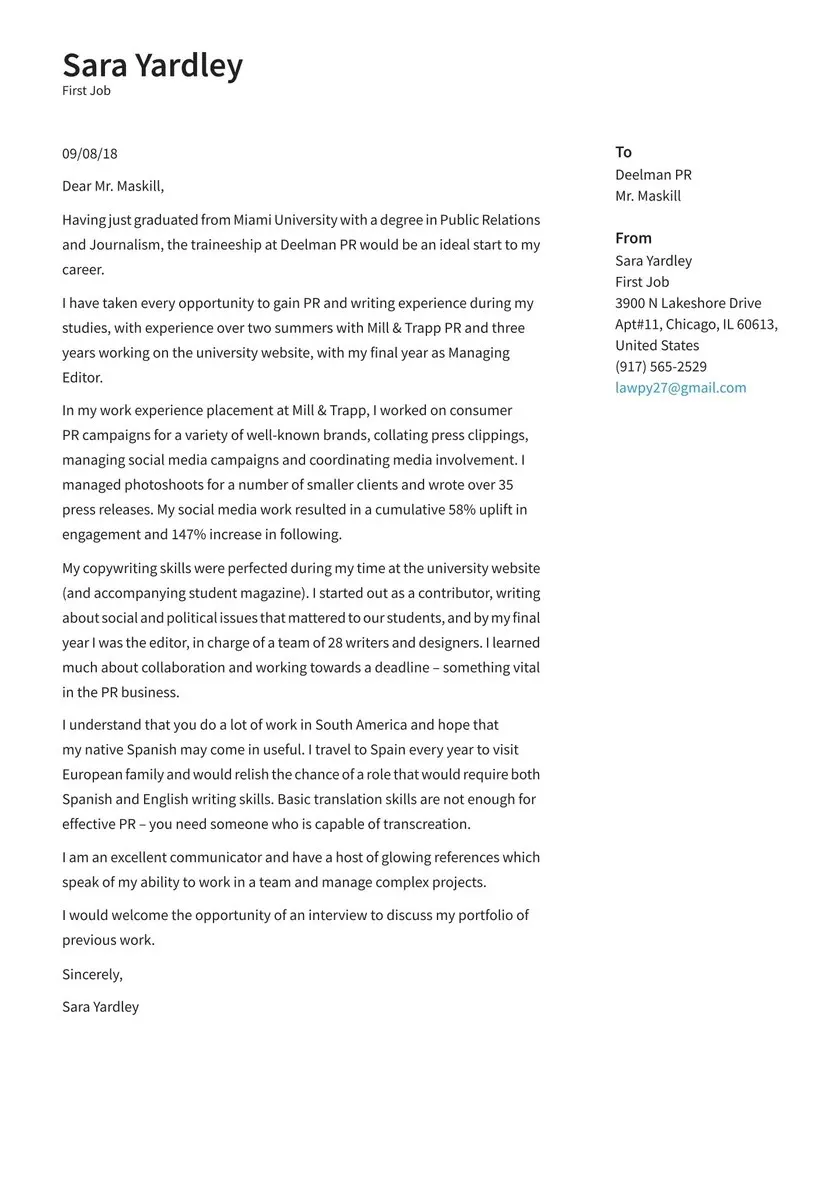
Why Cover Letters Still Matter
In an age dominated by online applications and digital resumes, you might be wondering if cover letters still hold any weight. The answer is a resounding yes. A well-crafted cover letter is your opportunity to make a strong first impression and to go beyond the limitations of your resume. It’s where you can demonstrate your personality, your enthusiasm for the role, and your understanding of the company’s needs. While your resume provides a snapshot of your experience and skills, your cover letter tells a story – a narrative of why you’re the perfect fit for the job. It’s a chance to connect with the hiring manager on a more personal level, showcasing your communication skills and your genuine interest in the opportunity.
Many employers still value cover letters because they provide insight into a candidate’s writing abilities, attention to detail, and ability to articulate their career goals. They also allow you to address any potential gaps in your resume or to explain why you’re making a career change. Furthermore, cover letters can be a differentiator. In a competitive job market, they provide a way to stand out from the crowd and to demonstrate that you’ve put in the extra effort. Ultimately, cover letters are a crucial part of the job application process, offering a valuable opportunity to make a lasting impression and increase your chances of landing an interview.
Highlighting Your Unique Value
Your cover letter is not just a rehash of your resume. It’s a chance to highlight what makes you unique and why you’re the best candidate for the job. Start by identifying the key skills and experiences that align with the job requirements. Then, think about what sets you apart from other applicants. Do you have a unique combination of skills? Have you overcome specific challenges in your previous roles? Do you possess a particular passion for the industry or company? The goal is to showcase your value proposition – the unique benefits you bring to the table. This could be anything from your specific expertise to your problem-solving abilities or your strong work ethic.
When highlighting your value, focus on how you can contribute to the company’s success. Consider the company’s mission, values, and goals. How can your skills and experience help them achieve those goals? Use specific examples to demonstrate your capabilities. For instance, instead of saying “I’m a good communicator,” describe a situation where you effectively communicated complex information to a diverse audience. By focusing on your unique value and showcasing how you can solve problems and deliver results, you’ll make a strong case for why you deserve the job. Remember to tailor your value proposition to each specific job application, highlighting the skills and experiences that are most relevant to the role.
Show, Don’t Just Tell

One of the most common mistakes in cover letter writing is simply stating what you can do without providing any evidence. Instead of saying “I am a team player,” demonstrate your teamwork skills through a specific example. This approach, known as “show, don’t tell,” is crucial for making your cover letter compelling and memorable. It involves providing concrete examples of your accomplishments, skills, and experiences. Use the STAR method (Situation, Task, Action, Result) to structure your examples. Start by setting the scene (Situation), then describe the challenge you faced (Task), explain the steps you took to address the challenge (Action), and finally, highlight the positive outcome you achieved (Result).
For example, instead of writing “I have strong problem-solving skills,” you could write “In my previous role, we faced a critical system failure. My task was to identify the root cause and implement a solution. I analyzed the system logs, collaborated with the IT team, and implemented a fix within 24 hours, preventing further downtime and saving the company an estimated $10,000 in potential losses.” This approach not only shows your problem-solving skills but also demonstrates your ability to work under pressure and deliver results. By providing specific examples, you make your claims more believable and more impactful. This helps the hiring manager understand how you can apply your skills in the specific role and how you can contribute to their team’s success.
Quantify Your Achievements
To make your achievements even more impactful, quantify them whenever possible. Numbers and metrics add credibility to your claims and provide concrete evidence of your accomplishments. Instead of saying “I improved customer satisfaction,” say “I increased customer satisfaction scores by 15% through implementing a new customer service protocol.” Quantifying your achievements helps the hiring manager understand the tangible impact you’ve had in previous roles. It provides a clear picture of your skills and abilities and helps you stand out from other applicants. Think about the results you’ve achieved in your previous roles and identify specific metrics that demonstrate your success. This could include things like sales figures, cost savings, project completion rates, or customer satisfaction scores.
When quantifying your achievements, be specific and accurate. Use data to support your claims and provide context for your results. For example, instead of saying “I managed a large team,” you could say “I managed a team of 20 employees, consistently exceeding sales targets by an average of 10% each quarter.” The more specific you are, the more impactful your cover letter will be. Quantifying your achievements is a powerful way to showcase your value and to demonstrate that you can deliver results. It provides concrete evidence of your skills and abilities and makes a strong case for why you’re the best candidate for the job. Remember to focus on the achievements that are most relevant to the job requirements and highlight the impact you’ve made in previous roles.
Tailoring Your Cover Letter
One of the biggest secrets to writing a standout cover letter is tailoring it to each specific job application. Generic cover letters are easily recognizable and often end up in the rejection pile. Take the time to research the company and the specific role you’re applying for. Understand the company’s mission, values, and goals. Read the job description carefully and identify the key skills and experiences the employer is seeking. Then, customize your cover letter to address those specific requirements. This involves highlighting the relevant skills and experiences from your resume, providing examples of your accomplishments that align with the job description, and demonstrating your genuine interest in the company and the role. Make sure to use the keywords and phrases from the job description throughout your cover letter.
Tailoring your cover letter demonstrates that you’ve put in the extra effort and that you’re genuinely interested in the opportunity. It shows the hiring manager that you’ve taken the time to understand the company’s needs and that you believe you’re a good fit for the role. You can also tailor your cover letter by addressing specific challenges or opportunities that the company is facing. Research the company’s recent news, projects, or initiatives. If possible, mention how your skills and experience can help them achieve their goals. By tailoring your cover letter, you significantly increase your chances of getting noticed and landing an interview. It’s a crucial step in making a strong first impression and demonstrating that you’re the right candidate for the job.
Researching the Company

Before you start writing your cover letter, invest time in researching the company. This will not only help you tailor your letter but also show the hiring manager that you’re genuinely interested in the opportunity. Visit the company’s website and learn about its mission, values, products or services, and recent news. Explore the “About Us” section and read the company’s blog or social media pages to gain insights into its culture and values. Understand the company’s position in the market and its competitors. This information will help you tailor your cover letter to address their specific needs and challenges. Also, research the hiring manager if possible. Look them up on LinkedIn or the company website to understand their role and background.
Researching the company will also help you identify specific keywords and phrases to use in your cover letter. Pay attention to the language they use in their job descriptions and on their website. Incorporate those keywords into your letter to show that you understand their needs and that you’re a good fit for their culture. By demonstrating that you’ve done your homework and that you’re knowledgeable about the company, you’ll make a strong impression. Mentioning specific projects, initiatives, or values that resonate with you will show that you’re genuinely interested in the opportunity. This will make your cover letter more compelling and increase your chances of landing an interview.
Addressing the Hiring Manager
Whenever possible, address your cover letter to a specific person, rather than using a generic greeting like “To Whom It May Concern.” This shows that you’ve taken the time to research the company and that you’re genuinely interested in the role. Find the hiring manager’s name by checking the job posting or by looking them up on LinkedIn or the company website. If you can’t find a specific name, try to find the name of the hiring team or the department head. This personal touch makes your cover letter more engaging and shows that you’ve put in the extra effort. It also helps you establish a connection with the hiring manager and makes your letter more memorable.
When addressing the hiring manager by name, double-check the spelling and ensure you use the correct title (e.g., Mr., Ms., Dr.). If you’re unsure, it’s always best to err on the side of caution and use a more formal salutation. In the body of your cover letter, refer to the hiring manager by name when appropriate. This helps create a more personal and conversational tone. By addressing your cover letter to a specific person, you demonstrate your attention to detail and your professionalism. It’s a simple but effective way to make a strong first impression and increase your chances of getting noticed. It also shows respect for the hiring manager’s time and effort in the hiring process.
Formatting for Impact
The formatting of your cover letter is just as important as its content. A well-formatted cover letter is easy to read and visually appealing. Use a professional font, such as Times New Roman, Arial, or Calibri, and a font size between 10 and 12 points. Maintain consistent formatting throughout the document. Use clear and concise language. Avoid using overly long paragraphs or dense blocks of text. Break up your text with bullet points or short, impactful sentences. Use headings and subheadings to organize your thoughts and to make it easy for the hiring manager to scan the document. Consider the overall layout of your cover letter. Use appropriate margins and spacing to create a balanced and visually appealing document.
When formatting your cover letter, pay attention to the use of white space. White space is the blank space around your text and between paragraphs. It’s important for readability. Use ample white space to prevent your cover letter from looking cluttered. Be consistent with your formatting throughout the document. For example, use the same font style, font size, and line spacing throughout your cover letter. Make sure your cover letter is easy to read on both a computer screen and in print. Ensure your cover letter is free of grammatical errors and typos. Formatting for impact is crucial for making a strong first impression and demonstrating your professionalism. A well-formatted cover letter shows that you pay attention to detail and that you value clarity and readability.
Proofreading and Editing

Before submitting your cover letter, carefully proofread and edit it. Errors in grammar, spelling, and punctuation can make you appear unprofessional and can undermine your credibility. Read your cover letter aloud to catch any awkward phrasing or typos. Ask a friend, family member, or career advisor to review your cover letter for you. A fresh pair of eyes can often catch errors that you might miss. Use grammar and spell-checking tools to help identify any mistakes. However, don’t rely solely on these tools. They can sometimes miss errors or make incorrect suggestions. Proofread your cover letter multiple times, and take breaks between each proofreading session to help you maintain focus. After completing your edits, read your cover letter one last time to ensure it is polished and error-free.
Proofreading and editing are crucial steps in the cover letter writing process. They ensure that your cover letter is professional, polished, and error-free. A well-proofread cover letter demonstrates your attention to detail and your commitment to excellence. It also helps you make a strong first impression and increase your chances of landing an interview. If you have any doubts about your writing skills, consider seeking help from a professional resume writer or career counselor. Investing in a professional review of your cover letter can significantly improve its quality and increase your chances of success. A polished and error-free cover letter showcases your communication skills and leaves a lasting positive impression on the hiring manager.
Call to Action
End your cover letter with a strong call to action. Tell the hiring manager what you want them to do next. Do you want them to contact you for an interview? Do you want them to review your resume? Make it clear what you’re hoping to achieve. Be specific and direct in your call to action. For example, instead of writing “I look forward to hearing from you,” you could write “I am eager to discuss my qualifications further and welcome the opportunity to schedule an interview at your earliest convenience.” This is more specific and demonstrates your enthusiasm for the role. Reiterate your interest in the position and thank the hiring manager for their time and consideration. Providing a call to action encourages the hiring manager to take the next step and increases your chances of landing an interview.
In your call to action, make it easy for the hiring manager to contact you. Include your phone number and email address. Make sure your contact information is accurate and up to date. By ending your cover letter with a clear and concise call to action, you leave a lasting impression and encourage the hiring manager to take the next step. The call to action is your final opportunity to make a strong impact and to demonstrate your interest in the role. A well-crafted call to action reinforces your qualifications and encourages the hiring manager to contact you for an interview. It’s a crucial step in the cover letter writing process and can significantly improve your chances of landing your dream job. Remember to tailor your call to action to each specific job application.