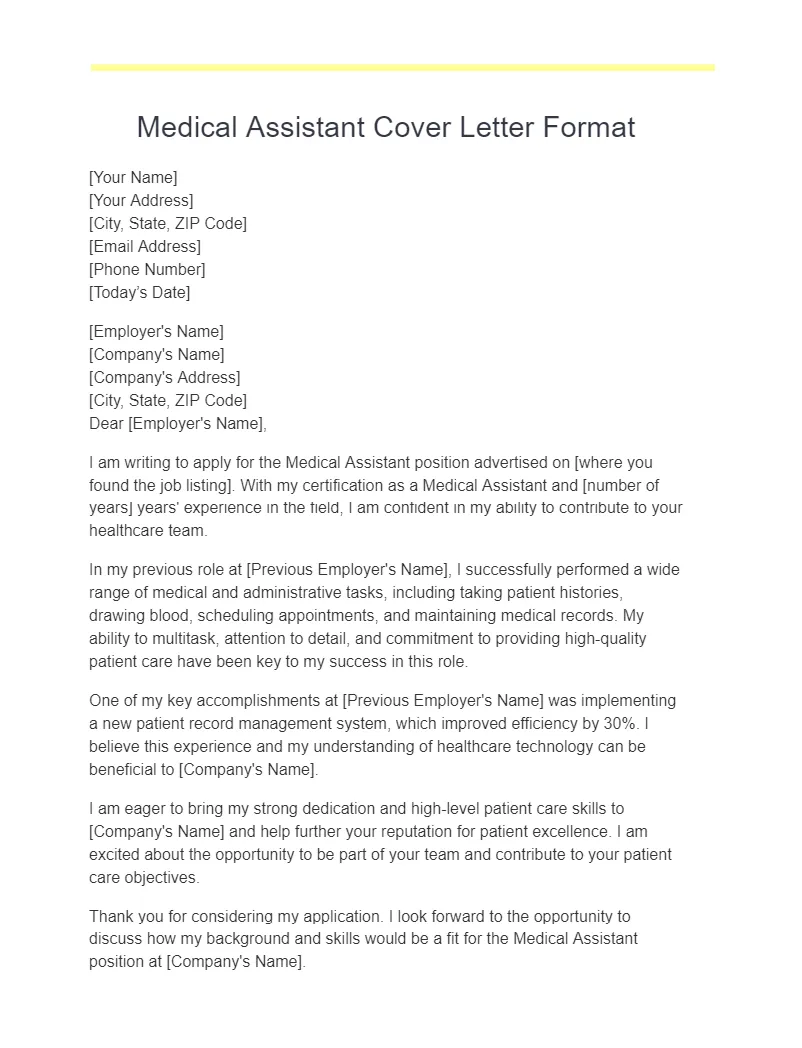
Why a Strong Cover Letter Matters for Medical Assistants
In the competitive field of healthcare, a well-crafted cover letter is your first opportunity to make a positive impression on potential employers. It’s a crucial tool for medical assistants seeking employment because it provides a space to showcase your personality, highlight your skills, and demonstrate your enthusiasm for the position. Unlike a resume, which provides a concise summary of your experience, a cover letter enables you to tell a story, elaborating on specific experiences and explaining why you are the perfect fit for the job. Medical assistants often have similar qualifications; therefore, a standout cover letter can significantly increase your chances of securing an interview. It shows you’ve taken the time to go beyond the basics and are genuinely interested in the role and the organization.
Highlighting Your Skills and Qualifications
Your cover letter should act as a spotlight, showcasing your relevant skills and qualifications. This is where you translate your resume’s bullet points into engaging narrative. Focus on how your abilities align with the specific requirements of the medical assistant position. Instead of simply listing your skills, provide examples of how you’ve used them successfully in previous roles. Quantify your achievements whenever possible – for example, ‘Managed patient scheduling for an average of 50 patients per day, reducing wait times by 15%’. This approach gives employers a clear picture of your capabilities and the value you can bring to their team. Remember, the goal is to demonstrate how your skills and experience directly address the employer’s needs and contribute to their success.
Key Skills to Showcase

As a medical assistant, you possess a unique blend of clinical and administrative skills. When crafting your cover letter, be sure to highlight these key areas. Proficiency in taking patient histories and vital signs is essential. Include your experience with common medical procedures, such as assisting with examinations, administering medications, and performing phlebotomy. Administrative skills, such as scheduling appointments, managing medical records, and handling insurance claims, are equally important. Highlight your expertise in using electronic health record (EHR) systems and other relevant software. Emphasize any specialized skills, such as experience with a specific medical specialty or knowledge of medical terminology. The more specific you can be, the more effectively you’ll demonstrate your qualifications.
Certifications and Education
Your cover letter should explicitly state your certifications and educational background. If you are a certified medical assistant (CMA) or have another relevant credential, such as a registered medical assistant (RMA), prominently display it. Mention the name of your certification and the institution that granted it. Include details about your education, such as the name of your school and the degree or diploma you obtained. List any specialized training or coursework that is relevant to the position. If you are pursuing further education, mention it and highlight how it enhances your skills. This information is crucial for employers to assess your professional qualifications and ensure you meet the minimum requirements for the role. Including this information upfront helps to build credibility and validate your commitment to the profession.
Tailoring Your Cover Letter
One of the most critical steps in writing a successful cover letter is tailoring it to each specific job application. Avoid using a generic template; instead, customize your letter to align with the requirements and culture of the clinic or practice. This personalization shows that you’ve taken the time to understand the employer’s needs and are genuinely interested in the opportunity. Always address the letter to a specific person, if possible. Research the organization and mention specific details that demonstrate your interest. Highlight how your skills and experience directly address the needs of the position and the values of the organization. Make sure to use keywords from the job description to increase the chances of passing through applicant tracking systems (ATS).
Researching the Clinic or Practice

Before you even begin writing your cover letter, conduct thorough research on the clinic or practice you are applying to. This includes understanding their mission, values, services, and the specific needs of the role. Visit their website, read online reviews, and check out their social media presence. Gather information about the healthcare professionals who work there and their areas of expertise. This research will help you tailor your letter to demonstrate that you understand their unique requirements and can contribute to their success. Use the information you gather to personalize your letter and show that you’re genuinely interested in the organization. This level of preparation demonstrates initiative and professionalism, setting you apart from candidates who submit generic applications.
Customizing Your Letter
Once you’ve researched the clinic or practice, use your findings to customize your cover letter. Start by addressing the letter to the hiring manager by name, if possible. In the body of the letter, mention specific aspects of the organization that appeal to you, such as their commitment to patient care, their use of specific technologies, or their involvement in the community. Highlight how your skills and experience align with their specific needs. For instance, if the job description emphasizes experience with electronic health records, emphasize your proficiency with those systems. If the clinic specializes in a particular area of medicine, mention any relevant experience or coursework you have in that area. This customization shows that you’re not just sending out a generic application; you’re genuinely interested in the position and the organization.
Formatting Your Cover Letter
A well-formatted cover letter is essential for making a positive first impression. Ensure your letter is easy to read, professional, and visually appealing. Use a standard font, such as Times New Roman or Arial, in a 10-12 point size. Maintain consistent formatting throughout the document, including line spacing, margins, and paragraph alignment. Use clear headings and subheadings to organize the content and make it easier for the reader to scan. The overall layout should be clean, uncluttered, and professional. A poorly formatted letter can give the impression that you lack attention to detail, which is a critical trait in medical settings. A well-formatted letter, on the other hand, shows that you are organized and professional, which can increase your chances of landing an interview.
Contact Information and Header

Your contact information is a crucial part of your cover letter. At the top of your letter, include your full name, phone number, email address, and professional LinkedIn profile URL, if you have one. Make sure this information is easily visible and accurately presented. Use a clear and professional email address. Below your contact information, include the date and the hiring manager’s name, title, and the clinic’s address. If you don’t know the hiring manager’s name, research it or use a general salutation like ‘Dear Hiring Manager.’ This information should be formatted consistently and neatly to show that you pay attention to detail. Proper formatting of the header demonstrates professionalism and makes it easy for the hiring manager to contact you if they are interested in your application.
Professional Tone and Language
The tone and language you use in your cover letter should be professional and appropriate for a medical setting. Use formal language and avoid slang or informal expressions. Be concise and to the point; get straight to the relevant information. Avoid using jargon or overly technical terms that the reader may not understand. Proofread your letter carefully for any grammatical errors or typos. Use positive and enthusiastic language to showcase your interest in the position. Focus on what you can offer the employer, not just what you are looking for in a job. Your cover letter should reflect your professionalism and communication skills, essential attributes for any medical assistant role. Remember, you are presenting yourself as a professional; your language should reflect that.
The Power of a Compelling Closing
The closing of your cover letter is your final opportunity to leave a lasting impression. It’s a chance to reiterate your interest, express gratitude, and make a strong call to action. The closing should be concise, professional, and memorable. This is not the place to be generic or cliché. It should encapsulate your enthusiasm for the role and leave the employer eager to learn more about you. Take care when crafting your closing; a strong ending can significantly boost your chances of securing an interview. A well-written closing can be the difference between your application being filed away and an invitation to the next stage of the hiring process.
Expressing Enthusiasm and Gratitude

In your closing, express your enthusiasm for the opportunity and your gratitude for the employer’s time and consideration. Reiterate your interest in the position and the clinic or practice. Mention something specific that you admire about the organization or the role. For example, you might say ‘I am particularly drawn to [Clinic’s Name]’s commitment to patient-centered care, and I am eager to contribute my skills to such a dedicated team.’ Show your genuine appreciation for their time by stating, ‘Thank you for considering my application’. This shows you are appreciative of the opportunity and respect their time. A sincere expression of gratitude leaves a positive impression and shows that you are polite and professional.
Call to Action
Your cover letter should conclude with a clear call to action. This encourages the employer to take the next step, which is often to contact you for an interview. State your availability for an interview and how they can reach you. For example, you might say, ‘I am available for an interview at your earliest convenience and can be reached at [your phone number] or [your email address].’ You could also add, ‘I look forward to the opportunity to discuss how I can contribute to your team.’ This call to action shows that you are proactive and eager to advance in the hiring process. Be sure to end your letter with a professional closing, such as ‘Sincerely’ or ‘Best regards,’ followed by your name.
Proofreading and Editing for Perfection
Proofreading and editing your cover letter is non-negotiable. Even the most well-written letter can be undermined by typos, grammatical errors, or formatting inconsistencies. Before you submit your cover letter, carefully review it for any mistakes. Read it aloud to catch any awkward phrasing or sentences. Ask a friend, family member, or career counselor to review your letter for feedback. They may spot errors you missed and provide suggestions for improvement. Pay close attention to the details, such as grammar, spelling, punctuation, and formatting. Ensure your contact information is correct and up-to-date. A polished and error-free cover letter demonstrates professionalism and attention to detail, significantly improving your chances of making a positive impression. This is a crucial step; always double-check your work.
Common Mistakes to Avoid

Several common mistakes can weaken a medical assistant cover letter. Avoid generic, mass-produced letters; customize each one. Don’t repeat information from your resume verbatim; instead, elaborate on your experiences. Refrain from using jargon or overly technical language. Do not include negative comments about previous employers or coworkers. Steer clear of clichés and overly casual language. Ensure your letter is not too long; keep it concise and focused. Make sure you address the letter to the correct person; if you don’t know the name, research it. Avoid typos, grammatical errors, and formatting inconsistencies. By avoiding these common pitfalls, you significantly increase your chances of crafting a winning cover letter that captures the hiring manager’s attention and helps you land an interview.
Seeking Feedback
Seek feedback on your cover letter from trusted sources before submitting it. Ask a friend, family member, career counselor, or mentor to review your letter and provide constructive criticism. They can offer a fresh perspective and help you identify areas for improvement that you might have missed. When seeking feedback, be open to suggestions and willing to revise your letter based on the input you receive. Pay attention to their comments about clarity, conciseness, and overall effectiveness. Ask them if your letter effectively highlights your skills, qualifications, and enthusiasm for the position. Getting a second pair of eyes on your cover letter can significantly improve its quality and increase your chances of success. Their feedback is invaluable in refining your writing and ensuring your letter is as effective as possible.