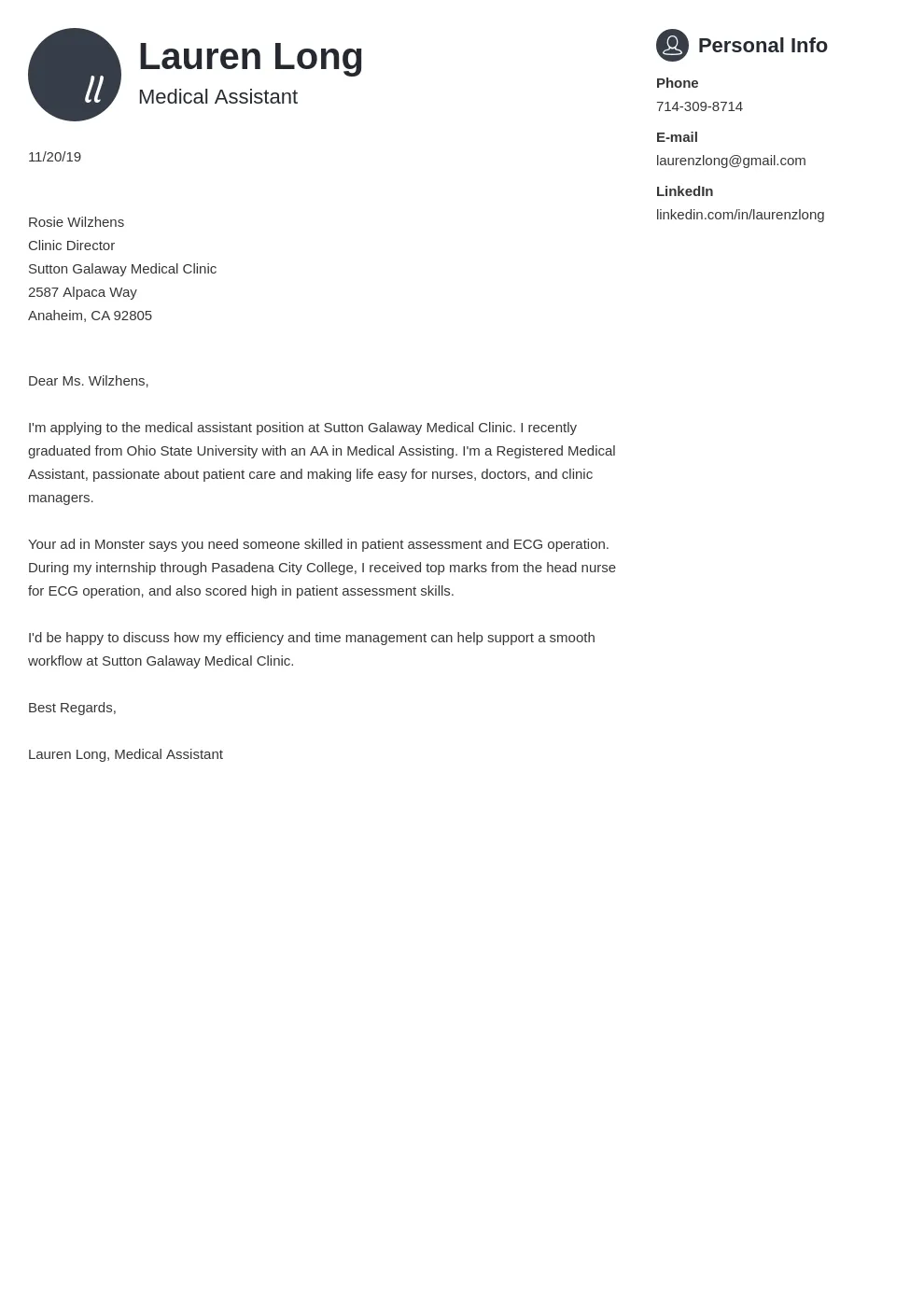
Understanding the Importance of a Cover Letter
In the competitive field of healthcare, a well-crafted cover letter can be your key to unlocking the door to your dream job as a Clinical Assistant. Often overlooked, the cover letter is your first chance to make a strong impression on a potential employer. It provides an opportunity to go beyond the confines of your resume and showcase your personality, skills, and passion for the role. A compelling cover letter isn’t just a formality; it’s a strategic tool that can set you apart from other applicants and significantly increase your chances of landing an interview. Remember, hiring managers use cover letters to assess your writing skills, attention to detail, and overall suitability for the position. A weak or generic cover letter can easily lead to your application being dismissed. Therefore, investing time and effort into crafting a standout cover letter is a crucial step in your job search journey.
Tip 1 Tailor Your Cover Letter to the Specific Job
One of the biggest mistakes applicants make is sending out generic cover letters. Tailoring your cover letter to each specific job application is essential. This shows the employer that you’ve taken the time to understand their needs and that you’re genuinely interested in the opportunity. Generic cover letters make it appear you’re applying for any job, rather than specifically the one they are offering. Customize your letter to reflect the specific requirements and responsibilities outlined in the job description. This shows that you have the skills and experience they are specifically looking for. Make sure you are also customizing the company name, the hiring manager’s name, or even better their title, and other relevant details to ensure they immediately realize that this letter is intended for them.
Highlight Relevant Skills and Experience

Carefully review the job description and identify the key skills and experiences the employer is seeking. In your cover letter, highlight those skills and experiences that align with the job requirements. Use specific examples from your previous roles or training to demonstrate how you’ve successfully applied these skills in a clinical setting. For instance, if the job description emphasizes patient communication, provide an example of how you effectively communicated with patients to explain procedures or address their concerns. If the description emphasizes your phlebotomy skills, describe your experience, proficiency, and any specific training you’ve had. Use action verbs to showcase your accomplishments, such as ‘managed,’ ‘coordinated,’ ‘assisted,’ or ‘implemented.’ Ensure that your highlighted skills and experiences directly address the employer’s needs, making you a strong candidate.
Research the Company and Address the Letter Properly
Before submitting your cover letter, research the company and address the letter to the appropriate person. Showing that you understand the company’s mission, values, and any recent achievements will show that you have taken the time to learn more about the company. Addressing the cover letter to the hiring manager or the specific person in charge of recruitment shows that you are detail-oriented and shows initiative. You can find the name of the hiring manager by researching the company’s website, looking at job boards, or using LinkedIn. Addressing the cover letter to a specific individual makes your application more personal and shows your interest in the role. Use the correct title and ensure the name is spelled correctly to avoid any negative impressions. Also, if possible, try to tailor the tone of the letter to match the company culture based on your research.
Tip 2 Showcase Your Clinical Skills
As a Clinical Assistant, your clinical skills are the core of your profession. Your cover letter should highlight these skills and provide concrete examples of how you’ve applied them in a clinical setting. This is your chance to shine and demonstrate your practical abilities beyond a simple list on your resume. Use the cover letter to give a brief overview of your clinical proficiency and provide detailed examples of your successful patient care experiences. Think about procedures you’ve assisted with, any specialized equipment you’ve operated, or any particular patient care situations where you’ve demonstrated excellence. For instance, describe your experience in taking patient vitals, assisting with medical examinations, or administering medications under supervision. The employer will be looking for skills that are relevant to the role that you are applying for, so ensure you mention the skills that relate the most to the job description.
Detail Your Clinical Experience

Provide specific details about your clinical experience, including the types of clinical settings you’ve worked in, the patient populations you’ve served, and the tasks you’ve performed. Quantify your experience whenever possible, such as the number of patients you’ve assisted daily or the duration of your experience in a particular setting. This will provide the employer with a clear picture of your skills and give them a sense of the experience that you have. For instance, you could mention the number of years you’ve worked as a Clinical Assistant in a clinic, hospital, or other healthcare setting. Mentioning specific patient types, such as geriatric patients, pediatric patients, or patients with particular medical conditions, can also highlight your experience. Providing these details gives the employer more insight into your clinical background and demonstrates your versatility. Make sure to use action verbs to highlight your accomplishments and responsibilities in previous roles.
Mention Certifications and Licenses
Always include any relevant certifications and licenses in your cover letter. This is crucial for establishing your professional qualifications and ensuring the employer that you meet the necessary requirements for the position. List your certifications, such as Certified Clinical Medical Assistant (CCMA), Certified Medical Assistant (CMA), or any other relevant credentials. Make sure that your certifications are current and valid. Also, mention any specialized training you’ve completed, such as phlebotomy certification, EKG certification, or any other specialized areas. Mentioning these qualifications enhances your credibility and shows your dedication to the profession. Remember to include the issuing organization and the date of your certification for verification. It is important to mention all current, valid certifications as soon as possible in the cover letter. This information is crucial for any potential employer.
Tip 3 Quantify Your Achievements
Don’t just tell employers what you did – show them the results. Use numbers, data, and metrics to demonstrate your impact in previous roles. Quantifying your achievements makes your claims more credible and helps the employer understand the value you can bring to their team. Instead of saying you improved patient satisfaction, state that you increased patient satisfaction scores by a specific percentage. If you streamlined a process, mention the amount of time or resources you saved. Provide examples of how you contributed to improved patient outcomes, increased efficiency, or enhanced the overall performance of the healthcare team. Providing numbers shows the interviewer that you care about the outcome, and you have measurable results of your performance. Be specific and avoid vague statements. Use precise data to support your claims and showcase your accomplishments.
Use Numbers and Data to Demonstrate Impact

When possible, use numbers and data to showcase the impact you had in your previous roles. Use metrics like percentages, statistics, and specific figures to quantify your achievements. For instance, if you reduced patient wait times, mention the percentage reduction you achieved. If you improved the accuracy of medical records, specify the improvement rate. Demonstrate how your actions positively impacted the clinical setting. Mention the number of patients you assisted daily, the number of procedures you performed, or the amount of money you saved. Using numerical data provides tangible evidence of your skills and capabilities. These figures provide a concrete measure of your performance and show the value you brought to previous roles, and in the long run, provide value to the company that you are applying to.
Provide Specific Examples of Success
Supplement your data with specific examples of your successes. Illustrate how you applied your skills to achieve positive outcomes. For example, you can mention a specific instance where you resolved a patient complaint, improved communication, or prevented a medical error. Describe a situation where you demonstrated exceptional teamwork or problem-solving skills. Highlight any initiatives you led or projects you completed that improved patient care or operational efficiency. When providing examples, use the STAR method (Situation, Task, Action, Result). This allows you to provide a clear, concise, and effective way of describing your actions and accomplishments. This structured approach helps you provide context, explain your role, detail your actions, and summarize the results. By offering these specific examples, you will showcase your ability to perform well in the Clinical Assistant position.
Tip 4 Demonstrate Your Soft Skills
In addition to your clinical expertise, soft skills are essential in the healthcare field. Demonstrating your soft skills in your cover letter is a great way to show your personality and how you will be as an employee. Hiring managers value individuals who are excellent communicators, team players, and possess strong empathy. Highlighting these soft skills shows that you’re not just a skilled professional, but also a well-rounded individual who can work well with patients and colleagues. These soft skills will also make it easier for you to integrate with the current team and improve performance in the office. By highlighting your communication skills, teamwork abilities, and empathy, you can showcase your commitment to delivering quality patient care.
Emphasize Communication, Teamwork, and Empathy

Focus on your communication skills, your ability to work as part of a team, and your capacity for empathy. Highlight instances where you communicated effectively with patients, explaining medical procedures or addressing their concerns. Provide examples of how you’ve collaborated with other healthcare professionals to ensure seamless patient care. Describe situations where you demonstrated empathy and provided support to patients and their families. Emphasize how you actively listen to patient concerns and how you effectively communicated with them. Providing examples of teamwork will help you show that you are a team player, that can effectively communicate with coworkers. Showcasing empathy is important, because it shows that you can put yourself in the place of the patient, which will make them more at ease during their visit.
Showcase Problem-Solving and Adaptability
Showcase your problem-solving skills, and your ability to adapt to changing situations. Provide examples of how you have quickly and efficiently resolved issues in the clinical setting. Describe instances where you handled unexpected situations or adjusted your approach to meet patient needs. Highlight your ability to remain calm under pressure and make quick decisions. If you’ve been in stressful situations and can still work through them efficiently, that shows a great level of adaptability. Detail how you’ve adapted to new technologies, protocols, or patient care requirements. Showcase your adaptability by describing your ability to learn new tasks quickly and your willingness to embrace change. In addition, you can show that you are ready to take on new responsibilities and provide the employer with the assurance that you are willing to help to enhance the patient experience.
Tip 5 Proofread and Polish Your Cover Letter
Before submitting your cover letter, proofread and polish it meticulously. Errors in grammar, spelling, and formatting can create a negative impression and undermine your credibility. It’s important to make sure that you are providing a letter that is both visually appealing and free of errors. Make sure that your letter is well-formatted, and that you are using the proper font, spacing, and structure. To avoid any mistakes, carefully review your letter for any errors. It may be helpful to read the letter out loud, or to have another person review the letter to catch any errors. Take the time to proofread your cover letter multiple times, paying close attention to detail and ensuring that your letter is free of errors. A polished and professional cover letter shows that you pay attention to details and are dedicated to creating a high-quality job application.
Check for Grammar and Spelling Errors

Carefully check your cover letter for grammar and spelling errors. Errors can distract the reader and create a negative impression. Ensure all words are spelled correctly and use proper punctuation. Check for sentence structure, subject-verb agreement, and correct tense usage. Use grammar and spell-check tools, but don’t rely on them entirely. Read the letter aloud to identify any awkward phrasing or unclear sentences. Ensure that the language is easy to understand and that your thoughts are conveyed clearly. Also, ensure that you are not using slang, jargon, or informal language that might not be appropriate for a professional document. Eliminating errors will improve your credibility and demonstrate your attention to detail. It may be helpful to have a friend or family member read your cover letter to make sure everything is correct.
Ensure a Professional Tone and Format
Maintain a professional tone and ensure your cover letter is formatted correctly. Using the proper tone will help you come off as an individual that is ready to get to work. Use formal language, and avoid slang or overly casual expressions. The format of your cover letter is equally important. Use a professional font like Times New Roman, Arial, or Calibri, and ensure consistent formatting throughout the document. Use appropriate spacing, and keep the layout neat and organized. Make sure your contact information is accurate and easy to find. Include the date, the hiring manager’s name and title, and the company’s address. Ensure that your cover letter is well-structured with clear paragraphs. Include a compelling introduction and a strong closing statement. Maintaining a professional tone and format shows that you have attention to detail, and a good first impression on potential employers. These details will enhance your application and increase your chances of landing an interview.