What Is a Teacher Cover Letter?
A teacher cover letter is a crucial document that accompanies your resume when applying for teaching positions. It serves as your introduction to the hiring committee, allowing you to highlight your qualifications, experience, and passion for teaching in a more personalized way than your resume alone. Think of it as your opportunity to make a strong first impression and demonstrate why you are the ideal candidate for the job. A well-crafted cover letter can significantly increase your chances of getting an interview and ultimately landing your dream teaching position. It is a snapshot of your teaching journey and your promise to excellence.
The Importance of a Teacher Cover Letter
In the competitive field of education, a cover letter is not just an optional add-on; it is a necessity. It offers a platform to explain your motivation for applying to a specific school or district and allows you to elaborate on skills and experiences that align with the school’s values and needs. It is also your chance to showcase your personality and teaching style, which are essential elements that a resume cannot fully capture. Moreover, a cover letter demonstrates your communication skills, attention to detail, and genuine interest in the position, all of which are highly valued by potential employers. Submitting a cover letter shows professionalism and initiative, setting you apart from other applicants.
Key Components of a Teacher Cover Letter

A compelling teacher cover letter comprises several key elements that work together to create a cohesive and persuasive narrative. Each section plays a vital role in conveying your qualifications, enthusiasm, and suitability for the role. From the professional header to the enthusiastic call to action, understanding these components is crucial for crafting a cover letter that grabs attention and makes a lasting impression.
Header
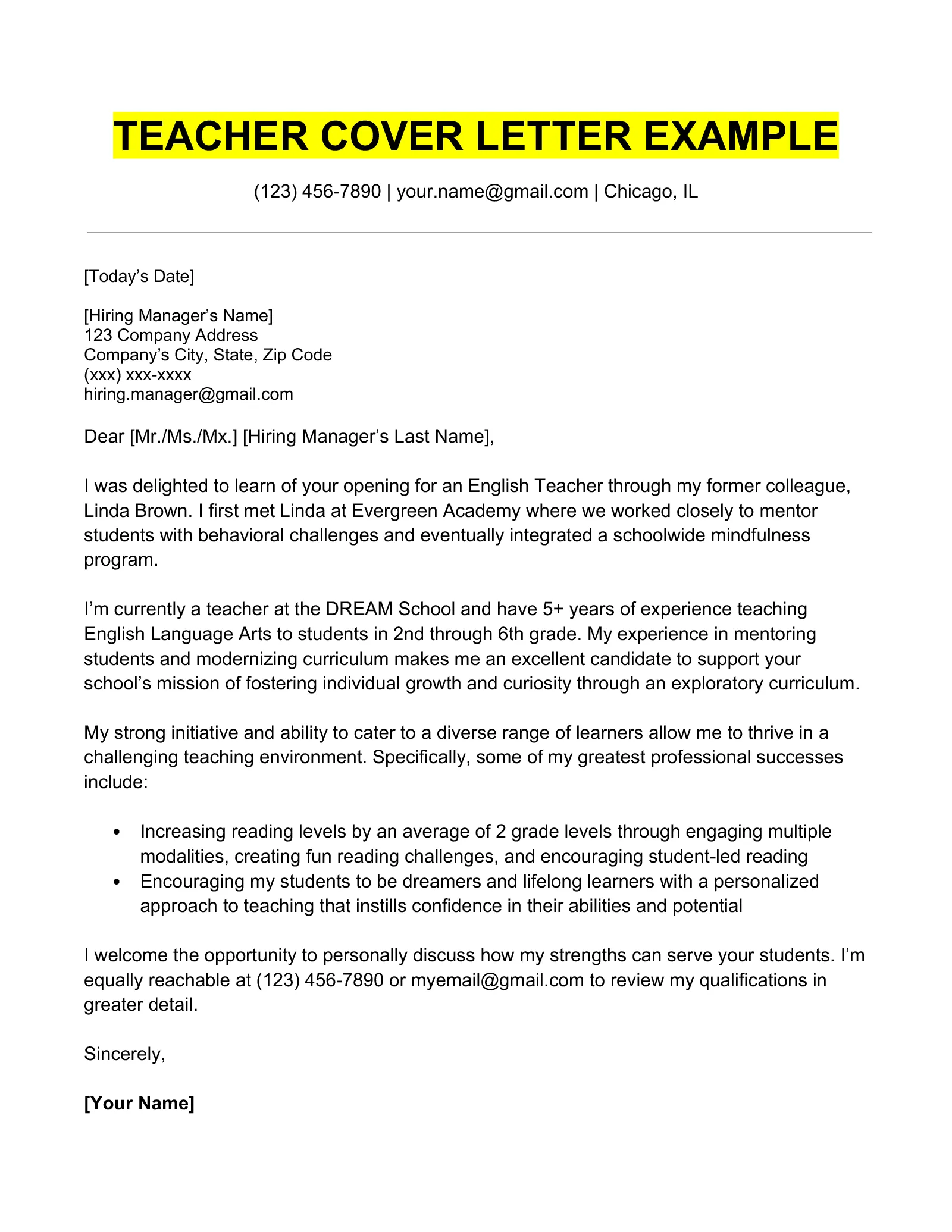
Start with a professional header that includes your contact information (name, phone number, email address, and optionally your LinkedIn profile URL). This information should be clearly visible at the top of the page, allowing the hiring manager to easily reach you. Ensure your email address is professional and appropriate for the application. Accuracy is key here; a misplaced digit can ruin your chances before your letter is even read, so double-check everything. Also, include the date and the recipient’s information (name, title, school name, and address) to address your letter properly. See the image above.
Greeting
A proper greeting sets the tone for your letter. Address the hiring manager by name if possible. Research the school’s website or LinkedIn to find the name of the principal or hiring committee member. If you can’t find a specific name, use a general greeting like “Dear Hiring Committee” or “Dear [School Name] Administration.” Avoid generic greetings like “To Whom It May Concern,” as they show a lack of personalization and effort. Use a comma after the greeting.
Opening Paragraph

The opening paragraph should immediately grab the reader’s attention. State the position you are applying for and where you found the job posting. Briefly mention your key qualifications or a compelling reason for your interest in the school. This is your chance to make a strong first impression and show why you are excited about the opportunity. Keep it concise and focused, setting the stage for the rest of your letter. Mentioning a mutual connection or a specific school program can be a good way to make an impact.
Body Paragraphs
The body paragraphs are where you provide detailed information about your qualifications, experience, and teaching philosophy. This section should be the bulk of your letter. Use this space to highlight your achievements, skills, and experiences that align with the job requirements. Provide specific examples to support your claims and showcase your ability to make a positive impact on students. Structure your body paragraphs logically, focusing on one or two key areas per paragraph, and use action verbs to describe your accomplishments.
Highlight Your Qualifications and Experience
Focus on the skills and experiences most relevant to the teaching position. Mention your degrees, certifications, and any specialized training you have received. Highlight specific accomplishments from your previous teaching roles, such as improved student test scores, successful classroom management strategies, or innovative teaching methods. Quantify your achievements whenever possible by using data and numbers to demonstrate your impact. For example, ‘Increased student test scores by 15%’ or ‘Implemented a new literacy program that improved reading comprehension by 20%’. Emphasize how your skills and experiences align with the school’s needs and values.
Showcase Your Teaching Philosophy

Your teaching philosophy reflects your beliefs about education and how you approach teaching. Briefly describe your teaching style, values, and what you hope to achieve in the classroom. Explain your methods for engaging students, creating a positive learning environment, and fostering student success. Demonstrate your understanding of child development and your commitment to creating an inclusive and equitable classroom. Show that you have a clear and consistent approach to teaching. Mentioning the school’s values and how they align with your approach can be highly effective.
Address the School’s Needs
Research the school and understand its specific needs and priorities. In your cover letter, address these needs directly by explaining how your skills and experience make you a good fit. If the school emphasizes a particular teaching methodology, such as project-based learning or differentiated instruction, mention your experience with this approach. Tailor your letter to the school’s mission and values. Show them how your approach to teaching aligns with what they are looking for in a new teacher. By showing that you understand their needs, you demonstrate that you’ve put in the work.
Closing Paragraph
In the closing paragraph, summarize your interest in the position and reiterate your enthusiasm. Thank the hiring manager for their time and consideration. Express your eagerness for an interview and your willingness to provide additional information or references. Keep it brief and professional, leaving the reader with a positive and memorable impression.
Call to Action

End your letter with a clear call to action. Specifically request an interview and mention your availability. Provide your contact information again to make it easy for the hiring manager to reach you. Consider including a statement about your excitement to discuss the opportunity further. Ensure that you use a professional and confident tone, showing that you are proactive and eager for the next step in the application process. See the image above.
Formatting Your Teacher Cover Letter
Proper formatting is essential for creating a professional and readable cover letter. The format should be clean and easy to navigate. A well-formatted letter shows that you pay attention to detail and respect the hiring manager’s time. Poor formatting can detract from your message, even if you have excellent qualifications. Always make sure your letter is clear and easy to read.
Choosing the Right Font and Font Size
Choose a professional and easy-to-read font, such as Times New Roman, Arial, Calibri, or Georgia. Avoid overly fancy or distracting fonts. Use a font size between 10 and 12 points for the body text. Larger sizes may look unprofessional, while smaller sizes can be difficult to read. Ensure consistency throughout the document by using the same font and size for all text elements. Check your letter on different devices to ensure readability.
Page Margins and Length

Use standard one-inch margins on all sides of your cover letter. This allows for proper spacing and creates a balanced look. Keep your cover letter to one page unless explicitly requested otherwise. A concise letter is more likely to be read in full. If you must exceed one page, ensure that the additional content is essential and relevant to the position. Avoid squeezing too much information onto the page by using a smaller font size or narrow margins, as this can make the letter appear cluttered and difficult to read.
Proofreading and Editing
Proofreading and editing are crucial steps in the writing process. Check for any grammatical errors, spelling mistakes, and punctuation errors. Have a friend or colleague review your cover letter to catch any errors you may have missed. Ensure that your letter flows logically and that your sentences are clear and concise. Check the overall tone of your letter to make sure it’s professional and enthusiastic. A polished and error-free cover letter demonstrates your attention to detail and professionalism.
Cover Letter Examples for Different Teaching Positions
Different teaching positions require tailored cover letters. This section provides examples of how to write a cover letter tailored to specific roles.
Elementary School Teacher Cover Letter Example

Dear [Hiring Manager Name],
I am writing to express my enthusiastic interest in the Elementary School Teacher position at [School Name], as advertised on [Platform]. With five years of experience in elementary education and a deep passion for fostering a love of learning in young children, I am confident that I possess the skills and dedication to excel in this role.
In my previous role at [Previous School], I successfully implemented a differentiated instruction program that significantly improved student engagement and reading comprehension scores. I am adept at creating a positive and inclusive classroom environment where every student feels valued and supported. I am particularly drawn to [School Name]’s commitment to [School Value], as it aligns with my own educational philosophy of nurturing the whole child.
I am excited about the opportunity to contribute to your school community and help students reach their full potential. Thank you for your time and consideration. I have attached my resume for your review and welcome the opportunity to discuss my qualifications further.
Sincerely, [Your Name]
Middle School Teacher Cover Letter Example
Dear [Hiring Manager Name],
I am writing to apply for the Middle School Teacher position at [School Name], as advertised on [Platform]. With a strong background in [Subject] education and a proven ability to engage middle school students, I am eager to contribute to your school.
In my previous role at [Previous School], I developed and implemented innovative lesson plans that increased student participation and improved overall academic performance. I am proficient in using various teaching methods to cater to diverse learning styles and have a strong understanding of adolescent development. I am particularly impressed by [School Name]’s dedication to [School Value] and am excited to bring my experience and passion to your team.
Thank you for your consideration. I have attached my resume and am available for an interview at your earliest convenience.
Sincerely, [Your Name]
High School Teacher Cover Letter Example
Dear [Hiring Manager Name],
I am writing to express my keen interest in the High School Teacher position at [School Name], as advertised on [Platform]. With a Master’s degree in [Subject] and several years of experience teaching at the high school level, I am confident that I can make a significant contribution to your school.
During my tenure at [Previous School], I successfully implemented a project-based learning curriculum that enhanced student critical thinking and problem-solving skills. I have a proven track record of preparing students for college and careers, and I am passionate about fostering a challenging yet supportive learning environment. I am excited by [School Name]’s commitment to [School Value] and believe my skills and experience align perfectly with your mission.
I have attached my resume and welcome the opportunity to discuss my qualifications in an interview. Thank you for your time and consideration.
Sincerely, [Your Name]
Special Education Teacher Cover Letter Example
Dear [Hiring Manager Name],
I am writing to express my strong interest in the Special Education Teacher position at [School Name], as advertised on [Platform]. With a specialized background in special education and a passion for advocating for students with diverse needs, I am eager to join your team.
In my previous role at [Previous School], I developed and implemented individualized education programs (IEPs) that helped students achieve their academic and personal goals. I have extensive experience working with students with various disabilities and am skilled in creating inclusive and supportive learning environments. I am deeply impressed by [School Name]’s commitment to [School Value] and believe my skills and experience perfectly align with your mission.
Thank you for your time and consideration. I have attached my resume and welcome the opportunity to discuss my qualifications in an interview.
Sincerely, [Your Name]
Tips for Writing a Strong Teacher Cover Letter
Crafting a strong teacher cover letter requires more than just listing your qualifications. It involves showcasing your passion, tailoring your letter to each application, and avoiding common mistakes. This section provides valuable tips to help you create a cover letter that stands out.
Tailor Your Cover Letter to Each Application
Avoid using a generic cover letter for every application. Customizing your letter to match the specific needs and values of each school is crucial. Research the school’s mission, vision, and values. Highlight how your skills and experience align with their priorities. Mention specific programs or initiatives that interest you. By tailoring your letter, you demonstrate that you are genuinely interested in the position and have taken the time to understand the school.
Use Action Verbs
Use strong action verbs to describe your accomplishments and responsibilities. Action verbs make your letter more dynamic and engaging. Instead of saying ‘Responsible for teaching,’ use ‘Developed and implemented lesson plans.’ Or instead of ‘Helped students,’ try ‘Mentored students to achieve academic goals.’ Examples include ‘Created,’ ‘Implemented,’ ‘Managed,’ ‘Developed,’ ‘Led,’ ‘Collaborated,’ and ‘Achieved.’ Action verbs bring your achievements to life.
Quantify Your Achievements
Whenever possible, quantify your achievements to demonstrate your impact. Use data and numbers to provide concrete evidence of your success. For instance, instead of saying ‘Improved student performance,’ state ‘Improved student test scores by 15%.’ Or, instead of ‘Increased parent involvement,’ say ‘Increased parent participation in school events by 20%.’ Quantifying your achievements provides tangible proof of your abilities and makes your letter more compelling. See the image above.
Show Enthusiasm and Passion
Let your passion for teaching shine through in your cover letter. Express your enthusiasm for the profession and your commitment to student success. Highlight what excites you about the position and why you want to work at that particular school. Your passion will make you more memorable and show the hiring manager that you are dedicated and motivated. Demonstrate your enthusiasm for education and for helping students reach their full potential. Make sure to show that you enjoy teaching!
Avoid Common Mistakes
Several common mistakes can undermine your teacher cover letter. Being aware of these pitfalls and avoiding them can significantly improve your chances of getting an interview. This section identifies common errors and offers advice on how to steer clear of them.
Grammar and Spelling Errors
Grammatical errors and spelling mistakes are a major turn-off for hiring managers. They reflect poorly on your attention to detail and professionalism. Always proofread your cover letter carefully before submitting it. Use a spell checker and grammar checker, but also read it aloud to catch any errors. Have someone else review your letter to provide a fresh perspective. Ensure that your writing is clear, concise, and free of errors.
Generic Cover Letters
Avoid using generic cover letters that could apply to any job. Generic letters show a lack of effort and a lack of understanding of the specific school’s needs. Tailor your letter to each application, highlighting your qualifications and experiences that align with the job requirements and the school’s values. Research the school and address its specific needs in your letter. Personalization is key to making a strong impression.
Focusing on Yourself Too Much
While it’s important to highlight your qualifications, avoid making your cover letter solely about yourself. Focus on how you can contribute to the school and how your skills and experience will benefit the students. Emphasize your understanding of the school’s needs and how you can meet them. Show that you are a team player and that you are committed to the success of the school and its students. Balance your accomplishments with the school’s needs.
Final Thoughts and Additional Resources
Writing a compelling teacher cover letter is a critical step in the job application process. By following the guidelines and tips outlined in this article, you can create a cover letter that grabs attention, highlights your qualifications, and increases your chances of getting an interview. Remember to tailor your letter to each application, use action verbs, quantify your achievements, and show your enthusiasm. Good luck with your job search!
Additional Resources
For more in-depth guidance, consider exploring the following resources: [Link to relevant websites or articles]. These resources can provide further examples, templates, and tips to help you create a winning cover letter.