Understanding the Executive Assistant Role
The role of an Executive Assistant is multifaceted, demanding a blend of organizational prowess, communication finesse, and a proactive approach to managing the executive’s needs. It’s a position that requires a high degree of professionalism, discretion, and the ability to anticipate requirements before they arise. An effective Executive Assistant is much more than an administrative support staff they are a crucial partner in the success of the executive and, by extension, the company. They act as a gatekeeper, a project manager, and a communications hub, all rolled into one.
Key Responsibilities of an Executive Assistant
Executive Assistants handle a broad range of responsibilities that are pivotal to the smooth operation of an executive’s daily activities. These responsibilities include managing schedules, coordinating travel arrangements, preparing reports and presentations, handling correspondence, and managing phone calls. They often serve as the primary point of contact, interacting with internal staff, external clients, and stakeholders. Moreover, they may be tasked with organizing meetings, managing projects, and conducting research on behalf of their executive, all while maintaining a high level of confidentiality and discretion.
Skills and Qualities Employers Seek

Employers seek a distinct combination of skills and qualities when hiring an Executive Assistant. Essential technical skills encompass proficiency in Microsoft Office Suite (Word, Excel, PowerPoint, Outlook), excellent typing speed, and the ability to learn new software quickly. Soft skills are equally important, including exceptional organizational skills, strong communication skills (both written and verbal), attention to detail, problem-solving abilities, and the capacity to work independently. Furthermore, the ability to prioritize tasks, manage time effectively, and maintain a professional demeanor under pressure is highly valued. A proactive, resourceful, and discreet individual with strong interpersonal skills will undoubtedly impress employers. (executive-assistant-skills.webp)
Crafting a Compelling Cover Letter
A compelling cover letter is your first opportunity to make a positive impression and showcase why you are the ideal candidate for the Executive Assistant role. It should be tailored to each specific job and highlight your relevant experience, skills, and accomplishments. The cover letter should go beyond simply repeating the information in your resume and instead, tell a story that captures the reader’s attention and demonstrates your understanding of the role and the company’s needs. It is your chance to present a professional, polished, and persuasive argument for why you deserve an interview. (compelling-cover-letter.webp)
Header and Contact Information
Begin your cover letter with a professional header that includes your full name, contact information (phone number, email address, and LinkedIn profile URL), and the date. Ensure your contact information is up-to-date and easily accessible. Also, include the hiring manager’s name (if known) and the company’s address to show attention to detail and personalization. This header sets the tone for the rest of your letter and gives the recipient all the information needed to reach you.
Personalized Salutation

Always address the hiring manager by name if possible. Research the company or check the job posting to find out who the hiring manager is or what their title is. Using a personalized salutation, such as “Dear Ms. [Last Name],” immediately grabs the reader’s attention and demonstrates that you’ve done your research and are genuinely interested in the position. Avoid generic greetings like “To Whom It May Concern” as they come across as impersonal and show a lack of effort.
Opening Paragraph to Grab Attention
The opening paragraph is crucial to capturing the reader’s interest. Start with a strong statement that immediately grabs their attention. Mention the specific position you’re applying for and briefly explain why you are excited about the opportunity. You can also highlight a key skill or experience that aligns with the job requirements. This initial paragraph sets the tone and encourages the reader to continue reading. For instance, you could begin by stating your enthusiasm for the company and expressing how your proven skills in executive support can contribute to the company’s success.
Highlighting Relevant Experience
The body of your cover letter should highlight your relevant experience and demonstrate how your skills align with the requirements of the Executive Assistant role. Focus on the experience that is most pertinent to the job description. Use specific examples to illustrate your accomplishments and responsibilities. Quantify your achievements whenever possible to show the impact you’ve made in previous roles. Describe your proficiency in managing schedules, coordinating travel, preparing reports, and handling correspondence. Showcase your ability to maintain confidentiality and manage multiple tasks simultaneously. These are all critical aspects to highlight.
Showcasing Skills and Achievements

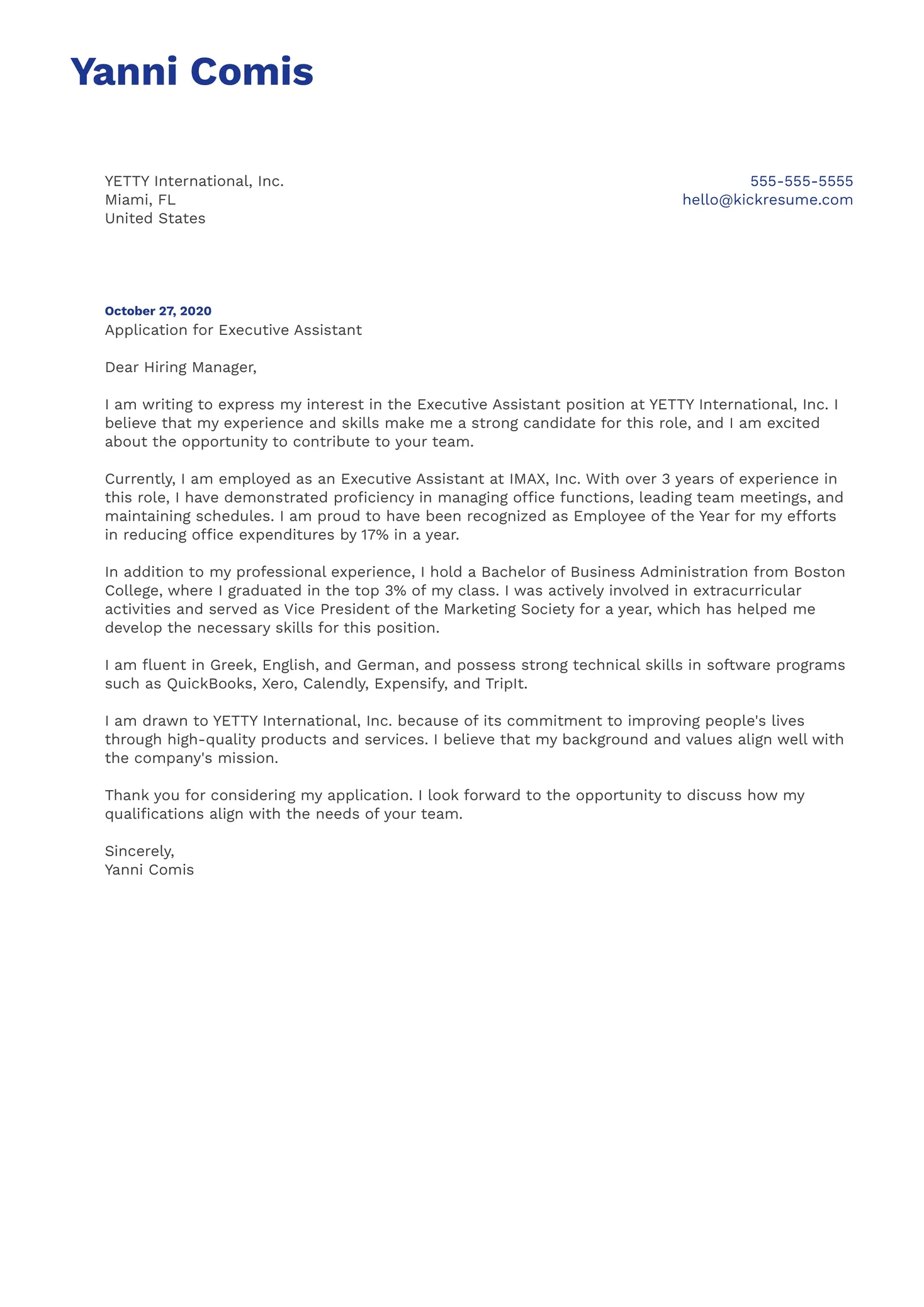
Clearly articulate your skills and achievements to convince the hiring manager of your suitability. Instead of simply listing your skills, provide concrete examples of how you have utilized those skills in past roles. For example, describe how you managed a complex project, resolved a challenging issue, or streamlined an administrative process. Provide details about your achievements, such as how you improved efficiency, reduced costs, or enhanced team performance. This approach gives the hiring manager a better understanding of your capabilities and potential contributions. (executive-assistant-cover-letter-2.webp)
Quantifying Accomplishments
Quantifying your accomplishments is an effective way to make your cover letter more impactful. Use numbers, percentages, and specific metrics to demonstrate your successes. For example, instead of stating you “improved office organization,” state that you “implemented a new filing system that reduced document retrieval time by 20%.” Similarly, instead of saying you “managed travel arrangements,” indicate that you “coordinated over 100 international trips with zero errors.” These concrete examples provide tangible evidence of your value and capabilities, leaving a lasting impression on the hiring manager.
Addressing the Employer’s Needs
Tailor your cover letter to show how your skills and experience align with the employer’s specific needs. Review the job description carefully and identify the key requirements and responsibilities. In your letter, address each of these points and explain how your experience and skills directly address those needs. This demonstrates that you have carefully considered the position and understand what the employer is looking for. It also proves you possess the qualifications needed to excel in the role.
Expressing Enthusiasm and Fit

Convey your enthusiasm for the position and the company. Demonstrate that you have researched the company and understand its mission, values, and culture. Explain why you are interested in working for them and how your skills and experience can contribute to their success. Expressing genuine interest and highlighting how your values align with the company’s will show that you are the right fit for the organization. This will make your cover letter more engaging and increase your chances of getting an interview.
Closing the Cover Letter
End your cover letter with a strong closing paragraph. Reiterate your interest in the position and thank the hiring manager for their time and consideration. Clearly state your desire for an interview and how you can be reached. Also, include a call to action, such as “I am eager to discuss my qualifications further in an interview” or “I look forward to the opportunity to speak with you.” This shows confidence and encourages the hiring manager to take the next step. Ensure your closing is professional and polite, using a formal closing such as “Sincerely” or “Best regards.”
Formatting and Proofreading for Perfection
The formatting and proofreading of your cover letter are critical to demonstrating professionalism and attention to detail. A well-formatted cover letter with no errors will impress the hiring manager and show that you can handle the duties expected of an Executive Assistant. It is essential that your cover letter is not only written well but also looks professional. (formatting-cover-letter.webp)
Choosing the Right Font and Style

Choose a professional and easy-to-read font such as Times New Roman, Arial, or Calibri, with a font size between 11 and 12 points. Maintain consistent formatting throughout the document, including spacing, margins, and alignment. Use a clear and concise writing style, and avoid using overly complex language or jargon. The appearance of your cover letter should be clean and organized, making it easy for the hiring manager to read and understand your message.
Proofreading for Errors
Thoroughly proofread your cover letter for any grammatical errors, typos, and punctuation mistakes. Errors can detract from your professionalism and create a negative impression. Use spell-check and grammar-check tools, but also read the letter carefully yourself to ensure accuracy. Have a friend or family member proofread your letter as a second pair of eyes can catch mistakes you may have missed. Ensure that all the information you provide is accurate and that your tone is professional throughout the document. (cover-letter-mistakes.webp)
Tailoring Your Cover Letter
A generic cover letter is unlikely to impress a hiring manager. Tailoring your cover letter for each job application is crucial. Customizing your letter demonstrates your genuine interest in the specific position and the company. It showcases your willingness to invest the time and effort to understand the role and how your skills and experience align with the employer’s needs. (tailoring-cover-letter.webp)
Researching the Company

Before writing your cover letter, research the company and its industry. Visit the company’s website, read their mission statement, and review their recent news and social media posts. Understand their values, culture, and goals. This information will help you tailor your letter to address the company’s specific needs and show that you understand their business and objectives.
Customizing for the Specific Job
Review the job description carefully and identify the key requirements and responsibilities. Use the same keywords and phrases from the job description in your cover letter. Highlight how your experience and skills align with the employer’s specific needs. Provide examples of how you have successfully handled similar responsibilities in previous roles. Make sure to tailor your letter to the company’s culture and tone.
Keywords to Include
Incorporate relevant keywords from the job description into your cover letter. These keywords are often used by applicant tracking systems (ATS) to screen applications. Including these keywords will increase the likelihood of your cover letter being reviewed by a hiring manager. Ensure you naturally integrate the keywords into your writing. For example, use keywords like “schedule management,” “travel coordination,” “communication,” “Microsoft Office Suite,” and “confidentiality” if these are specified in the job description.