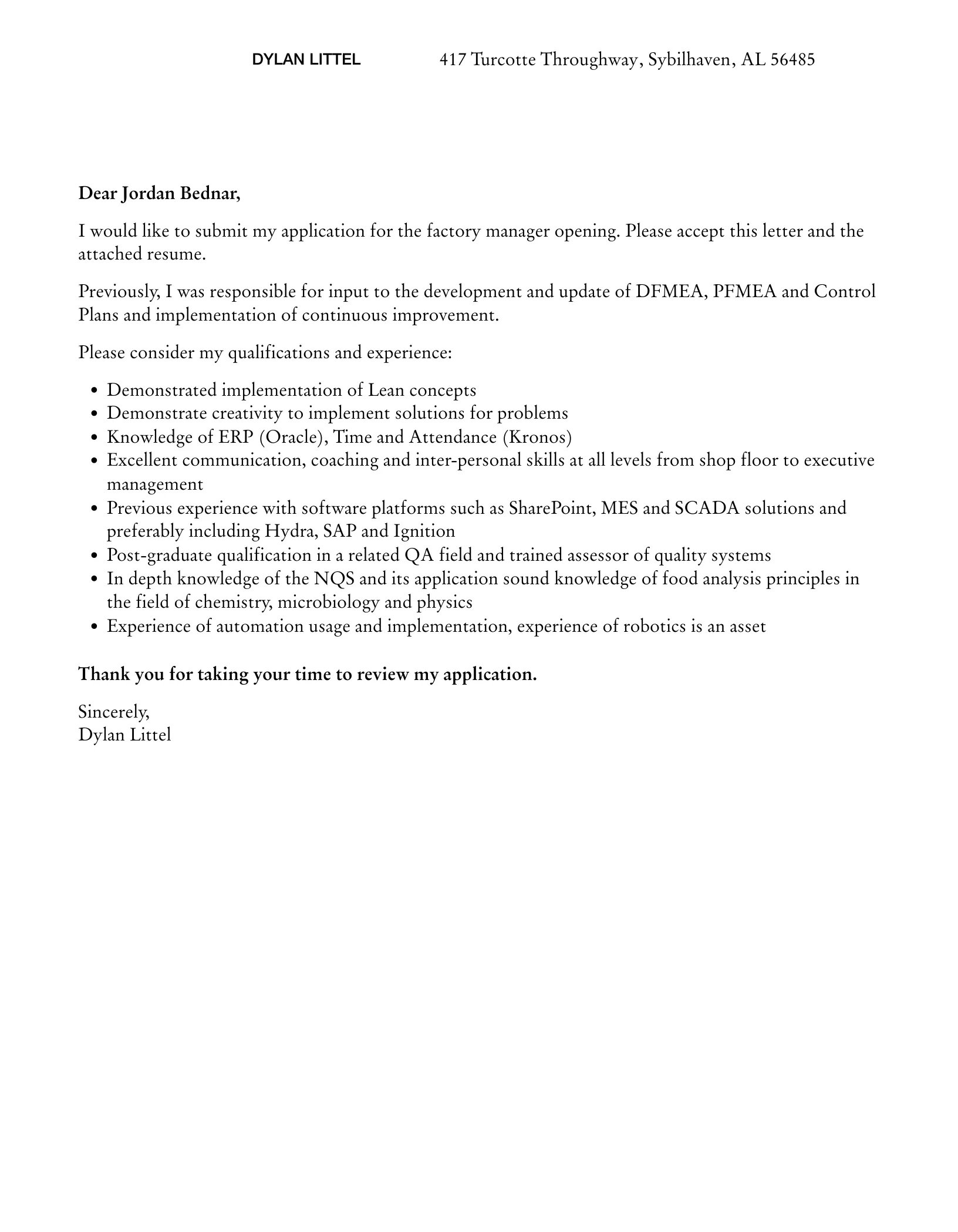
Why You Need a Cover Letter for a Factory Job
In the competitive landscape of job applications, especially for roles like factory work, a cover letter serves as your initial introduction and a crucial opportunity to distinguish yourself. While a resume provides a snapshot of your qualifications, a cover letter allows you to elaborate on your experiences, skills, and the value you bring to the table. It’s your chance to connect with the hiring manager on a personal level and express your genuine interest in the position. A well-crafted cover letter demonstrates your communication skills, attention to detail, and your understanding of the specific requirements of the factory job. Without one, your application may be overlooked, as it fails to provide the necessary context and personalization that employers seek. Remember, a cover letter is not just an option; it’s often a necessity for making a positive first impression and increasing your chances of getting hired.
Highlighting Your Skills and Experience
Your cover letter is where you shine the spotlight on your skills and experiences relevant to a factory job. This means more than just listing your past jobs; it means demonstrating how your previous experiences have equipped you to excel in this new role. Begin by identifying the key skills the employer is seeking, often found in the job description. Then, provide specific examples of how you’ve utilized those skills in previous roles. This could include operating machinery, following safety protocols, or working effectively within a team. Don’t just tell them what you did; show them the results. For instance, you might mention how you improved efficiency or reduced errors in a previous position. By clearly showcasing your abilities and relating them to the job requirements, you make a compelling case for why you are the ideal candidate.
Focusing on Relevant Work Experience

When detailing your work history, focus on experiences that align with the factory job requirements. Even if your background isn’t directly in factory work, highlight transferable skills like manual dexterity, problem-solving, and the ability to follow instructions. Briefly describe your responsibilities in previous roles and quantify your accomplishments whenever possible. For example, if you’ve worked in a warehouse, emphasize your experience with inventory management, operating forklifts, or meeting production quotas. If you have any experience with machinery or tools, be sure to mention it. Showing that you have a history of performing tasks similar to those required in a factory setting can significantly increase your chances of getting an interview. Focus on achievements and results rather than just a list of duties.
Emphasizing Physical Abilities and Stamina
Factory jobs often require physical stamina and the ability to perform repetitive tasks for extended periods. In your cover letter, make it clear that you possess the necessary physical capabilities. While you don’t need to go into excessive detail, briefly mention any physically demanding work you’ve done in the past, such as construction, landscaping, or any role involving heavy lifting. Highlight your ability to work on your feet for long hours and your capacity to maintain focus and productivity throughout your shift. If you have any specific certifications related to physical fitness or safety, be sure to mention them. Your commitment to physical fitness and readiness for a physically demanding job can make a strong impression on the hiring manager.
Showcasing Your Work Ethic and Reliability
Factory jobs rely heavily on a strong work ethic and reliability. In your cover letter, emphasize these qualities. Mention your punctuality, attendance record, and any instances where you went above and beyond in previous roles. Provide examples that demonstrate your commitment to meeting deadlines, working efficiently, and consistently delivering high-quality work. If you have received any awards or recognition for your performance, be sure to include them. Mention any positive feedback you’ve received from supervisors or colleagues regarding your work ethic or reliability. Your goal is to convince the employer that you’re someone they can depend on to show up on time, work hard, and contribute positively to the team.
Demonstrating Attention to Detail and Safety Awareness

Attention to detail and a strong awareness of safety protocols are crucial in factory settings. Highlight these aspects in your cover letter. Describe situations where you meticulously followed instructions, identified potential hazards, or adhered to safety guidelines. Mention any safety training you’ve received, such as OSHA certifications or first aid training. Provide specific examples of how you have prioritized safety in your previous roles. For instance, if you worked in a warehouse, you could mention how you followed procedures to prevent accidents or injuries. Demonstrating a commitment to safety not only shows that you are a responsible worker but also indicates that you understand the importance of following procedures to maintain a safe work environment.
Mentioning Your Adaptability and Teamwork Skills
Factory environments often demand adaptability and teamwork. Show that you are comfortable adjusting to changing priorities and working collaboratively with others. Give examples of how you have handled unexpected challenges or adapted to new processes in previous roles. Describe your experience working as part of a team, contributing to collective goals, and communicating effectively with colleagues. Highlight any experience you have with cross-functional collaboration or mentoring. Demonstrating your ability to work well with others, adapt to changing situations, and contribute positively to a team can significantly increase your chances of getting hired. Mentioning your willingness to learn new skills and take on additional responsibilities also shows your adaptability and proactive approach.
Formatting Your Factory Job Cover Letter
The format of your cover letter is as important as its content. A well-formatted letter is easy to read, professional, and showcases your attention to detail. Use a standard business letter format, with your contact information at the top, followed by the date, the hiring manager’s name (if known), and the company’s address. The body of the letter should be concise, with each paragraph focusing on a specific point. Use clear and easy-to-read fonts like Arial or Times New Roman. Keep the font size between 10 and 12 points. Maintain consistent margins (typically 1 inch) on all sides. Proofread your letter carefully for any grammatical errors or typos. A well-formatted and error-free cover letter conveys professionalism and attention to detail, both of which are highly valued in a factory job.
Using a Professional and Concise Tone

Maintain a professional and concise tone throughout your cover letter. Avoid slang, jargon, and overly casual language. Use clear and direct language to communicate your qualifications and your interest in the job. Keep your sentences and paragraphs brief and focused, highlighting the most relevant information. Avoid excessive use of adjectives and adverbs; instead, focus on using strong action verbs to describe your accomplishments. Proofread your letter carefully to eliminate any unnecessary words or phrases. A professional tone demonstrates your respect for the hiring manager and your commitment to the job, while a concise style ensures that your key qualifications are easily understood.
Structuring Your Letter for Clarity
Organize your cover letter logically for maximum impact. Start with a strong opening paragraph that grabs the hiring manager’s attention and states the position you’re applying for. The body paragraphs should focus on your key skills and experiences, using the job description as your guide to what the employer seeks. Each paragraph should address a specific qualification or aspect of your work history. Provide concrete examples and quantifiable results to support your claims. Use clear transitions between paragraphs to ensure a smooth flow of information. End with a strong closing paragraph that reiterates your interest in the job and includes a call to action, such as expressing your availability for an interview. A clear and well-structured letter allows the hiring manager to quickly grasp your qualifications and understand why you are the best candidate.
Tailoring Your Letter to the Specific Job
Never send a generic cover letter. Always tailor your letter to the specific factory job you’re applying for. Carefully review the job description and identify the key requirements and qualifications the employer is seeking. Then, adjust your letter to highlight the skills and experiences that directly match those requirements. Use keywords from the job description throughout your letter, but don’t overdo it; ensure they fit naturally within your sentences. Research the company to understand its values and mission. This shows you are genuinely interested in the position and the organization. Demonstrating that you have customized your cover letter for this specific opportunity shows the hiring manager that you are serious about the job and that you have taken the time to understand their needs.
Key Sections of Your Factory Job Cover Letter

Opening Paragraph to Grab Attention
The opening paragraph is your first and often only chance to make a strong impression. Start with a hook that grabs the hiring manager’s attention, such as a brief statement about your relevant experience or a specific achievement. Clearly state the position you are applying for. Briefly mention where you saw the job posting and why you are interested in the company. State your enthusiasm for the opportunity. Make it clear that you understand the job requirements. The goal is to immediately demonstrate that you’re a suitable candidate and that you’ve taken the time to personalize your letter. By setting the right tone from the start, you increase your chances of making the hiring manager want to read on.
Body Paragraphs to Showcase Qualifications
The body paragraphs are the heart of your cover letter. Use these paragraphs to showcase your qualifications and experiences that align with the job requirements. Focus on the skills and experiences mentioned in the job description, providing specific examples of how you’ve utilized these skills in the past. Quantify your achievements whenever possible to demonstrate the impact of your work. For example, instead of saying you ‘improved efficiency,’ mention that you ‘increased production output by 15%’. Use strong action verbs to describe your accomplishments. Link your skills and experience back to the company’s needs. Make sure to use keywords from the job description to show your understanding of the role. By providing specific and compelling examples, you convince the hiring manager that you possess the qualifications and skills required for the factory job.
Closing Paragraph with a Call to Action

The closing paragraph is your opportunity to reiterate your interest in the job and to encourage the hiring manager to take the next step. Thank the hiring manager for their time and consideration. Reiterate your enthusiasm for the opportunity and briefly summarize your key qualifications. Express your availability for an interview and provide your contact information again. End with a strong call to action, such as, ‘I am eager to discuss how my skills and experience can contribute to your team, and I look forward to hearing from you.’ Proofread your entire letter before sending it. A strong closing paragraph leaves the hiring manager with a positive impression and motivates them to take action, increasing your chances of getting an interview.