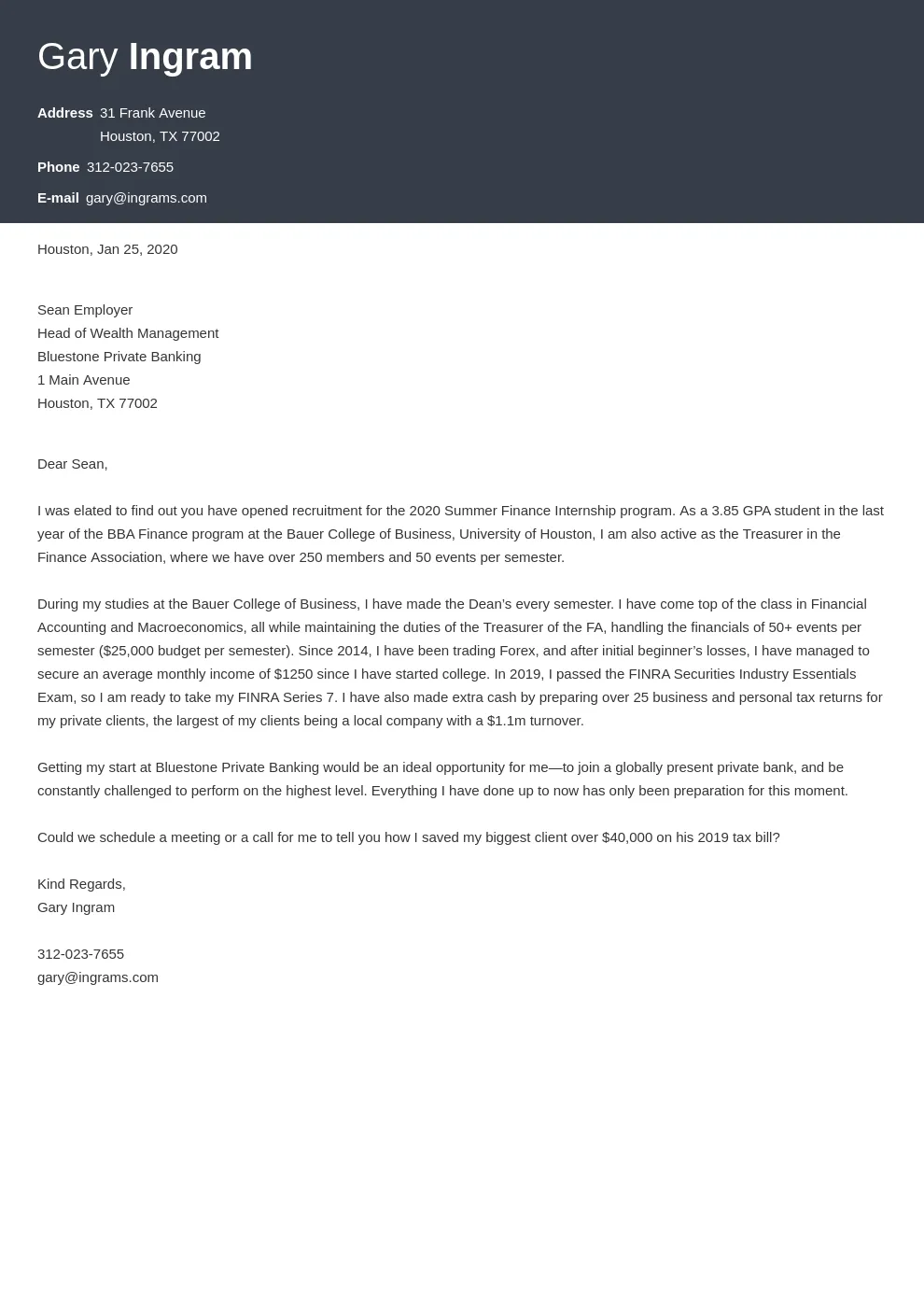
Understanding the Importance of a Finance Cover Letter
In the competitive world of finance, a well-crafted cover letter can be the key to unlocking your dream job. It’s not just a formality; it’s your first impression, your chance to stand out from the crowd and showcase your unique value proposition. Many applicants overlook the importance of a strong cover letter, focusing solely on their resume. However, a cover letter allows you to tell your story, explain your career goals, and connect your skills and experience to the specific requirements of the position. It’s your opportunity to make a compelling case for why you are the perfect fit for the role.
Why a Cover Letter Matters in Finance
A finance cover letter provides context to your resume. It allows you to elaborate on your experiences and demonstrate how your skills align with the specific job requirements. In a field where precision and communication are highly valued, your cover letter showcases your writing skills, attention to detail, and ability to convey complex information concisely. Recruiters in finance often use cover letters to assess a candidate’s communication style, personality, and genuine interest in the company and role. It’s your chance to show that you’ve done your research and that you understand the company’s mission and values.
Highlighting Your Unique Value Proposition

Your unique value proposition is what sets you apart from other candidates. In your cover letter, clearly articulate what makes you the best choice for the job. This involves highlighting your key skills, experiences, and achievements that are most relevant to the position. Consider what makes you different from others with similar qualifications. Are you particularly skilled in financial modeling, risk management, or investment analysis? Have you led successful projects or achieved impressive results? By quantifying your accomplishments and demonstrating your value, you can make a lasting impression on the hiring manager.
Key Elements of a Winning Finance Cover Letter
A winning finance cover letter is a well-structured document that clearly communicates your qualifications and enthusiasm for the role. It should include all the essential elements while maintaining a professional tone and style. The structure of your cover letter is just as important as the content. Each section should contribute to a cohesive narrative that tells the story of your career aspirations and how you are a perfect fit for the job.
Contact Information and Salutation
Begin your cover letter with your contact information, including your name, phone number, email address, and LinkedIn profile URL. This should be followed by the date and the hiring manager’s name and title, if known, and the company’s address. A professional salutation, such as “Dear Mr./Ms. [Last Name],” sets a professional tone and shows that you have taken the time to address your letter to the appropriate person. If you can’t find a specific name, use “Dear Hiring Manager”.
Opening Paragraph Grabbing Attention

The opening paragraph is your opportunity to grab the reader’s attention and make them want to read more. Briefly state the position you are applying for, where you saw the job posting, and why you are excited about the opportunity. You can also mention a key accomplishment or skill that immediately highlights your suitability for the role. Make it clear that you are a strong candidate and that you understand the requirements of the job and the needs of the company. Avoid generic opening lines; instead, personalize your introduction to demonstrate your genuine interest.
Body Paragraphs Showcasing Skills
The body paragraphs are the core of your cover letter, where you showcase your skills, experience, and achievements. Use specific examples to demonstrate how your qualifications align with the job requirements. Structure your body paragraphs logically, focusing on the most relevant skills and experiences. For each skill or experience, provide a brief description of your responsibilities, the outcomes of your actions, and any quantifiable results. This section must be very clear and easy to read. Showcasing skills is essential in the Finance field to show your capabilities.
Quantifiable Achievements and Metrics
Whenever possible, quantify your achievements using numbers and metrics. Instead of saying “Improved efficiency,” say “Improved operational efficiency by 15%.” Use numbers to showcase the impact of your contributions and demonstrate your ability to achieve results. This not only adds credibility to your claims but also helps the hiring manager quickly assess your value. For example, if you have experience in financial analysis, mention the size of the projects you’ve worked on, the cost savings you’ve achieved, or the investment returns you’ve generated. This allows the reader to quickly see how valuable your skills are.
Tailoring Your Letter to the Job Description

Carefully review the job description and tailor your cover letter to match the specific requirements of the role. Identify the key skills, experiences, and qualifications that the employer is seeking and highlight how you meet those criteria. Use the same keywords and phrases from the job description in your cover letter, but avoid simply repeating the description. Instead, provide specific examples of how you have demonstrated these skills in your previous roles. This will prove to the hiring manager that you have paid attention and are serious about being a good fit.
Closing the Letter with a Strong Call to Action
Conclude your cover letter with a strong call to action. Express your enthusiasm for the opportunity and reiterate your interest in the position. Thank the hiring manager for their time and consideration, and state your availability for an interview. Include a clear indication of how you can be reached, and express your willingness to provide any additional information they may need. A strong closing paragraph demonstrates your initiative and enthusiasm, leaving a lasting positive impression on the hiring manager and increasing your chances of being called for an interview.
Formatting and Style Guide for Finance Cover Letters
The formatting and style of your finance cover letter play a significant role in making a good impression. Your cover letter should be easy to read, well-organized, and visually appealing. Pay attention to every detail to ensure that your letter reflects your professionalism and attention to detail.
Professional Font and Layout Recommendations

Choose a professional and easy-to-read font, such as Times New Roman, Arial, or Calibri. Use a font size between 10 and 12 points. Maintain consistent formatting throughout your cover letter, including spacing, margins, and alignment. Use a clear and concise layout with appropriate headings and subheadings to organize your content and make it easy for the reader to follow. Keep your paragraphs short and to the point, and use bullet points or lists to highlight key information.
Proofreading and Editing Best Practices
Proofreading is an essential step. Carefully proofread your cover letter for any errors in grammar, spelling, and punctuation. Read your cover letter aloud to catch any awkward phrasing or sentence structures. Ask a friend, mentor, or career counselor to review your cover letter and provide feedback. Make sure to check all the details, including the company name, the hiring manager’s name, and the job title. Double-check your contact information to ensure it is accurate and up-to-date. This can make the difference between the hiring manager considering you or throwing it away.
Dos and Don’ts of Finance Cover Letters
Understanding what to do and what not to do is crucial for crafting a successful finance cover letter. By following these guidelines, you can increase your chances of making a strong first impression and securing an interview.
Common Mistakes to Avoid

There are some common mistakes in finance cover letters. Avoid generic cover letters. Each cover letter must be tailored to the specific job and company. Avoid using a one-size-fits-all approach. Do not focus on yourself; instead, emphasize how your skills and experience align with the employer’s needs. Don’t use jargon or overly technical language unless it is appropriate for the role. Avoid being overly casual in your writing style. Don’t exceed one page in length. Employers are busy; make sure your cover letter is concise and to the point. Don’t use the same cover letter for every job. Make sure that you tailor the cover letter for each role.
Using Keywords Effectively
Optimize your cover letter for applicant tracking systems (ATS) by strategically using keywords from the job description. Identify the key skills, qualifications, and experiences that the employer is seeking. Incorporate these keywords naturally throughout your cover letter, without keyword stuffing. Ensure that your cover letter is readable and engaging, and that the keywords are used in a way that enhances the overall flow and clarity of your writing. This will not only make it through the initial screening process but will also ensure that the hiring manager immediately knows the type of candidate you are.
Examples and Templates to Get You Started
Using examples and templates can be a very helpful approach. You can use these examples and adapt them to your specific situation and career goals. However, make sure you customize these to your skills.
Where to Find Finance Cover Letter Examples

There are several resources for finding finance cover letter examples. Online job boards often provide cover letter examples. Career websites and professional organizations offer samples and templates. You can also search for cover letter examples online. When selecting examples, focus on those that are relevant to your field, experience level, and the type of role you are applying for.
Adapting Templates to Your Situation
Once you have found a suitable template, tailor it to your unique background and the specific job you are applying for. Start by replacing the placeholder text with your own information, skills, and experiences. Customize the examples to reflect your achievements and demonstrate how your qualifications align with the job requirements. Always proofread the adapted template to ensure that it is free of errors and that the language is appropriate for your professional profile. By tailoring the templates, you will also be showcasing your skills and accomplishments, which will also enable you to stand out more.
Final Steps Submit and Follow Up
Before submitting your finance cover letter, it’s important to ensure that it is polished and ready for review. There are some final steps to take before you send your application.
Submitting Your Cover Letter
Carefully review the job application instructions and format your cover letter accordingly. Ensure your file format is compatible and that the file name is clear and professional. If submitting online, upload your cover letter as instructed, making sure all fields are correctly filled out. Double-check your contact information to ensure it is accurate. Send your application promptly, but take the time to make sure that all the details are correct and that you are ready. Make sure to send the right format and that you have the right file name.
Following Up After Submission
Follow up with the hiring manager or recruiter to express your continued interest in the position. Send a brief thank-you email or call within a week of submitting your application. Reiterate your interest in the role and briefly mention something specific that you discussed in your cover letter. Keep track of the status of your application, and if you haven’t heard back within a reasonable timeframe, reach out again to inquire about the progress. By following up, you demonstrate your initiative and professionalism and show your enthusiasm.