What is a Cover Letter for a Lab Report?
A cover letter for a lab report is a concise document that accompanies your lab report. It serves as an introduction to your work, providing essential context and summarizing the key aspects of your experiment. Think of it as a snapshot of your report, quickly informing the reader about your study’s purpose, methods, results, and significance. Unlike a detailed lab report, the cover letter is brief, typically spanning one page. Its primary goal is to capture the reader’s attention and give them a quick overview of your work before they dive into the full report. This is crucial for professors or supervisors who may be reviewing numerous reports.
Purpose of a Cover Letter
The main purpose of a cover letter is to introduce your lab report to the recipient and provide essential information at a glance. It offers a formal introduction to your work, making it easier for the reader to understand the context and purpose of your experiment. This document is not just a formality; it shows professionalism and attention to detail. It helps the reader quickly grasp the essence of your experiment, understand your findings, and appreciate the significance of your work without having to read the entire report immediately. Also, it serves as a communication tool that highlights any special circumstances or challenges encountered during the experiment.
Key Components of a Lab Report Cover Letter

A well-structured cover letter for a lab report includes several key components to ensure it effectively conveys the necessary information. Each element contributes to the clarity and professionalism of your communication. By including all the essential parts, you provide a comprehensive overview of your work, making it easy for the reader to understand your experiment and findings quickly. The following components are vital for a strong and effective cover letter, each playing a specific role in presenting your work in a concise and informative manner.
Your Name and Contact Information
Begin your cover letter by providing your full name, the course you are taking, and your contact information. This includes your email address and any other relevant details, such as your student ID. Make sure the information is accurate and up-to-date. This section ensures the recipient can easily identify you and reach you if they have any questions or need to provide feedback on your report. It’s a standard part of formal communication, setting the tone for the entire document.
Date of Submission
Include the current date to indicate when the report was submitted. This helps the recipient keep track of the submission timeline. It’s a simple yet important detail that aids in record-keeping and ensures everyone is aware of the submission date. This ensures clarity and proper organization of submissions.
Recipient’s Information

Address your letter to the intended recipient. This typically includes the professor’s name, their title, and the department or institution where the report is being submitted. Use the correct title (e.g., Dr., Professor) to show respect. Addressing the letter to the correct person shows you’ve paid attention to detail and that you know who will be reviewing your report. This attention to detail is crucial in academic and professional settings.
Report Title and Lab Course
Clearly state the title of your lab report and the name or number of the course for which you are submitting it. This immediately identifies the subject of your report and its context. The title should be concise and accurately reflect the experiment’s focus. Including the course information helps the recipient quickly associate the report with the correct assignment and understand its background. This makes it easier for the reader to file and review your work efficiently.
Brief Summary of the Experiment
Provide a concise overview of the experiment’s purpose and the methodology used. Briefly explain what you aimed to investigate and how you conducted the experiment. This section should be brief, summarizing the core objectives and the main steps involved. This helps the recipient understand the context of your report without having to read the entire document. It is essential to give a snapshot of the study and its goals, enabling a quick understanding of the experiment.
Key Findings and Results

Summarize your main findings and the key results of the experiment. Highlight the most important data or observations. This section gives the recipient a quick look at what you discovered and whether your experiment was successful. Be specific and clear in your presentation of the key results. This lets the reader know the core outcomes of your work, giving them a good idea of what you have achieved through your experimentation.
Any Special Circumstances or Notes
If there were any unexpected issues, challenges, or deviations from the original experimental plan, briefly mention them here. Explain any factors that might have affected your results or the integrity of the experiment. This is your chance to provide context and explain anything that may impact the reader’s interpretation of your report. This section shows you are being transparent and allows the reader to understand any possible limitations or circumstances surrounding your work.
Formatting Your Lab Report Cover Letter
The formatting of your lab report cover letter plays a critical role in its overall professionalism and readability. Adhering to standard formatting guidelines ensures that your letter is easy to read and reflects your attention to detail. Proper formatting helps to create a clear and organized presentation of your information. Consistent formatting helps make your letter look organized and polished, making a good impression on the recipient.
Font and Style

Use a professional and readable font, such as Times New Roman, Arial, or Calibri. Keep the font size between 10 and 12 points. This ensures that your letter is easy to read and looks professional. Avoid using overly fancy or distracting fonts. The aim is to have a clean and easy-to-read document, which allows the focus to be on the content.
Margins and Spacing
Set margins to one inch on all sides of the page. Use single or 1.15 line spacing. This formatting ensures the text is well-spaced and easy on the eyes. Proper margins and spacing make your cover letter look organized and professional, making a good impression on the reader. These standards are used to ensure the text has enough space around the edges and between the lines.
Length of the Cover Letter
Keep your cover letter concise, ideally no longer than one page. Focus on including the most important information in a clear and efficient manner. A brief, well-written letter demonstrates your ability to communicate effectively and respect the recipient’s time. Remember to get straight to the point, summarizing your experiment’s key points.
Tips for Writing a Strong Cover Letter

Writing a strong cover letter for a lab report requires more than just including the required components. It requires careful attention to detail, clarity, and professionalism. Effective cover letters provide essential context while making a positive impression on the recipient. By following these tips, you can significantly improve the effectiveness of your cover letter, increasing the likelihood that your report will be well-received and thoroughly understood. These strategies will help you present your work in the best possible light.
Proofread Carefully
Before submitting your cover letter, meticulously proofread it for any grammatical errors, spelling mistakes, and punctuation issues. Ensure the language is clear, concise, and professional. A polished cover letter shows attention to detail and reflects positively on your work. Taking the time to carefully review your letter helps prevent mistakes. Using a grammar checker is also advisable. A well-proofread document increases credibility and makes a better impression.
Tailor to the Specific Lab Report
Customize your cover letter to fit the specific lab report you are submitting. Avoid using a generic template; instead, highlight the aspects of your experiment that are most relevant and important. By personalizing your letter, you show that you care about your work and understand the experiment in detail. Tailoring it will make the information more relevant to the recipient and your specific experiment. Emphasize the unique findings or significant details of your experiment.
Use Professional Language

Use professional language throughout your cover letter. Avoid slang, informal language, and contractions. Keep your tone respectful and clear. A formal tone reflects your professionalism and shows respect for the recipient. Using precise language makes your letter more credible and easier to understand. Always maintain a formal tone.
Highlight Key Achievements
If you achieved notable results or overcame specific challenges during the experiment, briefly highlight these accomplishments in your cover letter. Show your ability to think critically and solve problems by mentioning any significant breakthroughs or successful methods you used. Highlighting key achievements can make your report stand out. Sharing accomplishments can make your lab report memorable, showing your efforts and expertise.
Example of a Lab Report Cover Letter
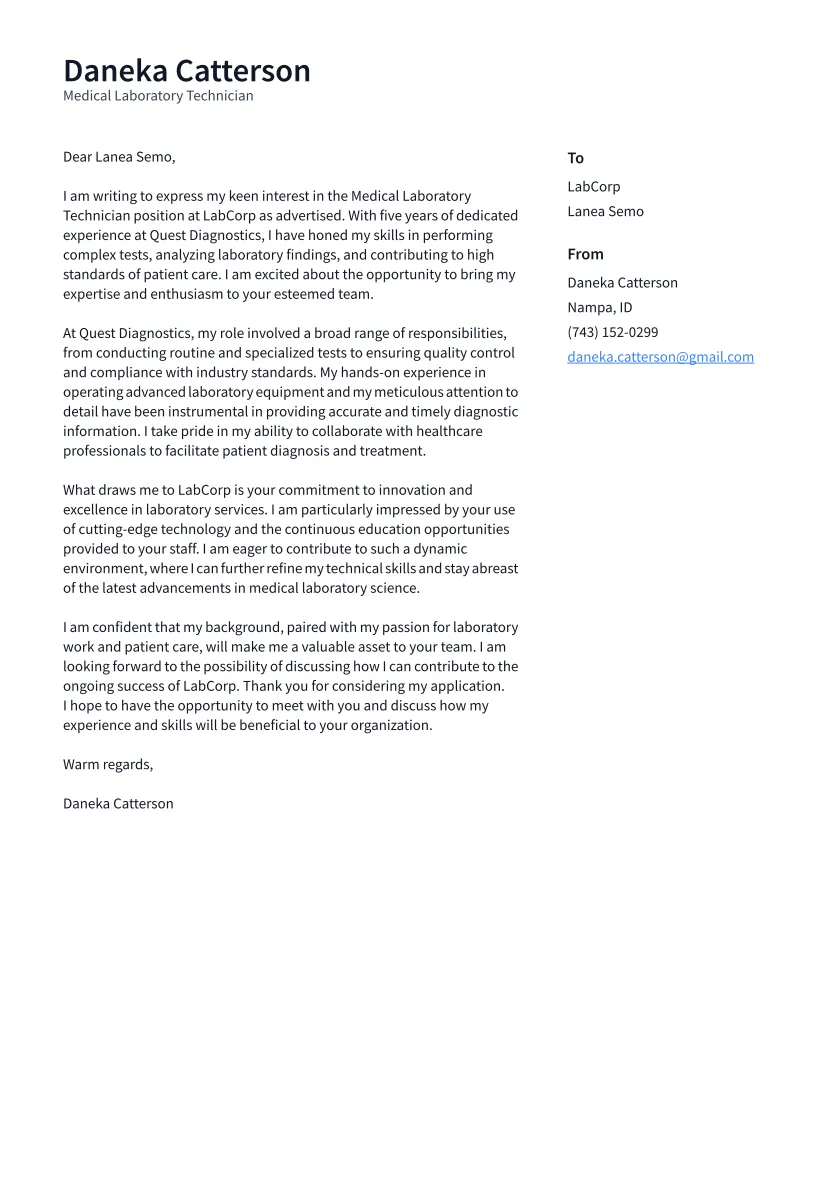
Here is an example to help you create your cover letter. Always adjust the content to fit your specific report.
Conclusion
Writing a cover letter for a lab report is an important step in the scientific communication process. By including essential elements, formatting it professionally, and following these writing tips, you can create a cover letter that introduces your work effectively and presents it in the best possible light. A well-crafted cover letter reflects your dedication, attention to detail, and understanding of the scientific method. Remember to always proofread and tailor your cover letter to match each unique lab report. This practice can significantly enhance the overall impact of your work.