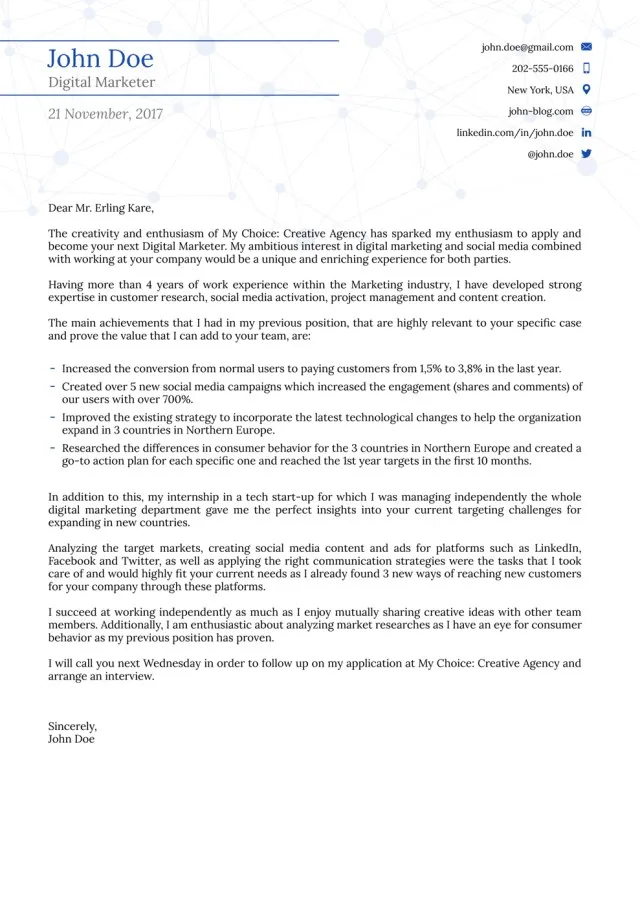
What is a Cover Letter and Why Is It Important
A cover letter is a crucial document that accompanies your resume when applying for a job. It serves as your introduction to the hiring manager, providing an opportunity to showcase your personality, express your enthusiasm for the role, and highlight the key skills and experiences that make you a strong candidate. Unlike a resume, which is a factual summary of your qualifications, a cover letter allows you to tell a story, connecting your past experiences to the specific requirements of the job and demonstrating why you are the perfect fit. A well-crafted cover letter can significantly increase your chances of getting an interview by making a positive first impression and setting you apart from other applicants.
Cover Letter Structure The Key Components
A professional cover letter follows a specific structure to ensure clarity and impact. This structure typically includes a header with your contact information, the date, the hiring manager’s name and title (if known), a compelling opening paragraph, a body that highlights your skills and experience, and a strong closing paragraph with a call to action. Each component plays a vital role in conveying your qualifications and enthusiasm. Understanding this structure is the first step in writing an effective cover letter that grabs the reader’s attention and encourages them to learn more about you.
Your Header Contact Information

Your header should clearly display your contact information. Include your full name, phone number, email address, and optionally, your LinkedIn profile URL or personal website. This information should be easy to find and read. Use a professional font and formatting style that is consistent with your resume. Make sure your email address is professional-sounding (e.g., firstname.lastname@email.com) and not something casual or outdated. Ensure all contact details are up-to-date and accurate, so the hiring manager can easily reach you.
Address the Hiring Manager
Whenever possible, address your cover letter to a specific person rather than using a generic greeting like “To Whom It May Concern.” Research the company and the hiring manager, if possible. Finding the correct name shows that you have taken the time to personalize your application and that you are genuinely interested in the position. If you can’t find a name, you can use a general greeting such as ‘Dear Hiring Manager’. However, using the name of the hiring manager makes your letter more engaging and shows you have done your research.
The Opening Paragraph Captivate the Reader
The opening paragraph is your chance to grab the reader’s attention. Start with a strong hook that immediately conveys your interest in the position. Clearly state the position you are applying for and where you found the job posting. Briefly mention something that caught your attention about the company or the role. This could be a specific project you admire or a mission that resonates with you. The goal is to make a strong first impression and encourage the reader to continue reading. Avoid generic opening lines; personalize it, making it clear why you are the perfect fit for the job.
Highlight Your Skills and Experience

The body of your cover letter is where you showcase your skills and experience. Focus on the skills and experiences most relevant to the job requirements. Use specific examples to demonstrate how you have used these skills to achieve positive outcomes in the past. Quantify your achievements whenever possible, providing numbers, percentages, or other measurable results to show your impact. Tailor each cover letter to the specific job you are applying for, highlighting the skills and experiences that align with the employer’s needs. Refer to the job description and match your experiences to the keywords and requirements listed.
Showcase Your Achievements
Instead of just listing your responsibilities, focus on your achievements. Use the STAR method (Situation, Task, Action, Result) to structure your examples. Describe the situation, the task you were assigned, the actions you took, and the results you achieved. This provides a clear and compelling narrative that highlights your accomplishments. For instance, instead of saying ‘Managed social media accounts’, say ‘Managed social media accounts, increasing follower engagement by 30% and website traffic by 20% within six months.’ Emphasizing your achievements will make your cover letter stand out.
Connect Your Skills to the Job Requirements
Carefully review the job description and identify the key skills and qualifications the employer is seeking. In your cover letter, explicitly connect your skills and experiences to these requirements. Provide specific examples of how you have demonstrated these skills in past roles. Use keywords from the job description to show that you have the necessary qualifications and that you understand what the employer is looking for. By directly addressing the employer’s needs, you demonstrate that you are a strong candidate and a good fit for the position.
Express Your Enthusiasm for the Company

Demonstrate your enthusiasm for the company and the role. Show that you have researched the company and understand its mission, values, and culture. Explain why you are excited about the opportunity and what you hope to contribute. This could involve mentioning a project or initiative that aligns with your interests or a specific aspect of the company’s work that resonates with you. By expressing genuine enthusiasm, you make a positive impression and increase your chances of standing out from other candidates. Do not simply say you are excited; show it with specific examples and details.
Call to Action Request an Interview
End your cover letter with a clear call to action. Request an interview and express your eagerness to discuss your qualifications further. Thank the hiring manager for their time and consideration. Reiterate your contact information to make it easy for them to reach you. Avoid generic closing statements; instead, personalize your request. For example, say something like, “I am eager to discuss how my skills and experience can contribute to [Company Name]’s success. Thank you for your time; I look forward to hearing from you soon.” A clear call to action ensures the hiring manager knows what the next step is.
Formatting Tips for a Professional Look
Formatting is essential for a professional cover letter. Use a clean, easy-to-read font, such as Times New Roman, Arial, or Calibri, with a font size between 10 and 12 points. Use consistent spacing and margins to ensure the document looks organized and professional. Keep the letter concise, ideally no more than one page. Use clear headings and bullet points (when appropriate) to break up large blocks of text and make the letter easier to read. Proofread carefully for any typos or grammatical errors. A well-formatted cover letter demonstrates attention to detail, which is crucial in a job application.
Proofread and Edit Your Cover Letter

Always proofread your cover letter meticulously. Check for any typos, grammatical errors, and inconsistencies in formatting. Consider having a friend, family member, or career counselor review your letter to provide a fresh perspective. Errors can undermine your credibility and make a negative impression on the hiring manager. A well-edited cover letter shows that you pay attention to detail and care about the quality of your work. Ensure the tone is professional, and the language is clear and concise. Before submitting, double-check that all the information is accurate and that the letter is tailored to the specific job and company.
In conclusion, a well-crafted cover letter is a powerful tool in your job search arsenal. By following these step-by-step guidelines, you can create a professional cover letter that effectively showcases your skills, experience, and enthusiasm, ultimately increasing your chances of landing an interview. Remember to tailor your cover letter to each job application, and always proofread carefully before submitting. Good luck with your job search!