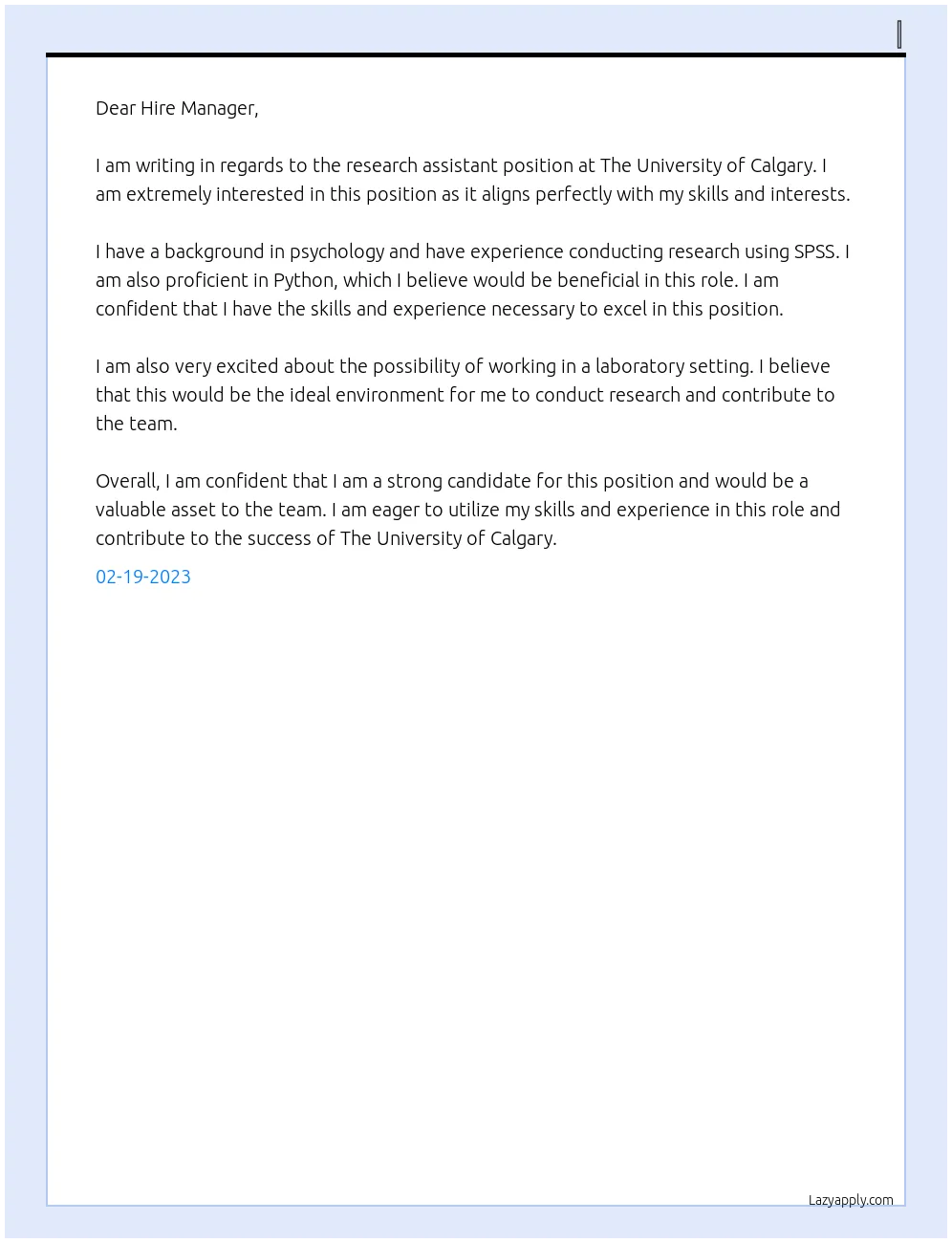
The Purpose of a Cover Letter
A cover letter serves as your personal introduction to a potential employer, offering a chance to showcase your personality, skills, and enthusiasm for a research assistant position. It’s your first opportunity to make a positive impression, setting the stage for your resume and demonstrating why you’re the perfect fit. A well-crafted cover letter provides context to your application, explaining why you’re interested in the specific role and organization. It goes beyond a simple listing of qualifications, telling a story about your aspirations and how you can contribute to their research endeavors. In essence, the primary goal is to secure an interview by captivating the hiring manager’s attention and making them want to learn more about you. A compelling cover letter highlights your unique qualities, differentiating you from other applicants, and demonstrating your genuine interest in the position and the research field. A cover letter is a valuable tool in the job application process, that can significantly increase your chances of landing an interview.
Cover Letter: Key Components
A strong cover letter for a research assistant position contains several key components that work together to create a compelling narrative. First, include your contact information at the top of the page, mirroring the information on your resume to ensure easy communication. After the contact information, a personalized greeting is essential, addressed to the hiring manager by name if possible, showing that you’ve taken the time to research the organization. In the body of the letter, start with an engaging introduction that grabs the reader’s attention and briefly states the position you’re applying for. The subsequent paragraphs should highlight your relevant skills and experience, providing specific examples to support your claims. Finally, wrap up with a clear and concise conclusion that reiterates your interest in the role, expresses gratitude for their time, and includes a call to action, such as requesting an interview. A well-structured cover letter is organized, easy to read, and effectively communicates your qualifications and enthusiasm.
Contact Information

At the beginning of your cover letter, provide your full name, address, phone number, and email address. Ensure that your email address is professional, as it will be used for communication. The contact information must be accurate and easy to find, making it simple for the hiring manager to reach you. It is advisable to use the same contact information as listed on your resume to maintain consistency across your application materials.
Greeting the Hiring Manager
Always address the hiring manager by name if possible. Research the organization and find the name of the person in charge of hiring, and address your cover letter to them. If you cannot find the name, use a professional greeting like ‘Dear Hiring Manager.’ Avoid generic greetings like ‘To Whom It May Concern’ as they do not demonstrate that you have taken the time to research the position. Personalizing your greeting shows initiative and attention to detail.
Body Paragraph 1 Skills
The first body paragraph is your chance to make a strong first impression by highlighting your key skills and experiences directly related to the research assistant role. Start by clearly stating the position you are applying for and briefly explaining where you found the opportunity. Next, identify 2-3 of the most crucial skills the employer is seeking based on the job description. Provide concrete examples to support your claims, illustrating how you’ve successfully applied these skills in past projects, coursework, or previous jobs. Emphasize the skills that demonstrate your ability to perform the job effectively, such as data analysis, laboratory techniques, or literature review. For instance, you could mention your experience with a specific software or research method that aligns with the job requirements. Tailor this paragraph to align with the job description, picking skills that are relevant to the specific position.
Highlighting Relevant Skills and Experience

Carefully review the job description to identify the key skills and experiences the employer is looking for. Then, select your experiences that directly relate to these requirements, and explain how these skills have helped you succeed in previous roles. Use the STAR method (Situation, Task, Action, Result) to structure your examples and demonstrate the impact you have had. This approach will help you showcase your abilities and provide evidence of your capabilities in relevant areas such as data collection, analysis, or reporting. Select examples that make you stand out. If you’ve previously worked on projects similar to the research being conducted, mention them to highlight your capacity to get started right away.
Quantifying Achievements
Whenever possible, quantify your achievements to show the tangible impact of your skills and experience. Rather than simply stating that you ‘managed data,’ indicate the volume of data you handled or the software you used. For example, you might say, ‘Managed and analyzed over 1,000 data points using SPSS, resulting in a 15% improvement in data accuracy.’ Use numbers and metrics to demonstrate your effectiveness, and provide context about the results you achieved. This approach not only makes your achievements more credible but also highlights your ability to achieve positive outcomes.
Body Paragraph 2 Why the Role and Company
In your second body paragraph, show that you’ve done your research by explaining why you are interested in this particular research assistant role and why you want to work for the specific organization. Demonstrate that you understand the organization’s mission, goals, and values, and explain how your skills align with their needs. Highlight any specific projects, research areas, or aspects of the organization that resonate with you. For instance, you could mention a specific professor or research group whose work you admire or a specific project you would be excited to be a part of. Expressing genuine enthusiasm for the organization and the role makes a positive impression.
Expressing Enthusiasm for the Position

Show your enthusiasm for the position by explaining why it aligns with your career goals and interests. Discuss what you hope to gain from the experience, how you envision contributing to the team, and your motivation for working in this specific research area. You might mention a passion for the research topic or the potential for intellectual growth. Demonstrating your genuine interest will impress the hiring manager and increase your chances of landing an interview. Show a deep understanding of the research and make it clear that you are excited to contribute.
Tailoring Your Letter to the Job
Always tailor your cover letter to the specific job and organization. Do not use a generic letter, but instead customize it to reflect the job description and highlight the skills and experience most relevant to the role. Research the organization, its mission, and values, and align your cover letter to match them. Mention specific projects, initiatives, or research areas that interest you. By personalizing your cover letter, you demonstrate your genuine interest in the position and show the hiring manager that you’ve taken the time to understand their needs.
Body Paragraph 3 Closing the Cover Letter
Conclude your cover letter with a strong closing paragraph that reiterates your interest in the research assistant position, summarizes your qualifications, and expresses gratitude for the opportunity. Reiterate your enthusiasm and make it clear why you are the best candidate for the role. Also, include a call to action, such as requesting an interview or inviting the hiring manager to contact you to discuss your application further. Finish with a professional closing like ‘Sincerely’ or ‘Best regards,’ followed by your full name.
Thank You and Call to Action

Express your gratitude for the hiring manager’s time and consideration. Thank them for reviewing your application, and show appreciation for the opportunity to be considered. Include a clear call to action, indicating your desire for an interview and providing contact information if needed. Suggest that you are available to discuss your qualifications in more detail and explain your willingness to answer any questions they may have. A strong closing that reiterates your interest and encourages the next steps will significantly increase your chances of success.
Formatting and Proofreading
The formatting and proofreading of your cover letter are as crucial as its content. A well-formatted and error-free letter demonstrates your attention to detail, professionalism, and respect for the hiring process. Use a clean, easy-to-read font, proper spacing, and a professional layout. Before submitting, thoroughly proofread the cover letter to catch any typos, grammatical errors, or inconsistencies, as these mistakes can leave a negative impression. Take your time to create a professional and polished cover letter, as this is an indication of your attention to detail and professionalism.
Font and Layout
Choose a standard, professional font such as Times New Roman, Arial, or Calibri, and use a font size between 10 and 12 points for easy readability. Use consistent formatting throughout the letter, including the font, spacing, and alignment. Maintain clear margins (1 inch on all sides) and use single spacing between lines, with a double space between paragraphs. Use proper alignment (left-aligned is generally recommended) to make your letter easy to scan. These details show that you care about presentation and understand professional communication.
Proofreading Your Cover Letter

Thoroughly proofread your cover letter multiple times to catch any errors. Check for spelling mistakes, grammatical errors, and punctuation errors. Read the letter aloud to listen for awkward phrasing or unclear sentences. Ask a friend, family member, or career advisor to review your cover letter for a second pair of eyes. Proofreading ensures that your letter is polished and professional, leaving a positive impression on the hiring manager. Consider using grammar and spell-checking software to help, but do not rely on it. A final manual check is always essential.
Cover Letter Examples and Templates
Utilizing cover letter examples and templates can be a useful starting point for crafting your own letter. However, remember to tailor the template to your specific situation and the requirements of the job. Online resources provide many examples of cover letters for research assistant positions, and you can customize these to reflect your skills and experiences. Remember to make the content unique to you.
Where to Find Examples and Templates
You can find cover letter examples and templates on career websites, job boards, and university career services websites. Search for ‘research assistant cover letter examples’ to find templates and sample letters. Some professional resume and cover letter writing services provide templates tailored to specific fields and positions. However, do not copy and paste. Use these examples to understand formatting, language, and structure, but always create original content.
Common Mistakes to Avoid

Avoid common mistakes that can undermine your application. Make sure you do not submit generic letters. They will show the hiring manager that you are not interested in the specific position. Do not include typos and grammatical errors, as these can make a negative impression, and do not include irrelevant information. Always proofread your letter before submitting it.
Generic Cover Letters
One of the most common mistakes is sending generic cover letters that are not tailored to the specific job. Always customize your cover letter to align with the requirements of the position and the organization’s mission. Show that you’ve researched the company, express a genuine interest in the role, and highlight the skills and experiences that make you a great fit. Sending a generic letter will quickly get your application tossed out.
Typos and Grammatical Errors
Typos and grammatical errors can create a negative impression. Always carefully proofread your cover letter multiple times. Ask a friend or family member to review it for a second opinion. Ensure the letter is error-free before submitting your application.