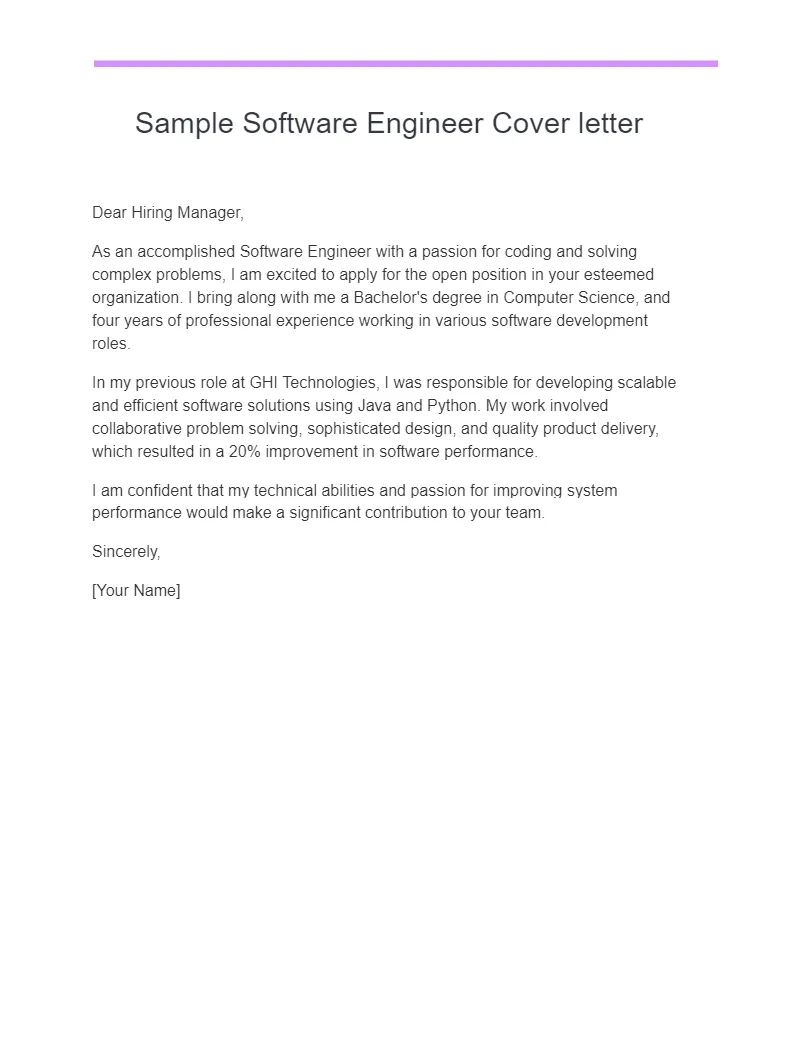
Cover Letter Essentials Software Engineers Need
A well-crafted cover letter is your chance to make a strong first impression and secure that coveted software engineering role. In a competitive job market, a compelling cover letter can set you apart from the crowd. It’s not just a formality; it’s a crucial tool that allows you to introduce yourself, showcase your skills, and demonstrate your genuine interest in the company and the specific position. This guide provides essential steps to create a cover letter that not only highlights your technical expertise but also resonates with potential employers. You’ll learn how to tailor your letter to each application, emphasize your achievements, and ultimately, increase your chances of landing an interview. Mastering the art of the software engineering cover letter is a strategic investment in your career, paving the way for new opportunities and professional growth. The goal is to create a document that is both informative and engaging, giving the hiring manager a clear picture of who you are and what you can bring to the table.
Understand the Purpose of a Cover Letter
The primary purpose of a software engineering cover letter is to complement your resume, not simply reiterate its contents. While your resume provides a detailed overview of your skills and experience, your cover letter offers the opportunity to provide context, express your personality, and articulate your enthusiasm for the role. It’s where you can explain why you’re a perfect fit for the specific company and position, detailing your understanding of their needs and how your skills align with them. Think of your cover letter as a narrative that tells your story, highlighting key accomplishments and demonstrating how your previous experiences have prepared you for the challenges of the job. It’s also an opportunity to address any potential gaps in your resume or explain career transitions. The goal is to convince the hiring manager that you’re not just qualified but also a good match for the company culture and values.
Highlighting Your Technical Skills

In your software engineering cover letter, highlighting your technical skills effectively is essential. Go beyond simply listing your skills; demonstrate how you’ve used them to achieve specific results. Mention the programming languages, frameworks, and tools you’re proficient in, but also provide examples of projects where you successfully applied these skills. For instance, instead of saying you know Java, describe a project where you developed a Java-based application, mentioning the challenges you overcame and the outcomes you achieved. Emphasize your expertise in areas that align with the job description, such as cloud computing, data structures, or specific software development methodologies. Use keywords from the job posting to showcase your relevance. This targeted approach shows the hiring manager that you have not only the technical skills but also the ability to apply them to real-world problems, making you a valuable asset for the company. Always back up your claims with concrete evidence to reinforce your technical capabilities and your ability to contribute to the team.
Choosing the Right Format and Structure
The format and structure of your cover letter are just as important as its content. A well-structured letter is easier to read and more likely to capture the hiring manager’s attention. Start with a professional header including your contact information and the date. Address the letter to the hiring manager, if possible; if not, use a general but professional salutation. Organize your letter into distinct paragraphs, each serving a specific purpose. The opening paragraph should state the position you’re applying for and where you saw the job posting, immediately grabbing the reader’s attention. The body paragraphs should delve into your skills and experience, showcasing your accomplishments and explaining why you’re a good fit. Conclude with a strong closing paragraph that reiterates your interest and includes a call to action, such as expressing your eagerness for an interview. A clear, concise structure makes your letter more persuasive and ensures that the essential information is easily accessible to the reader.
Formatting Your Cover Letter
Professional formatting is crucial for making your cover letter easy to read and visually appealing. Use a standard, readable font such as Arial, Calibri, or Times New Roman, and maintain a font size between 10 and 12 points. Keep your letter concise; ideally, it should fit on a single page. Use clear headings and bullet points to break up large blocks of text and highlight key information, making it easier for the hiring manager to scan the document. Maintain consistent margins (typically one inch on all sides) to give your letter a clean, uncluttered look. Proper spacing between paragraphs is also essential. Avoid excessive use of bolding, italics, or underlining; use these sparingly for emphasis. Ultimately, the goal is to present a document that is well-organized, visually appealing, and easy for the hiring manager to read and understand quickly.
Header and Contact Information

Your cover letter header should include your full name, phone number, email address, and professional LinkedIn profile URL. Ensure that your contact information is up-to-date and easily accessible. Include the date directly below your contact information. If you know the hiring manager’s name and title, include their information (name, title, company name, and address) before the salutation. This personalized touch shows that you’ve done your research and taken the time to tailor your application. Correctly formatting your header and contact information sets a professional tone from the start, demonstrating your attention to detail and professionalism, both of which are highly valued in the field of software engineering. Verify your email address and phone number for accuracy before submitting your cover letter, ensuring that potential employers can easily reach you.
Professional Salutation
The salutation sets the tone for your entire cover letter, so it’s crucial to get it right. Whenever possible, address the hiring manager by name, using ‘Dear Mr./Ms./Mx. [Last Name]’. This personal touch shows that you’ve taken the time to research the company and the role, demonstrating initiative and attention to detail. If the hiring manager’s name is unavailable, use a professional greeting like ‘Dear Hiring Manager’ or ‘Dear [Company Name] Recruiting Team’. Avoid generic or overly casual greetings like ‘To Whom It May Concern’ or ‘Hey’. Using a professional salutation conveys respect and sets a positive tone for your application, which can significantly influence the hiring manager’s perception of your application.
Body Paragraphs
The body paragraphs of your cover letter are where you showcase your skills, experience, and enthusiasm for the role. Start with a strong opening paragraph that states the position you’re applying for and how you learned about it. Then, in the subsequent paragraphs, highlight your most relevant skills and accomplishments, providing concrete examples of how you’ve used your technical abilities to achieve success. Use the STAR method (Situation, Task, Action, Result) to structure your examples, providing clear and concise details about the challenges you faced, the actions you took, and the positive outcomes you achieved. Tailor your body paragraphs to align with the specific requirements of the job description, using keywords from the posting to demonstrate your relevance. Conclude with a paragraph that reiterates your interest, expresses your eagerness for an interview, and thanks the hiring manager for their time and consideration.
Showcasing Your Projects and Experience

To effectively showcase your projects and experience in your cover letter, select the most relevant experiences that align with the job description. For each project or experience, provide a brief overview of the project’s purpose and your role within it. Focus on the specific technical challenges you faced and how you overcame them. Quantify your accomplishments whenever possible, using metrics to demonstrate the impact of your work. For example, mention how you improved code efficiency, reduced development time, or enhanced user satisfaction. Include links to your portfolio or GitHub repository to provide concrete examples of your work and make it easy for the hiring manager to review your projects. By highlighting your projects and experience in a clear, concise, and results-oriented manner, you provide tangible evidence of your technical capabilities and demonstrate your potential value to the company.
Quantifying Your Accomplishments
Quantifying your accomplishments is a powerful way to demonstrate the impact of your work and distinguish yourself from other applicants. Instead of general statements, provide specific metrics and data to support your claims. For instance, instead of saying you improved website performance, state that you ‘improved page load times by 30%, resulting in a 15% increase in user engagement’. When describing projects, mention the technologies you used, the challenges you overcame, and the tangible results you achieved. This could include the number of users impacted, the reduction in bugs, the increase in efficiency, or any other measurable outcomes. Quantifying your achievements adds credibility to your claims and provides concrete evidence of your abilities, making a strong impression on the hiring manager. It shows that you not only understand the technical aspects of your work but also the business impact and value of your contributions.
Demonstrating Company Alignment and Culture Fit
Demonstrating your alignment with the company and its culture is crucial for making a lasting impression. Research the company thoroughly to understand its mission, values, and recent projects. In your cover letter, explicitly state why you’re interested in working for this particular company, citing specific aspects that resonate with you. Explain how your skills and experiences align with the company’s goals and how you can contribute to their success. Show that you understand their industry, their products or services, and their target audience. If you can, mention any specific projects or initiatives you admire. Mentioning specific company values and culture aspects shows that you’ve done your homework and are genuinely interested in the organization, making you a more attractive candidate. By clearly articulating your understanding of the company and how you fit within its culture, you can make a compelling case for why you’re the right person for the job.
Tailoring Your Letter for Each Application

Tailoring your cover letter for each application is essential for demonstrating your genuine interest and suitability for a specific role. Don’t use a generic cover letter for every job; instead, carefully review the job description and customize your letter to align with the requirements and expectations. Research the company and its culture, and incorporate relevant information into your letter. Highlight the skills and experiences that are most relevant to the position, and use keywords from the job description to showcase your relevance. Mention specific projects or accomplishments that align with the company’s needs and express your understanding of their goals. By tailoring your cover letter, you demonstrate that you’ve taken the time to understand the role and the company, increasing your chances of making a strong impression and standing out from other applicants. Each cover letter should be a unique document, reflecting your understanding of the specific job and your ability to meet its requirements.
Keywords Research for Software Engineering
Keywords are vital for optimizing your cover letter and ensuring it aligns with the job description. Before you start writing, carefully review the job posting and identify the key skills, technologies, and requirements the employer is looking for. Incorporate these keywords naturally throughout your cover letter, emphasizing your experience with these specific areas. Keywords can relate to programming languages (e.g., Java, Python, C++), frameworks (e.g., React, Angular, Django), and other relevant technologies (e.g., cloud computing, DevOps, data structures). Using these keywords strategically helps your cover letter get noticed by applicant tracking systems (ATS) and also demonstrates to the hiring manager that you possess the skills and experience they require. Focus on integrating keywords organically, and avoid stuffing your cover letter with keywords at the expense of readability and clarity.
Cover Letter Review and Editing
Before submitting your cover letter, it’s crucial to review and edit it thoroughly. After writing your cover letter, take a break and then revisit it with a fresh perspective. Read through your letter multiple times, focusing on different aspects each time. Check for grammatical errors, spelling mistakes, and typos. Ensure that your language is clear, concise, and professional. Verify that your contact information is accurate and up-to-date. Make sure that the formatting is consistent and visually appealing. Consider asking a friend, mentor, or career advisor to review your cover letter and provide feedback. A second pair of eyes can catch errors you might have missed and provide valuable suggestions for improvement. A well-edited cover letter demonstrates your attention to detail and professionalism, making it a more compelling document.
Proofreading for Errors

Proofreading your cover letter is a critical step in the application process. Even minor errors can undermine your credibility and make a negative impression on the hiring manager. Carefully proofread your cover letter for any grammatical errors, spelling mistakes, typos, and punctuation errors. Use a spell checker and grammar checker as tools, but don’t rely on them entirely. Read your cover letter aloud to catch any awkward phrasing or sentence structure issues. Pay close attention to the details, such as capitalization, punctuation, and the use of correct terminology. Check that your contact information is correct and that the date is accurate. Make sure the formatting is consistent throughout the document. The goal of proofreading is to ensure your cover letter is polished, error-free, and professional, conveying that you pay attention to detail and are committed to producing high-quality work.
Refining Your Language
Refining your language is an essential step to ensure your cover letter effectively communicates your skills and experiences. Use clear, concise, and professional language throughout your letter. Avoid jargon and overly technical terms unless they are necessary for the specific role, and then ensure they are explained. Vary your sentence structure to keep the reader engaged and avoid a monotonous tone. Use strong verbs and active voice to make your writing more dynamic and engaging. Replace weak phrases with more impactful ones. For example, instead of saying ‘I have experience with,’ use ‘I have successfully implemented’ or ‘I led the development of’. Proofread your cover letter carefully to identify and correct any awkward phrasing or wordiness. The goal is to present a cover letter that is both informative and easy to read, highlighting your abilities in a clear and compelling manner.