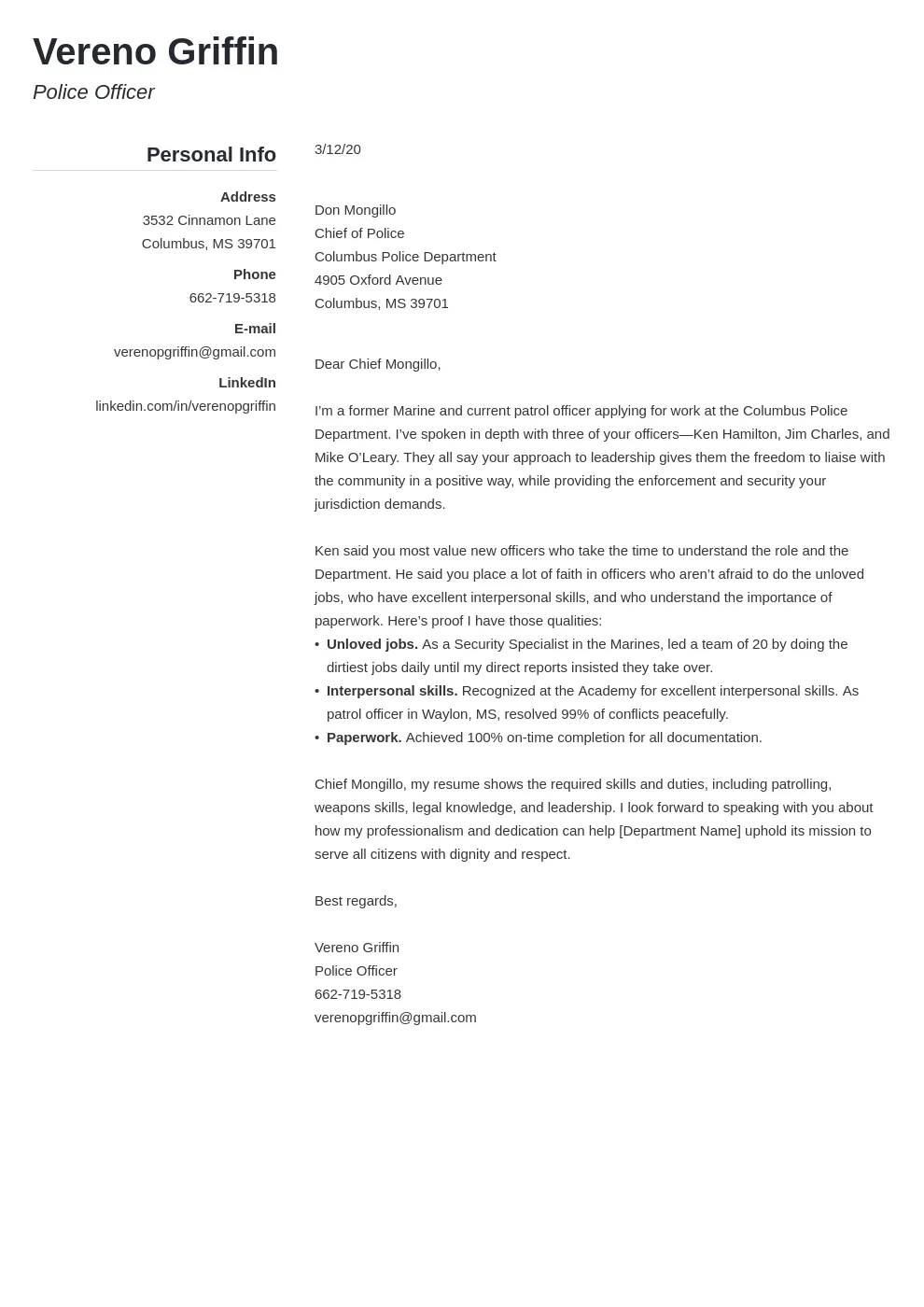
Why You Need a Law Enforcement Resume Cover Letter
In the competitive field of law enforcement, a well-crafted cover letter is not just a formality; it’s a necessity. It serves as your first introduction to the hiring manager, offering you the opportunity to make a compelling case for why you are the ideal candidate. Unlike a resume, which provides a snapshot of your qualifications, a cover letter allows you to elaborate on your skills, experience, and motivations, demonstrating how they align with the specific requirements of the law enforcement agency and the position. Think of it as your personal sales pitch, designed to grab the attention of the hiring manager and compel them to delve deeper into your qualifications by reviewing your resume and, ultimately, inviting you for an interview. A strong law enforcement resume cover letter can set you apart from other candidates by highlighting your personality and passion for the job.
Understanding the Purpose of a Cover Letter
The primary purpose of a cover letter in the context of law enforcement is to provide context to your resume. It’s your chance to explain why you’re interested in the specific agency, what skills you possess that align with their needs, and what makes you a strong candidate. It allows you to showcase your communication skills, attention to detail, and professionalism, all critical qualities for a law enforcement officer. Moreover, a cover letter offers an opportunity to demonstrate your understanding of the agency’s mission, values, and culture. By tailoring your letter to the specific agency and position, you can show that you’ve done your homework and are genuinely interested in joining their team, which can significantly increase your chances of getting noticed.
Key Elements of a Law Enforcement Cover Letter

A compelling law enforcement cover letter consists of several key elements that, when combined, create a persuasive argument for your candidacy. These elements include a clear and concise header with your contact information, a professional and well-formatted layout, a personalized address to the hiring manager, an engaging opening statement, highlighted qualifications, a demonstration of how your skills and experience align with the job requirements, a strong closing with a call to action, and meticulous proofreading. Each element plays a vital role in presenting you as a qualified and enthusiastic candidate. Neglecting any of these components could weaken your application and diminish your chances of securing an interview. It is imperative to tailor each section to match the specific agency and position.
Header and Contact Information
Your header should be at the top of your cover letter and include your full name, address, phone number, and professional email address. Ensure your contact information is accurate and up-to-date. Also, include the date and the hiring manager’s name and title, if known, along with the agency’s address. The header sets the tone of professionalism and makes it easy for the hiring manager to contact you. Make sure your email address is professional-sounding and not something casual or inappropriate, as this is a key component of your first impression. Keep it clean and easy to read, so it is easily scannable.
Professional and Clear Formatting
The formatting of your cover letter speaks volumes about your attention to detail and professionalism. Use a standard font like Times New Roman, Arial, or Calibri, and keep the font size between 11 and 12 points. Maintain consistent margins (typically one inch on all sides) and use single-spacing within paragraphs and double-spacing between paragraphs. The overall layout should be clean, organized, and easy to read. Avoid using excessive bolding, underlining, or italics, as this can distract from the content. A well-formatted cover letter demonstrates that you respect the reader’s time and understand the importance of presenting a polished document, which is crucial in law enforcement where attention to detail is paramount.
Addressing the Hiring Manager

Always address the hiring manager by name, if possible. Research the agency and identify the appropriate person, such as the Police Chief, Human Resources Director, or hiring officer. A personalized greeting, such as “Dear Mr. Smith,” shows that you’ve taken the time to research the agency and are genuinely interested in the position. If you cannot find a specific name, use a professional salutation such as “Dear Hiring Manager” or “To Whom It May Concern.” Avoid generic greetings like “Dear Sir or Madam,” as this can make your letter feel impersonal. Addressing the hiring manager by name demonstrates your initiative and attention to detail, which are valuable qualities in law enforcement.
Opening Statement: Grab Their Attention
Your opening statement should immediately grab the hiring manager’s attention and set the tone for the rest of your cover letter. Briefly state the position you are applying for and where you saw the advertisement. Then, use the opening to express your enthusiasm for the opportunity and highlight a key skill or experience that makes you a strong candidate. For example, you could start by stating your long-standing commitment to serving the community and your interest in joining a specific agency. The opening should be concise, impactful, and tailored to the specific agency and position. This initial impression is essential in determining whether the hiring manager will continue reading.
Highlighting Your Qualifications
The core of your cover letter is dedicated to highlighting your qualifications. This is where you elaborate on your skills, experience, and accomplishments, demonstrating how they align with the requirements of the law enforcement agency and the specific position. Rather than simply repeating your resume, use the cover letter to provide context and depth, explaining how your qualifications make you an exceptional candidate. Focus on the most relevant skills and experiences, providing specific examples and quantifiable achievements whenever possible. Make sure your cover letter clearly conveys why you would be a good fit for the agency, showing you have given careful consideration to their values and mission.
Showcasing Relevant Skills

Identify the key skills that the law enforcement agency is seeking and emphasize how you possess those skills. These may include communication, problem-solving, critical thinking, teamwork, leadership, and the ability to remain calm under pressure. Provide specific examples of how you have demonstrated these skills in past roles or situations. For instance, if the job description emphasizes the ability to effectively communicate with diverse populations, describe a time you successfully mediated a conflict or resolved a difficult situation using your communication skills. Tailor your skill showcase to the agency’s specific needs and values. Demonstrating a clear understanding of the required skills enhances your credibility and shows you are a serious candidate.
Emphasizing Experience
Detail your relevant work experience, focusing on roles and responsibilities that align with the law enforcement position you are seeking. Explain how your past experiences have prepared you for the role, providing specific examples of your accomplishments and contributions. If you have experience in a related field, such as security, military service, or community service, highlight those experiences and explain how the skills and knowledge you gained are transferable to law enforcement. Even if you lack direct law enforcement experience, you can still demonstrate your suitability by highlighting transferable skills and experiences. Focus on leadership, teamwork, problem-solving, and any experience that demonstrates your ability to handle stressful situations and make sound judgments.
Quantifying Your Accomplishments
Whenever possible, quantify your accomplishments to make them more impactful. Use numbers, percentages, or specific data to illustrate your achievements and contributions. For example, instead of saying “Improved team efficiency,” state “Improved team efficiency by 15% through implementing new training protocols.” Quantifying your accomplishments provides concrete evidence of your capabilities and demonstrates your ability to achieve results. Law enforcement agencies value candidates who can demonstrate a track record of success and a commitment to achieving measurable outcomes. Providing specific data makes your accomplishments more credible and allows the hiring manager to see the value you would bring to the agency.
Demonstrating Your Fit for the Role

Show the hiring manager that you have carefully considered the role, the agency’s mission, and its values. Explain why you are interested in joining this specific agency and how your values align with theirs. Research the agency’s mission, community involvement, and any recent initiatives to demonstrate that you are informed and engaged. This demonstrates that you are genuinely interested in the position and the agency. Show that you share the agency’s commitment to community service, public safety, and upholding the law. Making a clear connection between your personal values and the agency’s mission will make your cover letter more compelling and memorable. Ensure your statements are authentic and genuine.
Closing the Cover Letter
Your closing should summarize your key qualifications, reiterate your interest in the position, and include a call to action. This is your final opportunity to make a positive impression and encourage the hiring manager to take the next step. It’s a crucial part of the cover letter. A strong closing can significantly increase your chances of moving forward in the hiring process.
Expressing Enthusiasm
Reiterate your enthusiasm for the opportunity and express your genuine interest in the agency. State that you are excited about the possibility of contributing to their mission and serving the community. This demonstrates your passion for the law enforcement profession and your desire to join their team. Convey your excitement in a professional and sincere manner, showing that you are motivated and eager to make a positive impact. Show the hiring manager that you have a deep interest in their agency and the opportunity to work with them. Sincerity is key when expressing enthusiasm, as the hiring manager can recognize your passion.
Call to Action: Requesting an Interview

End your cover letter with a clear call to action, such as requesting an interview. State that you are eager to discuss your qualifications further and are available for an interview at their earliest convenience. Provide your contact information again, making it easy for the hiring manager to reach you. Also, thank them for their time and consideration. A strong call to action is essential in encouraging the hiring manager to move forward with your application. This shows initiative and demonstrates your confidence in your abilities. It’s the final touch to convey your desire to join the agency.
Proofreading and Editing Your Cover Letter
Before submitting your cover letter, proofread it carefully for any errors in grammar, spelling, punctuation, and formatting. A polished and error-free cover letter demonstrates your attention to detail and professionalism. Read your cover letter aloud to catch any awkward phrasing or grammatical errors. It can be helpful to have someone else review your cover letter, as a fresh pair of eyes can often spot mistakes you might have missed. Ensure the formatting is consistent, the language is clear and concise, and the tone is appropriate for the law enforcement profession. Proofreading is a vital step in ensuring your cover letter makes a positive impression.
Common Mistakes to Avoid
Avoid common mistakes that can weaken your application. These can lead to your cover letter being disregarded, which could decrease your chances of an interview. By avoiding these pitfalls, you can significantly improve your chances of success in the hiring process. Understanding and avoiding these common pitfalls is key.
Overusing Jargon

Avoid using excessive jargon or technical terms that the hiring manager may not understand. While it’s acceptable to use law enforcement terminology, ensure that you explain any complex terms. Keep the language clear, concise, and easy to understand. Using jargon can make your cover letter feel pretentious and could confuse the hiring manager. The goal is to communicate your skills and experience clearly and effectively. Tailor your writing style to match the agency’s tone and values, ensuring you use language appropriate for the law enforcement profession.
Generic Content
Avoid using a generic cover letter template that you send to multiple agencies. Generic cover letters demonstrate a lack of interest and a lack of attention to detail. Tailor your cover letter to each specific agency and position, highlighting your skills and experience that align with their specific needs. Research the agency, understand its mission, and show them why you are specifically interested in joining their team. A personalized cover letter shows the hiring manager that you care about the position and the agency.
Ignoring Instructions
Carefully review the job posting and follow all instructions provided. Some agencies may have specific requirements for the cover letter, such as a specific length or a particular format. Failing to follow instructions demonstrates a lack of attention to detail and can lead to your application being rejected. Pay close attention to every detail and show that you can follow directions. If you have questions, contact the agency for clarification before submitting your application. Show that you are a candidate who can follow directions and be thorough in every aspect of the application process.
Tips for Tailoring Your Cover Letter

Tailoring your cover letter to the specific law enforcement agency and position is critical to demonstrating your interest and qualifications. This demonstrates your initiative, your interest in that particular position, and your ability to adapt. These tips can help you tailor your cover letter effectively.
Researching the Law Enforcement Agency
Before writing your cover letter, research the law enforcement agency thoroughly. Visit their website, read their mission statement, and learn about their community involvement and recent initiatives. Understanding the agency’s values, culture, and priorities will help you tailor your cover letter to align with their specific needs. Showing that you have invested time in learning about the agency demonstrates your genuine interest in joining their team. Use this information to highlight the most relevant skills and experiences. The more you know about the agency, the better you can make your cover letter relevant.
Matching Skills to Job Requirements
Carefully review the job description and identify the key skills, qualifications, and experience that the agency is seeking. Then, tailor your cover letter to highlight how your skills and experience align with those requirements. Use the same keywords and phrases from the job description to demonstrate that you possess the desired qualifications. Provide specific examples of how you have demonstrated these skills in past roles or situations. Matching your skills to the job requirements shows the hiring manager that you understand the position and are a strong fit.
Using Action Verbs
Use action verbs to start your sentences and describe your accomplishments. Action verbs create a sense of energy and make your cover letter more engaging. For example, instead of saying “Responsible for managing evidence,” say “Managed and maintained evidence, ensuring chain of custody.” Using action verbs makes your cover letter more dynamic and helps the hiring manager understand your accomplishments. Consider verbs such as led, supervised, investigated, resolved, and implemented. These verbs are great for bringing your accomplishments to life and leaving a lasting impression on the hiring manager.
Following Up After Submission
Follow up with the hiring manager or the agency’s contact person to reiterate your interest in the position. Send a brief, professional email or make a phone call within a week or two after submitting your application. Thank them for their time and consideration and express your eagerness to learn about the next steps in the hiring process. Following up demonstrates your initiative and your commitment to the position. It also provides an opportunity to clarify any questions or concerns the hiring manager may have. Remember to keep your communication professional and concise. A thoughtful follow-up can sometimes tip the scales in your favor.