Understanding the Importance of a Leasing Agent Cover Letter
In the competitive world of property management, securing your dream job as a leasing agent requires more than just a stellar resume. A well-crafted cover letter is your opportunity to make a lasting first impression, showcasing your personality, skills, and enthusiasm for the role. It’s a crucial tool that can set you apart from other applicants and significantly increase your chances of landing an interview. Many candidates underestimate the value of a cover letter, viewing it as a mere formality, but it’s your chance to tell a story that the resume alone cannot convey. Remember, your cover letter is the first point of contact with a potential employer, and it should be used to your advantage.
Why is a Cover Letter Crucial?
A cover letter serves multiple vital functions in the job application process. Firstly, it allows you to elaborate on your resume, providing context to your achievements and demonstrating how your skills align with the specific requirements of the leasing agent position. Secondly, it’s an avenue to express your passion for the role and the property, showing potential employers that you’re genuinely interested in the opportunity, and not just sending out generic applications. Moreover, a well-written cover letter highlights your communication skills, a critical asset for any leasing agent, who needs to interact effectively with prospective tenants. By demonstrating your ability to write persuasively and professionally, you prove that you possess key skills needed to excel.
Highlighting Your Skills and Experience

Your cover letter is the ideal platform to showcase the skills and experiences that make you an ideal leasing agent candidate. Detail your accomplishments and quantify them whenever possible. Instead of merely stating that you have ’excellent customer service skills’, provide an example: ‘Successfully resolved over 50 tenant inquiries per month, consistently achieving a 95% satisfaction rate.’ Similarly, when highlighting sales abilities, give specific examples such as, ‘Increased property occupancy by 15% in six months through effective marketing and lead conversion strategies.’ This level of detail proves your capabilities and gives potential employers concrete evidence of your abilities. Customize your letter to highlight the experiences and skills that align directly with the job description to make your application more impactful and relevant. (Image: leasing-agent-skills.webp)
Key Components of an Effective Leasing Agent Cover Letter
Formatting and Structure
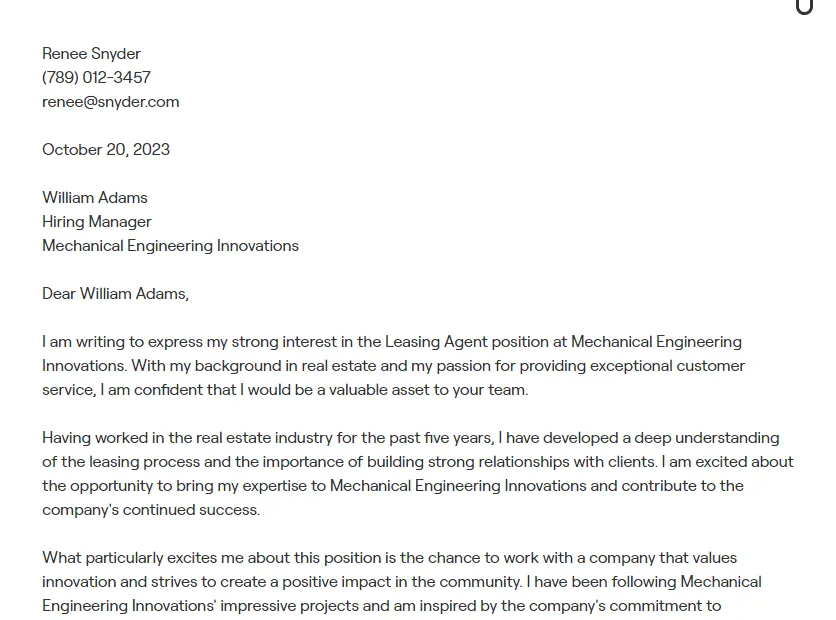
A well-structured cover letter is easier to read and leaves a positive impression on the hiring manager. Maintain a clean and professional format, using a standard font like Times New Roman, Arial, or Calibri, and a font size between 10 and 12 points. The structure should be logical, with clear sections that include an introduction, body paragraphs, and a conclusion. Use single-spacing within paragraphs and double-spacing between paragraphs to ensure readability. Keep the letter concise, aiming for one page, and avoid overly long sentences or complex language. Proper formatting makes your letter professional and helps the reader quickly understand your key qualifications. (Image: leasing-agent-cover-letter-format.webp)
Essential Sections to Include

Header and Contact Information
Start with a professional header that includes your name, address, phone number, and email address. Make sure the email address is professional; avoid using nicknames or informal language. If you’re applying for a specific position, you may include the date and the name and address of the property management company. This information ensures that the hiring manager can quickly identify who the letter is from and how to contact you.
Greeting
Address the hiring manager by name if possible. Research the property management company or check the job posting to find the name of the hiring manager or contact person. Using a specific name shows that you’ve put in the effort to personalize your application, making a better impression than a generic greeting. If the name is unavailable, use a professional greeting like ‘Dear Hiring Manager’ or ‘Dear [Company Name] Hiring Team’. Avoid informal greetings such as ‘To Whom It May Concern’.
Opening Paragraph

The opening paragraph is your chance to grab the reader’s attention. State the position you’re applying for and where you found the job listing. Then, briefly highlight your key qualifications and express your enthusiasm for the role. Make it clear why you’re interested in the specific company and the position. Your opening should set the tone for the rest of the letter, demonstrating your enthusiasm and making the reader want to learn more about you.
Body Paragraphs
The body of your cover letter is where you elaborate on your skills, experiences, and achievements. Use specific examples to demonstrate how you have excelled in previous roles and how these experiences make you a strong fit for the leasing agent position. Highlight skills that are relevant to the job description, such as sales, customer service, communication, and property management software knowledge. Quantify your accomplishments whenever possible by using metrics, such as sales figures, occupancy rates, or customer satisfaction scores. Organize your thoughts logically and focus on the value you can bring to the company.
Closing Paragraph
In the closing paragraph, restate your interest in the position and thank the hiring manager for their time and consideration. Express your eagerness for an interview and mention how you can be contacted. Reiterate your qualifications briefly to reinforce the value you bring to the role. Be professional and courteous; this is your final opportunity to make a positive impression and show your genuine interest. Include a professional closing, such as ‘Sincerely’ or ‘Best regards’, followed by your name and contact information. (Image: leasing-agent-application.webp)
Proofreading and Editing

Proofreading is a critical step that should not be overlooked. Errors in grammar, spelling, and punctuation can undermine your credibility and suggest a lack of attention to detail. Carefully review your cover letter multiple times, preferably after taking a break to refresh your perspective. Consider asking a friend, family member, or career counselor to review it for you. This can help you catch mistakes that you might have missed. Ensure that the language is clear, concise, and professional. A well-written and error-free cover letter is a testament to your professionalism and attention to detail.
Tips for Tailoring Your Cover Letter
Researching the Company
Before you start writing your cover letter, research the property management company and the specific property you’re applying to. Visit their website, read reviews, and look at their social media profiles to gain insights into their values, culture, and any recent achievements. This knowledge will help you tailor your cover letter to address the company’s needs and demonstrate your genuine interest in the role. Understanding the company’s mission, values, and current goals will enable you to emphasize how your skills and experiences align with their needs. Showing that you’ve taken the time to learn about the company will set you apart from other applicants.
Using Keywords

Carefully review the job description and identify the keywords and phrases used to describe the ideal candidate. Incorporate these keywords naturally throughout your cover letter. This helps the hiring manager quickly recognize that you meet the essential requirements of the role. Make sure the keywords fit seamlessly into your writing, maintaining a natural and professional tone. Using relevant keywords can also improve your chances of passing through applicant tracking systems (ATS) used by many companies to screen applications.
Showcasing Achievements
Instead of simply listing your responsibilities, highlight your achievements and quantify them with specific data. For example, instead of saying ‘Managed property showings,’ say ‘Managed over 50 property showings per week, resulting in a 20% increase in lease applications.’ Use the STAR method (Situation, Task, Action, Result) to structure your examples: describe the situation, outline the task you needed to complete, explain the action you took, and detail the results of your efforts. Highlighting your accomplishments is an effective way to demonstrate your value to a potential employer and illustrate your ability to perform successfully in the role. (Image: leasing-agent-achievements.webp)
Common Mistakes to Avoid
Generic Content

Avoid using a generic, one-size-fits-all cover letter. Tailor each cover letter to the specific job and company you’re applying for. Generic content shows a lack of interest and effort and can be quickly dismissed by hiring managers. Show that you have taken the time to understand the company’s needs and have the specific skills required for the position. Personalize the content to showcase your skills and enthusiasm for the role, demonstrating that you are serious about the opportunity and are interested in working for the company.
Typos and Grammatical Errors
Carelessly written cover letters riddled with typos and grammatical errors give a negative impression. Always proofread your cover letter thoroughly before submitting it. Use a spell checker, but don’t rely solely on it; often, these tools can miss subtle errors. Ensure that your writing is clear, concise, and professional. Having a friend or career counselor review your cover letter can also help you catch mistakes that you might have missed. (Image: leasing-agent-mistakes.webp)
Focusing Solely on Your Needs
A cover letter is not just about what you want; it’s about what you can offer the employer. Avoid solely focusing on your needs, such as the desire for a new job, and instead emphasize the value you can bring to the company. Highlight how your skills and experiences align with the job description and how you can contribute to the company’s success. Show that you understand the company’s needs and goals. By showing a focus on what you can offer, you demonstrate that you are a valuable asset to the team, enhancing your chances of securing the position.
Examples of Strong Leasing Agent Cover Letter Phrases
Highlighting Sales and Closing Skills
When highlighting your sales and closing skills, use phrases that clearly demonstrate your abilities. For example, instead of saying you have ‘sales experience,’ you could say ‘Proven ability to consistently exceed sales targets and close deals.’ Other effective phrases include ‘Expert in identifying and qualifying leads,’ ‘Skilled in negotiating lease terms to maximize revenue,’ and ‘Proficient in creating and implementing successful marketing strategies.’ These phrases show that you have experience, and can bring results.
Demonstrating Customer Service Abilities
Excellent customer service skills are crucial for a leasing agent. Use phrases that showcase your ability to provide outstanding customer service. Consider phrases such as ‘Dedicated to providing exceptional customer service,’ ‘Expert in resolving tenant issues efficiently and effectively,’ and ‘Proven ability to build rapport and maintain positive relationships with tenants.’ Use your experiences and describe how you consistently go above and beyond to meet the needs of tenants and ensure their satisfaction. (Image: leasing-agent-customer-service.webp)
Showcasing Property Management Knowledge
Demonstrate your property management knowledge by using relevant phrases. For instance, mention your experience with property management software, such as Yardi or Rent Manager, or say, ‘Knowledgeable in property maintenance and lease enforcement.’ You can also state, ‘Experience in managing lease renewals and move-in/move-out processes.’ Highlighting your experience with these aspects of property management will make your cover letter stand out.
Finalizing and Submitting Your Cover Letter
Reviewing and Refining
Before submitting your cover letter, thoroughly review and refine it. Ensure that it’s free of errors and that the content is compelling and relevant to the job. Check for any inconsistencies and confirm the format and structure are clear and professional. Seek feedback from a trusted colleague or career counselor. A well-reviewed and refined cover letter boosts your chances of capturing the hiring manager’s attention and securing an interview.
Submitting Your Application
When submitting your application, make sure you follow the instructions provided in the job posting. Some companies prefer applications via email, while others use online application systems. Include your cover letter and resume as attachments, and name the files clearly, for example, ‘Your Name - Cover Letter.pdf’ and ‘Your Name - Resume.pdf’. Ensure your contact information is current and correct, and be mindful of the submission deadline. Following these steps correctly will make your application more likely to be considered and increase your chances of landing an interview. (Image: leasing-agent-cover-letter-header.webp)