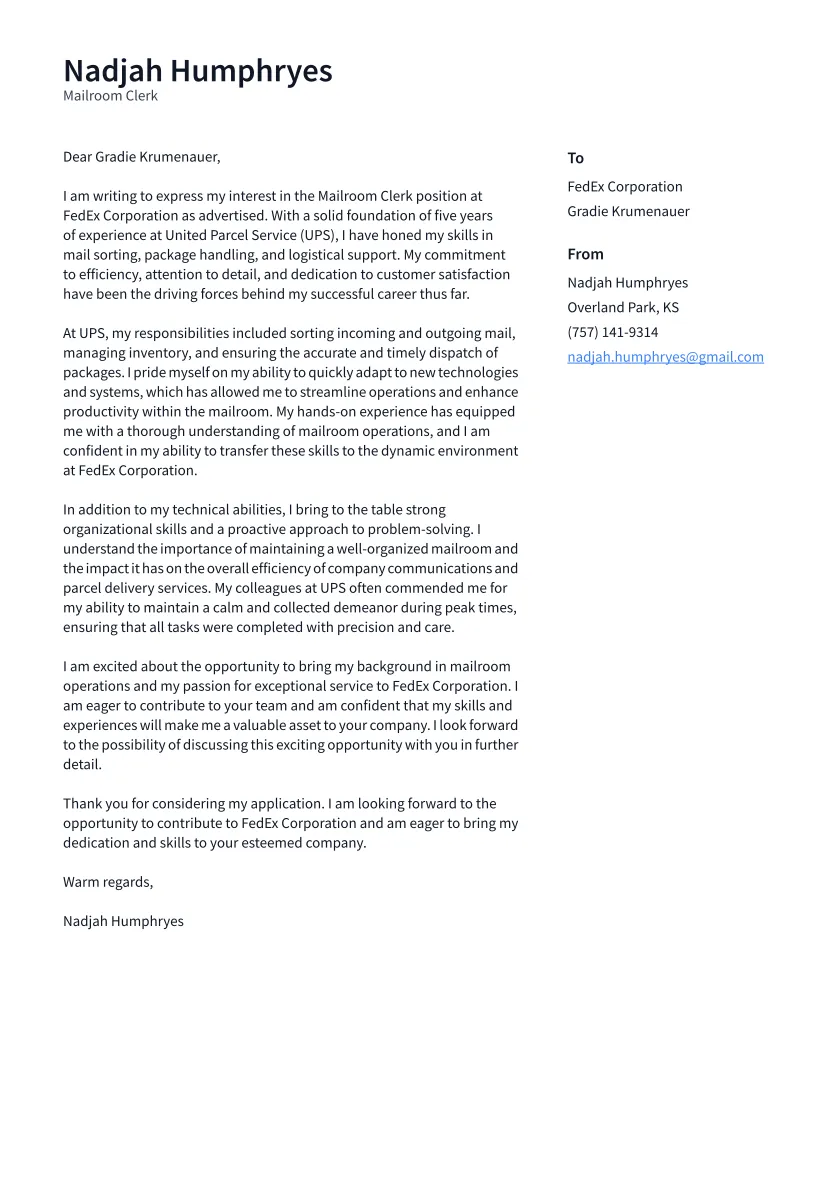
Crafting a Winning Mailroom Clerk Cover Letter
A well-crafted mailroom clerk cover letter is your first opportunity to make a positive impression on a potential employer. It is a vital tool in your job search arsenal, serving as a formal introduction and a chance to highlight your qualifications, experience, and enthusiasm for the role. Unlike a resume, which provides a factual overview of your background, a cover letter allows you to explain why you’re the perfect fit for the specific position and company. It allows you to showcase your personality, communication skills, and understanding of the mailroom clerk role. By taking the time to create a compelling cover letter, you significantly increase your chances of landing an interview and ultimately securing the job. The goal is to make the hiring manager want to read your resume and learn more about you.
Understanding the Mailroom Clerk Role
Before you even begin writing your cover letter, it’s crucial to understand the responsibilities and requirements of a mailroom clerk. This understanding will enable you to tailor your letter to the specific needs of the employer. Researching the role involves more than just a quick Google search; it means delving into the typical duties, required skills, and the work environment associated with the position. This knowledge provides you with the foundation needed to effectively market yourself as a suitable candidate. This also helps you speak the language of the employer. Understanding the intricacies of the job helps you frame your skills and experience to directly address the employer’s needs and expectations.
Key Responsibilities of a Mailroom Clerk

Mailroom clerks are the gatekeepers of communication within an organization. Their daily tasks include receiving, sorting, distributing, and delivering incoming and outgoing mail and packages. This involves a range of activities, from operating mail processing equipment to maintaining accurate records of mail flow. Additionally, mailroom clerks are often responsible for preparing outgoing mail, which can include weighing packages, applying postage, and ensuring proper addressing. Other typical duties might encompass managing office supplies, assisting with administrative tasks, and maintaining a clean and organized mailroom environment. The ability to handle these responsibilities efficiently and accurately is key to success in this role, and your cover letter should reflect your competence in these areas. Consider including information that you have experience in tracking packages, using postage equipment, and following protocols.
Essential Skills for Mailroom Clerk Success
While specific job requirements vary, certain skills are essential for excelling as a mailroom clerk. Attention to detail is paramount to accurately sort and deliver mail. Organizational skills are also critical for managing the flow of mail efficiently and maintaining an organized work environment. Communication skills, both written and verbal, are important for interacting with colleagues and external parties. Moreover, physical stamina and the ability to lift and move packages are often necessary. Proficiency in basic computer skills is increasingly important, given the need to use mail processing software and track packages. Highlighting these skills, backed by specific examples, will demonstrate your readiness to succeed in the role, showcasing your understanding of what makes a mailroom function efficiently.
Highlighting Your Qualifications
Your cover letter is your chance to shine a light on the qualifications that make you the ideal candidate. This is where you show potential employers why you stand out from other applicants. This is not a mere summary of your resume, but a chance to provide context and demonstrate how your skills and experience align with the job’s specific requirements. By using strategic language and concrete examples, you can effectively communicate your suitability for the role and leave a lasting positive impression. This section allows you to show your knowledge of the company. Be sure to use keywords from the job description.
Showcasing Relevant Experience

When detailing your work experience, go beyond listing your past jobs. Instead, focus on the responsibilities you held that are most relevant to a mailroom clerk position. Provide specific examples of how you handled tasks like sorting mail, managing packages, and using mail processing equipment. If you’ve worked in a mailroom before, highlight your knowledge of postal regulations and procedures. Even if your experience isn’t directly related to mailroom work, identify transferable skills, such as organizational skills, attention to detail, and customer service experience. Show how these skills align with the needs of the role and underscore your ability to perform the required duties effectively. Try to use the STAR method: Situation, Task, Action, Result.
Quantifying Achievements in Your Cover Letter
Quantifying your achievements makes your cover letter more impactful and demonstrates the value you can bring to the role. Whenever possible, use numbers and data to illustrate your accomplishments. Instead of simply stating that you “managed mail efficiently,” you could say, “Processed an average of 500 pieces of mail daily with 99% accuracy.” If you improved any processes in a previous role, mention the changes you made and the results. For example, “Implemented a new sorting system that reduced delivery time by 15%.” These specific examples will make your qualifications more concrete and help the hiring manager understand the tangible benefits of hiring you.
Tailoring Your Cover Letter
Generic cover letters are easily spotted and are unlikely to impress hiring managers. Customize each cover letter you send to align with the specific job description and the company’s needs. This demonstrates that you have taken the time to understand the role and are genuinely interested in the opportunity. Researching the company and the role before writing your letter is crucial. Identify the key skills and qualifications the employer is seeking, and then tailor your letter to highlight how your experience and abilities match those requirements. This will make your application more relevant and increase your chances of getting an interview.
Researching the Company and Job Requirements

Before writing your cover letter, research the company and the specific job requirements. Visit the company’s website, read news articles about the organization, and check their social media presence. Understanding the company’s mission, values, and culture can help you tailor your letter to resonate with the hiring manager. Carefully review the job description, noting the key skills, experience, and qualifications the employer is seeking. Incorporate these keywords and phrases into your cover letter to demonstrate that you are a good fit. If you’re applying for a mailroom clerk position in a tech company, the language used in the job description is likely different than a mailroom clerk position in a law office. Tailoring helps you speak their language.
Matching Skills and Experience to the Job Description
The core of a successful cover letter is a clear connection between your skills, experience, and the requirements listed in the job description. Carefully compare your skills and experiences to the essential qualifications outlined by the employer. Identify how your skills align with the job description and provide specific examples of how you have demonstrated those skills in the past. For instance, if the job description mentions the need for someone with strong organizational skills, you could describe your experience in organizing mail, maintaining records, or implementing efficient filing systems. By showing a direct connection between your abilities and the job requirements, you demonstrate that you understand the role and have the capabilities to excel in it.
Formatting and Structure for Impact
The structure and format of your cover letter can significantly impact the reader’s perception. A well-formatted letter is easy to read and conveys professionalism. Follow a standard business letter format with the correct use of headings, paragraphs, and spacing. Keep the tone of your cover letter professional and formal. Use clear and concise language, avoiding jargon and slang. Proofread your cover letter carefully to eliminate any errors in grammar or spelling. A polished and well-structured cover letter will show the hiring manager that you can communicate effectively and pay attention to detail.
Effective Opening Paragraphs

Your opening paragraph is your first and often only chance to grab the reader’s attention. It should be concise, engaging, and clearly state the purpose of your letter—to apply for the mailroom clerk position. Start by mentioning the specific job you’re applying for and where you saw the job posting. Briefly state your key qualifications or the skills that make you a good fit for the role. If you know someone at the company, mention their name and how you know them. Aim to create immediate interest by demonstrating your enthusiasm for the position and the company. The opening paragraph is essential to create a positive first impression. Make it count.
Writing a Compelling Body
The body of your cover letter should expand on the key points you made in your opening paragraph. Provide specific examples that highlight your relevant skills and experience. Use the STAR method (Situation, Task, Action, Result) to structure your examples, clearly illustrating your actions and the positive outcomes you achieved. Be sure to match your skills and experiences to the specific requirements listed in the job description. Avoid repeating your resume word-for-word; instead, use the body to provide context and explain how your skills will benefit the company. Keep each paragraph focused, and use strong action verbs to describe your accomplishments.
Creating a Strong Closing
Your closing paragraph should leave the hiring manager with a clear understanding of your interest and qualifications. Reiterate your enthusiasm for the position and the company. Summarize your key strengths and reiterate your suitability for the role. Express your interest in an interview and state how you can be reached. Thank the hiring manager for their time and consideration. Make sure your closing paragraph conveys your professionalism and your eagerness to move forward in the hiring process. A well-crafted closing paragraph leaves the reader with a positive and lasting impression.
Proofreading and Editing Your Cover Letter

Even a perfectly written cover letter can be undermined by errors in grammar, spelling, or punctuation. Proofreading and editing your cover letter is therefore an essential step in the application process. Take the time to read through your letter carefully, looking for any mistakes. It can be helpful to read it aloud, as this can help you catch errors that you might miss when reading silently. It is also very important to make sure that your grammar and spelling are correct. Typos and grammatical errors can create a negative impression and undermine your credibility. By proofreading and editing your cover letter, you can ensure that it presents you in the best possible light.
Common Mistakes to Avoid
Certain mistakes can immediately disqualify a candidate, no matter how qualified they may be. Avoid generic cover letters that fail to address the specific requirements of the job or the company. Don’t include information that is irrelevant or that makes you appear unprofessional. Ensure you have a compelling opening, body and closing. Avoid using jargon and slang. Never lie or exaggerate your experience; be truthful. Always ensure your cover letter is original. Proofread carefully, checking for any errors in grammar, spelling, or punctuation. These mistakes can easily damage your credibility and prevent you from getting hired.
Seeking Feedback for Improvement
After you’ve written your cover letter, ask someone you trust to review it and provide feedback. A fresh set of eyes can often catch mistakes or suggest improvements that you may have missed. Ask a friend, family member, or career counselor to read your letter and provide constructive criticism. They can assess your grammar and clarity. Consider the feedback carefully and make any necessary revisions. It’s a worthwhile step in the process, helping you to refine your cover letter and increase your chances of making a positive impression on potential employers. Seeking feedback ensures that your cover letter is the best it can possibly be.