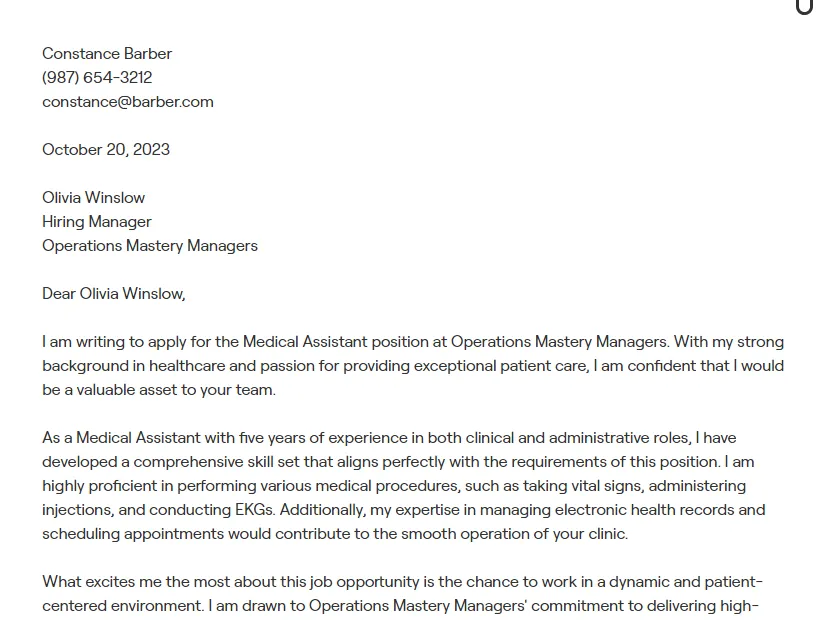
What is a Medical Assistant Cover Letter?
A medical assistant cover letter is a professional document that accompanies your resume when applying for a medical assistant position. It serves as your introduction to a potential employer, providing a concise overview of your skills, experience, and qualifications. Unlike a resume, which is a factual summary, a cover letter allows you to showcase your personality, express your interest in the specific role and company, and highlight the aspects of your background that make you a strong candidate. It is a crucial tool in making a positive first impression and persuading the hiring manager to review your resume in detail. Think of it as your personal sales pitch, designed to capture the employer’s attention and secure an interview.
Why is a Medical Assistant Cover Letter Important?
A well-crafted medical assistant cover letter is important for several reasons. Firstly, it demonstrates your professionalism and attention to detail, key attributes employers seek in healthcare professionals. Secondly, it provides an opportunity to personalize your application and show genuine interest in the position and the clinic or hospital. Thirdly, it allows you to elaborate on your skills and experiences, providing context and examples that might not fit within the constraints of your resume. Finally, a compelling cover letter can differentiate you from other applicants, especially in a competitive job market. It shows that you are not just submitting a resume, but actively pursuing the opportunity and are prepared to invest time and effort into the application process. Ignoring this step can be a missed opportunity to make a memorable impact.
How to Write a Medical Assistant Cover Letter

Writing an effective medical assistant cover letter involves several key components. The structure of your letter should be clear and concise. The tone should be professional, and the language should be free of errors. The content of your letter should be tailored to the specific job description and the needs of the employer. By following a few simple guidelines, you can create a cover letter that gets noticed and increases your chances of landing an interview. Remember to always proofread your letter carefully before submitting it. Let’s explore the core components of a Medical Assistant Cover Letter.
Header Information
The header of your cover letter should include your contact information and the date. Start with your full name, address, phone number, and email address. This information should be clearly presented, usually at the top left or right corner of the document. Next, leave a space and then include the date you are writing the letter. Ensure the date is formatted correctly. Having correct header information is the first step to make a professional first impression. Make sure to review it before submitting the cover letter.
Applicant Contact Information
Your contact information includes your full name, address, phone number, and a professional email address. This information should be accurate and up-to-date. Double-check that your phone number is correct, and your email address is professional (avoid nicknames or unprofessional email handles). The applicant contact information is placed at the top of the letter, often flush left or right. This makes it easy for the hiring manager to quickly find your contact details if they are interested in contacting you.
Date

The date of the cover letter is crucial as it provides context and shows when the application was submitted. The date is usually placed below your contact information and is aligned to the left or right. Ensure the date format is consistent with the standard practices of the country you are applying in. This simple detail can communicate professionalism and accuracy, vital traits for a medical assistant.
Employer Contact Information
Below the date, you should include the employer’s contact information. This usually includes the name of the hiring manager (if known), their title, the name of the clinic or hospital, and the address. If you don’t know the hiring manager’s name, you can use a general salutation like “Dear Hiring Manager.” This demonstrates that you’ve researched the company and are paying attention to detail. This information is usually left-aligned and helps the reader easily identify to whom the letter is addressed.
Salutation
The salutation is your greeting. Use a professional salutation such as “Dear Mr./Ms./Mx. [Last Name],” if you know the hiring manager’s name. If the name is not available, use “Dear Hiring Manager,” or “Dear [Department Name] Team.” Avoid generic greetings like “To Whom It May Concern.” A personalized salutation immediately makes a positive impression and shows you’ve done your research. Always ensure that you spell the name correctly.
Body Paragraphs

The body of your cover letter is where you highlight your skills, experience, and interest in the medical assistant position. The body is typically divided into three or four paragraphs. Each paragraph should have a clear purpose and support your overall goal of securing an interview. The body paragraphs should demonstrate your value to the employer and explain why you are the best fit for the role. Remember to be concise, specific, and enthusiastic throughout these paragraphs. Your main purpose is to show you meet the required criteria.
First Paragraph Purpose
The first paragraph should state the position you’re applying for and how you learned about the opportunity. Express your interest in the position and the company. Briefly mention your key qualifications or the skills that make you a strong candidate. Your goal is to capture the reader’s attention from the beginning. Keep it concise, enthusiastic, and specific. This initial statement sets the tone for the rest of the letter and encourages the hiring manager to read further. Avoid generic phrases and instead, focus on why you are specifically interested in this role and this organization.
Expressing your interest and stating the position
Clearly state the specific medical assistant position you are applying for. Mention where you saw the job posting (e.g., company website, job board). Express your enthusiasm for the opportunity. Your interest should be genuine and relevant to the job description. A good way to start this section is by writing directly to the person who is reading your application; be genuine and show how excited you are to contribute your skills to the workplace.
Second Paragraph Purpose

The second paragraph is where you highlight your relevant skills and experience. Focus on the qualifications that align with the job requirements. Provide specific examples from your past experiences to demonstrate your abilities. Quantify your accomplishments whenever possible (e.g., “Managed a patient load of 30+ per day”). Show how your skills and experience have prepared you for the role and why you are a good fit for the clinic or hospital. This paragraph is the core of your cover letter, where you prove your value to the employer.
Highlighting relevant skills and experience
This section should showcase your most relevant skills and experiences. Focus on the skills mentioned in the job description. Use examples from your previous jobs or experiences to illustrate your abilities. For instance, if the job requires experience with electronic health records (EHR) systems, mention your proficiency with specific software and describe how you used it effectively. Quantify your achievements whenever possible. This section should demonstrate your ability to succeed in the role.
Third Paragraph Purpose
In the third paragraph, you can mention your qualifications and achievements that support your application. This could include certifications, licenses, or specific skills relevant to the role. Mention any awards or recognitions you have received. Briefly explain how your qualifications align with the needs of the employer. This paragraph serves to reinforce your suitability for the position and highlights the value you bring to the table. Provide a compelling reason for the employer to hire you and convince them to call you for an interview.
Mentioning qualifications and achievements

This section should provide a clear summary of your qualifications. List relevant certifications (e.g., Certified Medical Assistant), licenses, or specialized training. Briefly describe your most significant accomplishments. Tailor this information to match the requirements of the job. Emphasize how your qualifications and achievements demonstrate your ability to perform the job effectively and contribute to the organization’s success. Make your achievements easy to understand and easy to follow to capture the reader’s attention.
Call to Action
In the final paragraph, include a call to action. Express your enthusiasm for the opportunity and reiterate your interest in the position. Thank the reader for their time and consideration. State your availability for an interview and how they can contact you. Make it easy for the employer to take the next step. This paragraph is very important as it is where you make an impression. Your goal is to have them feel like you’re already part of their company.
Closing Paragraph Purpose
The closing paragraph should reiterate your interest and enthusiasm. Thank the hiring manager for considering your application. Include a call to action, such as inviting them to contact you for an interview. Express your confidence in your ability to contribute to the organization. It should be professional, confident, and leave a positive final impression. Always express your gratitude and provide contact information.
Complimentary Close and Signature

End your cover letter with a professional closing, such as “Sincerely,” “Best regards,” or “Thank you.” Leave space for your signature (if printing and mailing) and then type your full name below. If submitting electronically, you can simply type your name. Ensure your signature is clear and legible. A professional closing adds a final touch of professionalism to your cover letter. A good signature will provide a sense of confidence and professionalism in your written application.
Top 5 Medical Assistant Cover Letter Samples
Here are five samples, each highlighting different aspects of a medical assistant’s skills and experience. These samples are designed to give you a starting point for your own cover letter and to show you how to tailor your letter to different situations. Remember to customize these templates to reflect your unique qualifications and the specific requirements of the job you are applying for. Use these samples as inspiration and a guide to creating a cover letter that will impress potential employers.
Sample Cover Letter 1 Emphasizing Clinical Skills
This sample focuses on clinical skills like taking vital signs, assisting with examinations, and administering medications. It highlights experience with specific medical procedures and equipment. This type of letter is ideal for positions that heavily emphasize direct patient care and require a strong clinical background. This sample ensures that your clinical skills are recognized and appreciated, making it easy for the employer to hire you.
Sample Cover Letter 2 Highlighting Patient Care

This sample emphasizes your ability to provide excellent patient care, including communication skills, empathy, and patient education. It also showcases your ability to create a welcoming and supportive environment. This is an excellent sample to use when applying to a clinic or hospital where patient satisfaction is a top priority. This type of cover letter is important, as you are letting the employer know your interest in the medical field and your commitment to helping others.
Sample Cover Letter 3 Showing Organizational Skills
This sample demonstrates organizational skills, such as scheduling appointments, managing patient records, and handling administrative tasks. It focuses on efficiency, accuracy, and the ability to multitask. This type of cover letter is well-suited for positions that involve significant administrative responsibilities, highlighting your ability to maintain a smooth and organized office environment. A cover letter with organizational skills will make it easy for the company to know you can handle various tasks at once.
Sample Cover Letter 4 Focusing on Teamwork
This sample highlights your teamwork skills, communication abilities, and collaboration skills. It also emphasizes your ability to work effectively with physicians, nurses, and other staff members. This sample is important as employers value teamwork and are often looking for team players. A good team player will communicate effectively and work well with others; this cover letter will make the employer feel confident that they have found the right candidate.
Sample Cover Letter 5 Detailing Medical Terminology Proficiency
This sample highlights your proficiency in medical terminology, including your ability to understand medical reports, communicate effectively with physicians, and maintain accurate medical records. A cover letter that highlights your medical terminology proficiency is ideal for positions that require a strong understanding of medical language. This is very important, as medical terminology is used daily in medical settings. A solid grasp of medical language will help employers.
Key Skills to Include in Your Cover Letter
When writing your cover letter, include relevant skills that match the job description. Be sure to provide specific examples and quantifiable results whenever possible. The most important skills for a medical assistant include clinical, administrative, and soft skills. Customize your letter to highlight those skills most relevant to the specific job. This will increase your chances of impressing the hiring manager and securing an interview. A good cover letter highlights the skills that are most important in your field of work.
Clinical Skills
Clinical skills are crucial for medical assistants. Highlight your experience with taking vital signs, assisting with examinations, administering medications, and performing basic lab procedures. Mention any certifications or training you have in specific medical procedures. Your goal is to convey that you are competent and capable of providing excellent patient care. Emphasize any experience with electronic health records (EHR) systems and medical equipment. Include skills that show your willingness to provide care. Emphasize your skill in a variety of medical procedures and in providing patient care.
Administrative Skills
Administrative skills are essential for maintaining a smooth and efficient office environment. Emphasize your experience with scheduling appointments, managing patient records, handling insurance claims, and processing billing. Highlight your ability to multitask, prioritize tasks, and communicate effectively with patients and other staff. Include any experience with medical software or administrative systems. These skills show that you can handle the administrative aspects of the job, which will support your clinical colleagues. Your organizational skills will play a very important role in your day-to-day medical setting.
Soft Skills
Soft skills are interpersonal and essential for success in healthcare. Highlight your communication, empathy, and problem-solving skills. Mention your ability to work effectively in a team, provide excellent patient care, and maintain a positive attitude. Provide examples of how you have demonstrated these skills in the past. Soft skills are important because they will demonstrate that you are a people person and that you can deal with stressful situations professionally. Showcase your ability to build rapport with patients and create a supportive environment. Emphasize your teamwork abilities.
Formatting Tips for Your Cover Letter
Proper formatting makes your cover letter easy to read and professional. Ensure your cover letter is well-organized, with clear headings and paragraphs. Use a professional font, appropriate font size, and consistent spacing. Proofread your letter carefully for errors in grammar, spelling, and punctuation. Make sure your formatting is consistent throughout the document. Pay attention to your formatting so that your cover letter is easy to read, and your message is clear. Use appropriate spacing and paragraphing to make your cover letter easy to review.
Font Selection
Choose a professional and readable font, such as Times New Roman, Arial, or Calibri. Avoid using unusual or decorative fonts that might be difficult to read. Stick to a font size between 10 and 12 points for the body of your text. Use a font that is easy on the eyes and projects a sense of professionalism. A good font will help in ensuring the hiring manager can clearly read your cover letter.
Font Size and Spacing
Use a font size between 10 and 12 points for the body of your cover letter. Use 1-inch margins on all sides of the page. Single-space the text within paragraphs, but double-space between paragraphs. This ensures your cover letter is easy to read and looks clean and organized. Proper spacing improves readability. Choose a font that is easy on the eyes.
Proofreading and Editing Your Cover Letter
Proofread your cover letter carefully for any errors in grammar, spelling, and punctuation. Ask a friend or family member to review your letter as well. Errors can detract from your professionalism and make a negative impression on the hiring manager. Make sure all the information is correct, and that the language is appropriate. Proofreading is extremely important as it shows your attention to detail. Proofreading can also help in finding any information that should be removed. Take your time when proofreading.