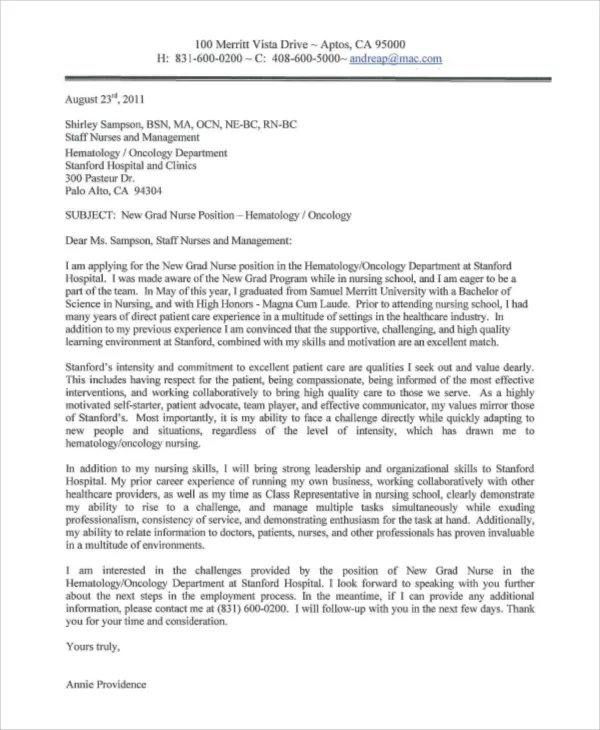
What is a Cover Letter and Why Does it Matter
A cover letter is your first introduction to a potential employer, acting as a crucial supplement to your resume. It’s your chance to showcase your personality, passion for nursing, and suitability for the specific role. Unlike a resume, which provides a snapshot of your qualifications, a cover letter allows you to tell a story. It explains why you’re interested in the position, how your skills and experiences align with the job requirements, and what you can bring to the team. For new grad nurses, a well-crafted cover letter is especially important, as it provides context to your limited clinical experience. It allows you to highlight your education, clinical rotations, and any relevant volunteer or extracurricular activities, demonstrating your eagerness to learn and grow in the profession. A strong cover letter can significantly increase your chances of landing an interview, making it a vital component of your job application.
Cover Letter Essentials for New Grad Nurses
Creating a compelling cover letter requires careful consideration of several key elements. First, personalize your letter to the specific job and employer. Generic cover letters are easily identifiable and can be detrimental to your application. Second, highlight your relevant skills and experiences, even if they are limited. Emphasize your clinical rotations, coursework, and any volunteer work that demonstrates your commitment to patient care and your understanding of the nursing profession. Third, showcase your personality and passion for nursing. Let your enthusiasm shine through, demonstrating your eagerness to learn and contribute to the team. Fourth, tailor your letter to the specific requirements of the job description. Carefully review the job posting and identify the key skills and qualifications the employer is seeking. Finally, proofread your letter meticulously for any typos or grammatical errors. A polished and error-free cover letter demonstrates your attention to detail and professionalism.
Highlighting Your Education and Skills

As a new grad nurse, your education is your most significant asset. In your cover letter, emphasize your nursing degree and any relevant coursework or specializations. For example, if you have experience in a specific area, such as medical-surgical nursing or critical care, be sure to highlight it. If you’ve completed clinical rotations in the same specialty as the job you’re applying for, mention that as well. List any certifications or licenses you’ve obtained, such as BLS or ACLS, as these are essential for many nursing roles. Consider mentioning any academic achievements, such as honors or awards, that demonstrate your dedication to learning and your strong academic performance. Highlight any simulation experiences or case studies you participated in, as these can demonstrate your ability to apply theoretical knowledge to real-world clinical scenarios.
Focusing on Clinical Experience
While your clinical experience may be limited, it’s crucial to highlight it effectively in your cover letter. Describe your clinical rotations, emphasizing the settings, patient populations, and procedures you performed. For each rotation, provide specific examples of your accomplishments and contributions. Did you assist with complex procedures, administer medications, or provide patient education? Did you receive positive feedback from preceptors or patients? Quantify your accomplishments whenever possible. For instance, you might say you “assisted with the care of an average of 10 patients per shift.” If you took on any leadership roles during your clinical rotations, such as charge nurse or team lead, be sure to mention those, as they demonstrate your leadership potential and ability to manage patient care.
Showcasing Relevant Skills
Nursing requires a diverse skill set, so highlight the skills that are most relevant to the job you’re applying for. Refer to the job description and identify the key skills the employer is seeking. These might include skills in areas such as patient assessment, medication administration, wound care, electronic charting, and communication. Provide specific examples of how you’ve demonstrated these skills in your clinical rotations or other relevant experiences. If you’re proficient in any specific medical software or equipment, be sure to mention it. Use action verbs to describe your skills, such as “assessed,” “administered,” “managed,” and “educated.” Tailor your skills section to align with the specific requirements of the job, showcasing your ability to perform the duties and responsibilities outlined in the job description.
Emphasizing Soft Skills

In addition to clinical skills, employers are looking for nurses with strong soft skills. These include communication, teamwork, critical thinking, problem-solving, empathy, and time management. In your cover letter, provide examples of how you’ve demonstrated these skills in your clinical rotations or other experiences. For instance, describe how you effectively communicated with patients and their families, collaborated with other healthcare professionals, or resolved a challenging patient situation. Explain how you used critical thinking to assess a patient’s condition, identify potential problems, and develop a plan of care. Showcase your empathy by describing how you provided emotional support to patients and their families during difficult times. Soft skills are essential for providing high-quality patient care and contributing to a positive work environment.
Tailoring Your Cover Letter for Each Application
One of the most common mistakes new grad nurses make is submitting a generic cover letter. Tailoring your cover letter to each job application is crucial for demonstrating your genuine interest in the specific role and employer. Carefully review the job description and identify the key requirements, skills, and qualifications the employer is seeking. Research the hospital or clinic and learn about its mission, values, and patient care philosophy. Use this information to personalize your cover letter, highlighting how your skills and experiences align with the employer’s needs and values. Mention specific programs, initiatives, or departments that interest you. This shows that you’ve taken the time to understand the organization and are genuinely interested in joining their team. Customizing your cover letter demonstrates that you’re not just sending out a mass application, but that you’re taking a thoughtful and strategic approach to your job search.
Researching the Hospital or Clinic
Before writing your cover letter, research the hospital or clinic to understand its mission, values, and patient care philosophy. Visit their website, read their mission statement, and explore any information they provide about their nursing department. Learn about their specialties, awards, and any innovative programs they offer. This information will help you tailor your cover letter to their specific needs and values. For example, if the hospital emphasizes patient-centered care, you can highlight your experience providing compassionate and individualized care to patients. If they are known for their advanced technology, you can mention your experience with electronic charting systems. By researching the hospital or clinic, you can demonstrate your genuine interest and your understanding of their specific requirements, which can significantly increase your chances of getting an interview. This also helps you assess if the organization aligns with your career goals.
Matching Skills to Job Requirements

The job description is your roadmap to success in creating a compelling cover letter. Analyze it carefully to identify the key skills, qualifications, and experiences the employer is seeking. Use these keywords and phrases throughout your cover letter, demonstrating how your skills and experiences align with the job requirements. Provide specific examples of how you’ve demonstrated these skills in your clinical rotations or other relevant experiences. Don’t just list your skills; show how you’ve applied them in practice. For instance, if the job description mentions a need for someone with strong communication skills, describe a time when you effectively communicated with a patient, family member, or other healthcare professional. By directly addressing the job requirements, you can show the hiring manager that you possess the skills and qualifications they are looking for and that you are the best candidate for the position.
Writing a Compelling Opening
The opening paragraph of your cover letter is your first opportunity to capture the hiring manager’s attention. Make it strong and memorable. Start by stating the position you’re applying for and where you saw the job posting. Then, briefly express your interest in the position and the organization. Highlight your enthusiasm for the role and your understanding of the organization’s mission or values. Consider including a brief statement that grabs their attention. For example, you could mention a specific skill, accomplishment, or experience that aligns with the job requirements. Avoid generic opening lines like “I am writing to express my interest…” Instead, aim for a more engaging and personalized approach. The goal is to make the hiring manager want to read more and learn about your qualifications and passion for nursing.
Crafting a Strong Body Paragraph
The body paragraphs are where you provide the details to support your claims. Use these paragraphs to showcase your skills, experiences, and qualifications in more depth. Focus on the key requirements outlined in the job description and provide specific examples of how you’ve demonstrated those skills. Use the STAR method (Situation, Task, Action, Result) to structure your responses. Describe the situation you were in, the task you were assigned, the actions you took, and the results you achieved. Quantify your accomplishments whenever possible. For example, instead of saying, “I provided excellent patient care,” say, “I consistently maintained a high level of patient satisfaction, as evidenced by positive feedback from patients and their families.” Tailor the content of the body paragraphs to the specific needs of the job and highlight your most relevant experiences. The body paragraphs are your chance to convince the hiring manager that you are the ideal candidate for the position.
Writing a Powerful Closing

The closing paragraph is your last chance to leave a lasting impression on the hiring manager. Summarize your key qualifications and reiterate your interest in the position. Express your enthusiasm for the opportunity to learn more about the role and the organization. Clearly state how you can be reached and that you are available for an interview. Thank the hiring manager for their time and consideration. End your letter professionally by using a formal closing, such as “Sincerely” or “Respectfully.” Proofread the entire letter one final time to ensure it is free of any typos or grammatical errors. The closing should be concise, confident, and leave the hiring manager with a positive impression of you and your suitability for the position. This is your final opportunity to highlight your enthusiasm and eagerness for the role.
Formatting Your Cover Letter
A well-formatted cover letter is essential for making a positive first impression. Use a professional and easy-to-read format. Maintain consistent formatting throughout the letter. Use standard margins (1 inch) and single-spacing. Ensure proper alignment and spacing between paragraphs and sections. A well-formatted cover letter reflects your attention to detail and professionalism. It also makes the letter easier to read, allowing the hiring manager to quickly scan your qualifications and assess your suitability for the position. The formatting of your cover letter should enhance the readability of your content and showcase your professionalism. Therefore, the formatting is as important as the content itself.
Choosing the Right Font and Font Size
The choice of font and font size can significantly impact the readability of your cover letter. Choose a professional and easy-to-read font, such as Times New Roman, Arial, or Calibri. Stick to a standard font size, typically 11 or 12 points, to ensure that the text is easy to read without being too large or too small. Avoid using overly decorative or unusual fonts, as they can make your letter look unprofessional. Ensure that the font size is consistent throughout the letter and is appropriate for the length of your content. A clear and legible font, along with a comfortable font size, helps the reader to focus on the content and appreciate your qualifications and the quality of the letter itself, rather than being distracted by the font style. Maintain consistency throughout the document for a professional look.
Formatting Basics

Adhere to these formatting basics to create a polished cover letter. Use a standard business letter format, including your contact information, the date, and the hiring manager’s contact information. Address the hiring manager by name whenever possible. Use clear and concise language. Use paragraphs to break up large blocks of text and make the letter easier to read. Proofread your cover letter carefully for any typos or grammatical errors. Use proper grammar and punctuation throughout the letter. Ensure that the letter is free of any slang or jargon that the hiring manager may not understand. A well-formatted and professionally written cover letter demonstrates your attention to detail and your respect for the employer.
Cover Letter Examples for Inspiration
Reviewing cover letter examples can be a great source of inspiration and guidance as you create your own. Numerous resources, including online job search websites and career advice sites, offer cover letter examples for new grad nurses. Pay attention to the format, tone, and content of these examples. Analyze how the authors highlight their skills, experiences, and qualifications. Use the examples as a template, but don’t simply copy and paste; tailor the content to your own qualifications and the specific job you’re applying for. Adapt the examples to your own situation and experiences. Consider using the examples to identify phrases and keywords that you can incorporate into your own cover letter. Use examples as a guide, ensuring that the content reflects your unique background and is relevant to the role.
Example 1 New Grad Nurse with Limited Experience
A new graduate with limited experience can highlight their clinical rotations, skills learned, and any volunteer work. This example demonstrates the candidate’s enthusiasm and commitment to learning. The letter emphasizes the candidate’s eagerness to learn from experienced nurses. It should demonstrate the applicant’s quick learning ability and adaptability to different healthcare settings. This example illustrates how to focus on transferable skills and the applicant’s passion for patient care. This will allow the candidate to impress the hiring manager despite the lack of extensive professional experience. Highlighting the skills and knowledge from the nursing program and the clinical rotations becomes particularly important.
Example 2 New Grad Nurse with Volunteer Experience

For a new graduate with volunteer experience, showcase how these experiences have shaped your skills and values. This example illustrates how volunteer work demonstrates compassion and a dedication to healthcare. The letter emphasizes the applicant’s dedication to serving others. The applicant highlights relevant skills, such as patient communication and teamwork, developed through volunteer activities. It demonstrates the candidate’s ability to work well in a team setting. Moreover, it demonstrates the applicant’s experience in providing hands-on patient care. This also helps highlight the candidate’s ability to manage stress and effectively provide care to the patients.
Example 3 New Grad Nurse with Previous Healthcare Experience
If you have previous healthcare experience, such as a CNA or medical assistant, the cover letter becomes a way to leverage this knowledge. This example demonstrates the applicant’s experience in providing care and their familiarity with medical terminology. The letter showcases how the prior experience will help the applicant adjust quickly to the new role. It highlights the transferrable skills, such as patient assessment and medication administration, that the applicant has developed. The applicant also shows their ability to handle the physical and emotional demands of a healthcare job. They can also showcase their understanding of the ethical and professional boundaries of healthcare practice.
Common Cover Letter Mistakes to Avoid
To improve your chances of success, it’s essential to avoid common cover letter mistakes. Common mistakes include not tailoring your cover letter to each job application, using generic opening lines, and providing too much irrelevant information. Avoid overusing jargon or slang, and not proofreading for typos and grammatical errors. The following sections will discuss some common mistakes in more detail.
Typos and Grammatical Errors
Typos and grammatical errors can create a negative impression and make your cover letter look unprofessional. Always proofread your cover letter carefully for any errors. Use spell-check and grammar-check tools, but don’t rely solely on them. Read your cover letter aloud to catch any errors that spell-check might miss. Ask a friend, family member, or career counselor to review your cover letter for you. A perfect cover letter demonstrates attention to detail and professionalism. It shows that you are committed to producing high-quality work. A well-proofread cover letter will increase your chances of landing an interview.
Generic Cover Letters
Submitting a generic cover letter that is not tailored to the specific job is one of the biggest mistakes you can make. A generic letter doesn’t demonstrate your interest in the position or the organization. Personalize your cover letter by researching the employer and the job requirements. Include information about your skills, experiences, and qualifications. Show how they align with the specific needs of the role. A well-tailored cover letter shows the hiring manager that you’ve taken the time to learn about the opportunity and are genuinely interested in the position. Generic cover letters are easily identifiable and can be quickly dismissed by the hiring manager.
Not Addressing the Hiring Manager
Failing to address the hiring manager by name can make your cover letter seem impersonal. This often indicates that you have not put in the effort to learn about the organization or the person who will be reviewing your application. Find out the name of the hiring manager by researching the company’s website or by contacting the human resources department. If you can’t find the name, you can use a general greeting such as “Dear Hiring Manager.” A personalized greeting shows that you have taken the time to learn about the company and the specific role. It creates a better first impression. It is also an excellent way to set your application apart.
Key Takeaways and Next Steps
Crafting a compelling cover letter is an essential part of the job search process for new grad nurses. By focusing on your education, skills, and experiences, tailoring your letter to each job application, and avoiding common mistakes, you can significantly increase your chances of landing an interview. The next steps include carefully reviewing the job description, researching the employer, and crafting a compelling cover letter that highlights your qualifications and your passion for nursing. Proofread your letter carefully and seek feedback from others. A well-written cover letter will make you a strong candidate and help you land your dream job. Remember, this is your chance to make a strong first impression and showcase your potential to the employer.