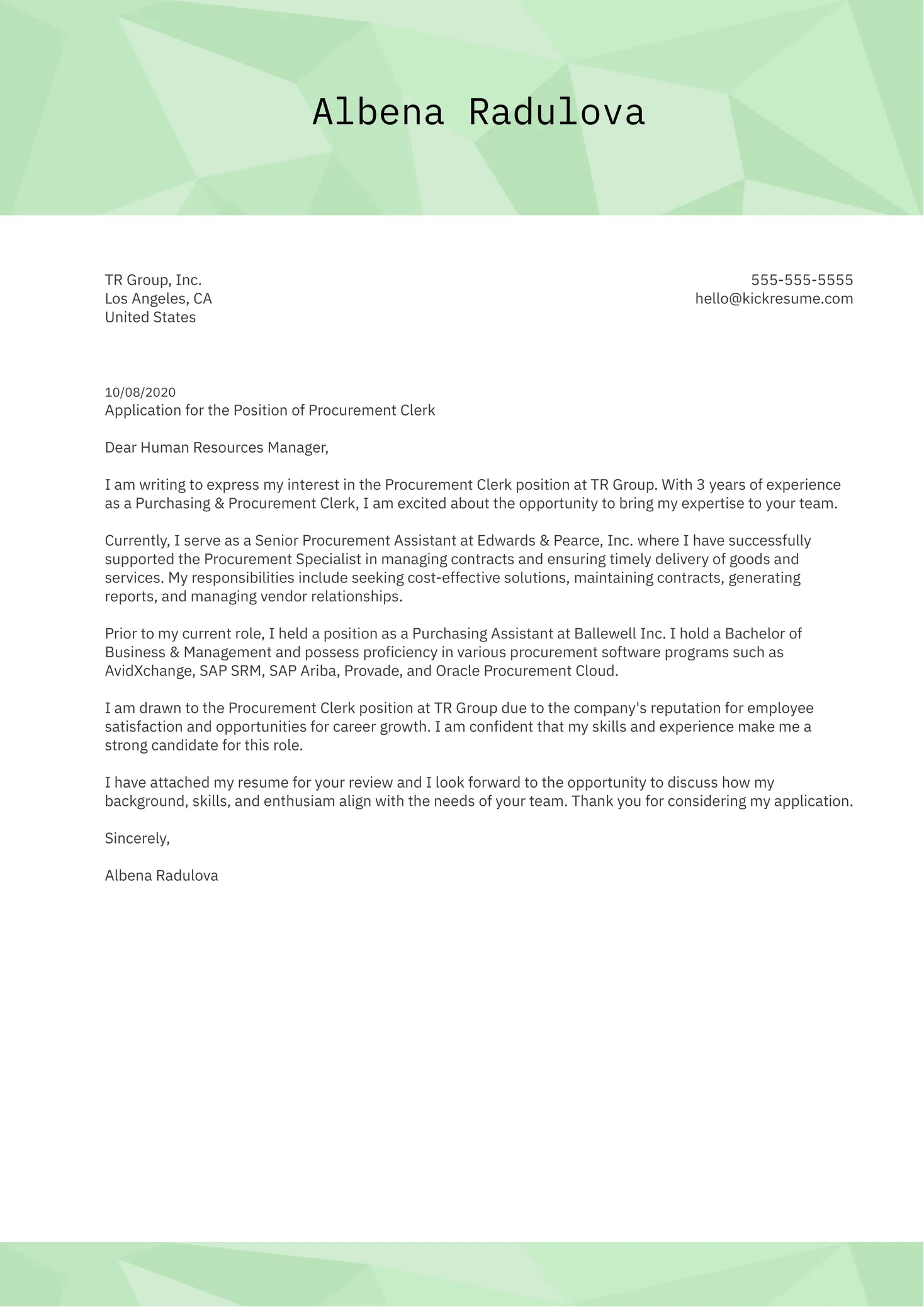
What is a Procurement Officer Cover Letter
A Procurement Officer cover letter is a crucial document that accompanies your resume when applying for a procurement officer position. It serves as your introduction to the hiring manager, allowing you to highlight your relevant skills, experience, and qualifications in a concise and compelling manner. Unlike a resume, which provides a factual overview of your professional history, a cover letter allows you to showcase your personality, express your enthusiasm for the role and company, and explain why you are the ideal candidate. It’s your opportunity to make a positive first impression and differentiate yourself from other applicants. Crafting a well-written cover letter can significantly increase your chances of securing an interview and landing your dream job.
Why is a Cover Letter Important
In today’s competitive job market, a cover letter is more important than ever. It offers a platform to connect with the hiring manager on a personal level, going beyond the basic information presented in your resume. A strong cover letter allows you to elaborate on specific accomplishments, demonstrate your understanding of the company’s needs, and articulate how your skills and experience align with the job requirements. It showcases your communication skills, attention to detail, and ability to tailor your application to the specific role and company. Many employers consider a cover letter a mandatory part of the application process, and failing to include one can immediately disqualify you from consideration. A well-crafted cover letter demonstrates your genuine interest in the position and your commitment to making a positive contribution to the organization.
Key Components of a Procurement Officer Cover Letter

Header Section
Your Contact Information
Start your cover letter with your contact information, including your full name, phone number, email address, and LinkedIn profile URL (optional). This information should be clearly displayed at the top of the page, ensuring the hiring manager can easily reach you.
Date

Below your contact information, include the date you are sending the cover letter. This helps the hiring manager understand when you applied for the position.
Employer’s Contact Information
Include the hiring manager’s name and title (if known), the company’s name, and the company’s address. If you’re unable to find a specific name, you can use a general salutation like “Dear Hiring Manager.”
Salutation
Use a professional salutation such as “Dear Mr./Ms./Mx. [Last Name],” if you know the hiring manager’s name. If you are unsure of the name, use “Dear Hiring Manager” or “Dear [Company Name] Hiring Team.” Avoid generic greetings like “To Whom It May Concern.”
Body of the Cover Letter

First Paragraph
Express your interest and state the position
Begin your cover letter by clearly stating the position you are applying for and where you found the job posting. Express your enthusiasm for the opportunity and the company. Briefly mention what attracted you to the role, such as the company’s mission, values, or industry reputation. For example, “I am writing to express my keen interest in the Procurement Officer position at [Company Name], as advertised on [Platform Name]. I am particularly drawn to [Company’s specific attribute] and believe my skills and experience align perfectly with your requirements.”
Second Paragraph

Highlight your skills and experience
This is where you showcase your relevant skills and experience. Focus on the qualifications and requirements outlined in the job description. Provide specific examples of how you have successfully performed similar duties in the past. Mention your experience in areas such as sourcing, negotiating contracts, managing vendor relationships, and ensuring compliance with procurement policies. Tailor your examples to the specific needs of the company and the role. Use action verbs to describe your accomplishments, such as “negotiated,” “managed,” “implemented,” and “achieved.”
Quantify your achievements
Whenever possible, quantify your achievements to demonstrate your impact. Instead of saying “Improved procurement processes,” say “Improved procurement processes, resulting in a 15% reduction in costs and a 10% increase in efficiency.” Using numbers and data makes your accomplishments more tangible and convincing. Highlight any cost savings, process improvements, or other measurable results you have achieved in your previous roles. This shows the hiring manager the value you can bring to their organization.
Third Paragraph

Showcase your understanding of the company
Demonstrate your understanding of the company’s mission, values, and industry. Research the company and mention specific aspects that resonate with you. Explain why you are interested in working for them and how your skills and experience align with their goals. This shows the hiring manager that you have done your homework and are genuinely interested in the company. Refer to their recent projects, initiatives, or any news that demonstrates your genuine interest.
Closing
Formal closing and Signature

End your cover letter with a strong closing paragraph. Reiterate your interest in the position and express your gratitude for their time and consideration. State your availability for an interview and how they can contact you. Use a professional closing such as “Sincerely,” “Best regards,” or “Thank you for your consideration.” Include your typed name below the closing and your signature above your typed name if you are printing and sending the cover letter.
Formatting and Design
Font and Font Size
Choose a professional and easy-to-read font such as Times New Roman, Arial, or Calibri. Use a font size between 10 and 12 points. Ensure the font is consistent throughout the document. A clear font and appropriate font size make your cover letter more visually appealing and easier for the hiring manager to read. Avoid using overly decorative or unusual fonts, as they can be distracting and make your letter less professional. Sticking to standard fonts ensures your cover letter is accessible and maintains a polished appearance.
Margins and Spacing

Use standard one-inch margins on all sides of your cover letter. Use single spacing within paragraphs and double spacing between paragraphs. This formatting creates a clean and uncluttered look, making your cover letter easier to read and more visually appealing. Proper spacing also prevents your cover letter from appearing crowded or dense. Ensuring proper margins and spacing contributes to a professional and organized presentation.
Proofreading Your Cover Letter
Proofreading is a critical step in the cover letter writing process. Carefully review your cover letter for any grammatical errors, spelling mistakes, and typos. Check for correct punctuation and proper sentence structure. Read your cover letter aloud to catch any awkward phrasing or unclear sentences. Ask a friend, family member, or career advisor to proofread your cover letter for a fresh perspective. A polished and error-free cover letter demonstrates your attention to detail and professionalism. Proofreading ensures that your cover letter presents you in the best possible light and helps you avoid making a negative first impression.
Common Mistakes to Avoid
Avoid these common mistakes to ensure your cover letter is effective. Do not simply repeat your resume. Instead, elaborate on your skills and experience, providing specific examples. Do not use a generic cover letter. Tailor each letter to the specific job and company. Avoid typos, grammatical errors, and spelling mistakes. Do not use overly casual language or slang. Do not be too lengthy; keep your cover letter concise and to the point. Do not focus solely on what you want; instead, highlight how you can benefit the company. By avoiding these common pitfalls, you can create a compelling cover letter that grabs the hiring manager’s attention and increases your chances of getting an interview.