Why a Cover Letter is Crucial for Sales Associates
In the competitive world of sales, securing your dream job requires more than just a stellar resume. A well-crafted cover letter is your secret weapon, a crucial tool that can significantly increase your chances of landing an interview. It’s your first opportunity to make a strong impression, showcasing your personality, enthusiasm, and unique qualifications. Unlike a resume, which provides a snapshot of your experience, a cover letter allows you to tell a compelling story, connecting your skills and achievements to the specific needs of the employer. By demonstrating your genuine interest in the role and the company, you set yourself apart from other applicants. A cover letter provides a platform to elaborate on key skills, highlight relevant experiences, and articulate your career aspirations, making you more than just another name on a list of candidates.
Showcasing Your Sales Skills
Your cover letter is the ideal space to shine a spotlight on your sales skills. Focus on the abilities that make you an effective salesperson. Highlight your proficiency in communication, emphasizing your ability to articulate value propositions clearly and persuasively. Showcase your active listening skills, detailing how you understand customer needs. Mention your negotiation skills, providing examples of successful deals you’ve closed. Don’t forget to include your skills in building rapport and creating positive customer relationships. Quantify your achievements whenever possible. For instance, if you consistently exceeded sales targets, mention the percentage or the specific amount by which you exceeded them. If you’ve developed a strong customer base, describe the number of clients you’ve acquired and maintained. Demonstrating these skills and quantifying your achievements proves you’re not just talking the talk; you’re walking the walk.
Highlighting Your Achievements and Experience

While your sales skills are critical, your cover letter should also highlight your relevant achievements and experiences. Go beyond simply listing your job responsibilities; focus on your accomplishments. Think about instances where you exceeded sales targets, received positive customer feedback, or improved sales processes. When describing your experiences, use the STAR method (Situation, Task, Action, Result) to provide context and demonstrate your capabilities. For example, describe the situation you faced, the task you were assigned, the action you took, and the positive result you achieved. Quantify your accomplishments whenever possible. Did you increase sales by a certain percentage? Did you reduce customer complaints by a specific amount? Did you acquire a certain number of new clients? Use these specific details to demonstrate your value and convince the hiring manager that you are the best candidate for the job. Remember, employers are looking for results, so showcasing your achievements is key to grabbing their attention and securing an interview.
Tailoring Your Cover Letter to the Job
A generic cover letter simply won’t cut it. To stand out from the crowd, you must tailor your cover letter to each job application. This requires careful attention to detail and a deep understanding of the specific requirements of the position. Start by thoroughly reviewing the job description. Identify the key skills, experiences, and qualifications the employer is seeking. Then, align your cover letter with these requirements, highlighting the experiences and skills that directly match what the employer is looking for. This shows that you understand the needs of the company and are a strong match for the role. Use the same language and keywords as those used in the job description, but avoid simply copying and pasting. Instead, demonstrate how your skills and experiences make you a perfect fit for the position. Mention how you’ve previously utilized these skills and achieved results, providing concrete examples that support your claims. This targeted approach shows that you’ve put in the effort to understand the role and the company, significantly increasing your chances of getting noticed.
Understanding the Job Description
The job description is your roadmap to crafting a compelling cover letter. It’s not just a list of responsibilities; it’s a window into the employer’s needs and expectations. Carefully analyze the job description to identify the essential skills, qualifications, and experiences. Look for keywords and phrases that the employer is using to describe the ideal candidate. These keywords are crucial for two reasons; first, they help you align your cover letter with the job’s specific requirements, demonstrating that you understand what the employer is looking for. Second, they can help your application pass through applicant tracking systems (ATS), which many companies use to screen resumes and cover letters. When writing your cover letter, incorporate these keywords naturally into your text. Avoid keyword stuffing, but make sure to mention the skills and experiences the employer values. This will help your application stand out and increase your chances of being selected for an interview.
Researching the Company

Before writing your cover letter, take the time to research the company. Understanding the company’s mission, values, products, and services is crucial for demonstrating your genuine interest and tailoring your application effectively. Visit the company’s website, read news articles about the company, and explore their social media profiles. Look for information about their culture, values, and recent achievements. This research will give you insights into what the company values and how you can align your skills and experiences with their needs. Mention specific aspects of the company that resonate with you in your cover letter. For example, if the company emphasizes customer satisfaction, highlight your customer service skills and experience. If the company has won awards or achieved specific milestones, mention that you are impressed by their achievements. This level of detail demonstrates your genuine interest and shows that you’ve taken the time to learn about the company, significantly increasing your chances of getting noticed.
Structuring Your Cover Letter
A well-structured cover letter is easy to read and makes a strong impression. It should typically include an opening paragraph, body paragraphs, and a closing paragraph. The opening paragraph should grab the reader’s attention and state the position you’re applying for. The body paragraphs are the main section of your cover letter, where you showcase your skills, experiences, and achievements. Use these paragraphs to tell your story and connect your qualifications to the job description. The closing paragraph should reiterate your interest in the position, thank the reader for their time and consideration, and include a call to action. Keep your cover letter concise and to the point. Aim for one page in length. Use clear, concise language and avoid jargon. Use headings and bullet points to break up the text and make it easier to read. A well-structured cover letter demonstrates professionalism and attention to detail, making a positive impression on the hiring manager.
The Opening Paragraph
The opening paragraph is your chance to make a great first impression. It should be concise, engaging, and clearly state the position you’re applying for. Start by addressing the hiring manager by name, if possible. This personal touch shows that you’ve done your research and shows you care about the opportunity. In the opening paragraph, express your interest in the position and briefly mention why you’re a good fit. Consider including a hook to capture the reader’s attention. This could be a brief anecdote, a strong statement about your skills, or a mention of something specific that attracted you to the company. Your goal is to immediately capture the hiring manager’s interest and make them want to read more. Avoid generic openings. A strong opening paragraph will make your cover letter stand out and encourage the hiring manager to read on. This sets the tone for the rest of your application, making it crucial to get it right. The opening should be professional, enthusiastic, and focused.
The Body Paragraphs

The body paragraphs are the heart of your cover letter, where you showcase your skills and experience. This section provides you with the opportunity to elaborate on your key accomplishments and explain why you’re a perfect fit for the role. Use these paragraphs to tell your story. Connect your experiences and skills to the job requirements. Provide specific examples that demonstrate your abilities. Use the STAR method to provide context and demonstrate your capabilities. Structure your body paragraphs logically, organizing your experiences and skills in a way that makes sense to the reader. Start with your most relevant and impressive qualifications. Use keywords from the job description to show that you understand the requirements. Avoid simply restating your resume. Instead, provide additional context and detail. Explain the impact of your actions and the results you achieved. This will paint a clear picture of your capabilities and make you a more compelling candidate. The body paragraphs should be informative, persuasive, and tailored to the specific job requirements.
The Closing Paragraph
The closing paragraph is your last chance to leave a lasting impression. It should reiterate your interest in the position, thank the hiring manager for their time and consideration, and include a call to action. Reiterate your enthusiasm for the opportunity and briefly summarize why you are a great fit for the role. Express your gratitude for the hiring manager’s time and attention, showing respect for their busy schedule. Include a call to action, such as expressing your availability for an interview and providing your contact information. This lets the hiring manager know what steps you would like them to take next. Keep your closing paragraph brief and to the point. Avoid clichés and make it clear that you are looking forward to hearing from them. A strong closing paragraph will leave the hiring manager with a positive impression and increase your chances of getting an interview. It is a critical step in ensuring your application stands out.
Key Skills to Include in Your Cover Letter
When writing your cover letter, it’s crucial to emphasize the skills that are most relevant to the sales associate position. These skills can be divided into several categories. Firstly, communication and interpersonal skills are paramount. Secondly, sales and closing techniques are essential. Customer service and relationship building skills are also important. In the Communication and Interpersonal Skills section, you should highlight your ability to communicate effectively. Mention your skills in active listening, clearly articulating value propositions, and tailoring your communication style to different audiences. Sales and Closing Techniques skills should include your expertise in identifying customer needs, handling objections, and closing deals. Provide examples of successful sales strategies and techniques you’ve used in the past. Include customer service and relationship building. Showcase your ability to build rapport, provide excellent customer service, and create positive customer experiences. Quantify your achievements whenever possible. For example, if you have a high customer retention rate, mention the percentage. Demonstrating your skills in these areas is key to convincing the hiring manager you have the tools to succeed.
Communication and Interpersonal Skills

Effective communication and interpersonal skills are crucial for success as a sales associate. These skills enable you to build relationships, understand customer needs, and convey the value of your products or services. Highlight your communication skills. This includes clear and concise articulation, active listening, and adapting your communication style to diverse audiences. Mention your ability to use both verbal and written communication to convey the essential information clearly. Showcase your interpersonal skills. This includes building rapport, showing empathy, and collaborating effectively with colleagues. Discuss how you build trust with customers. Offer examples of successful communication in sales situations. For example, describe how you have handled customer objections or used active listening to understand customer needs and tailor your approach. The ability to communicate effectively and build strong relationships is vital for creating positive customer experiences and achieving sales targets.
Sales and Closing Techniques
Sales associates must possess strong sales and closing techniques to drive revenue and meet targets. Highlight your experience in various sales strategies. Emphasize your proficiency in identifying customer needs, presenting product features, and addressing objections. Describe your skills in building rapport with customers, creating trust, and understanding their requirements. Explain your techniques for closing deals, such as using persuasive language, handling pricing negotiations, and creating a sense of urgency. Provide specific examples of successful sales outcomes. If you have consistently met or exceeded sales targets, mention those achievements. Quantify your achievements whenever possible. If you increased sales revenue by a certain percentage or acquired a specific number of new clients, mention these achievements. Illustrating your experience with sales techniques demonstrates your ability to contribute immediately to the team.
Customer Service and Relationship Building
Excellent customer service and relationship-building skills are essential for creating loyal customers and driving repeat business. Demonstrate your ability to build rapport. Explain how you build trust and create positive relationships with customers. Showcase your customer service skills. This includes providing exceptional customer service, addressing customer concerns, and resolving complaints effectively. Share examples of how you go above and beyond to meet customer needs. Quantify your achievements whenever possible. If you improved customer satisfaction scores or reduced customer complaints, mention those achievements. Highlight your ability to create positive customer experiences. Discuss how you create a welcoming and positive environment for customers. Describe your experience with customer relationship management (CRM) systems. Mention any awards or recognition you’ve received for your customer service skills. These elements create confidence in your ability to attract and retain customers, which in turn benefits the company.
Example Cover Letter for Sales Associate
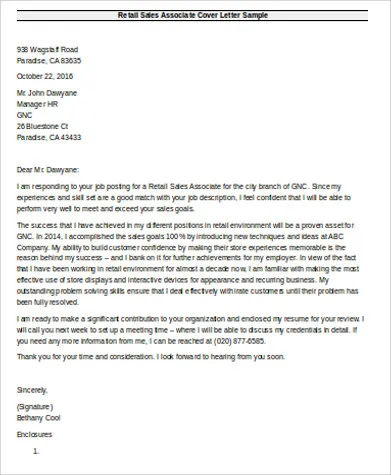
Here’s a sample cover letter to guide you, remember to customize it.
[Your Name] [Your Address] [Your Phone Number] [Your Email]
[Date]
[Hiring Manager Name (if known), or “Hiring Team”] [Company Name] [Company Address]
Dear [Mr./Ms./Mx. Last Name or Hiring Team],
I am writing to express my keen interest in the Sales Associate position at [Company Name], as advertised on [Platform where you saw the job posting]. With my proven track record of exceeding sales targets, exceptional customer service skills, and strong communication abilities, I am confident in my ability to contribute significantly to your team’s success.
In my previous role at [Previous Company], I consistently surpassed sales goals by an average of [Percentage or Amount]. I achieved this by building strong relationships with clients, understanding their needs, and providing tailored solutions. Furthermore, I excel at identifying customer needs and offering value propositions. For example, I successfully [specific achievement].
I am proficient in various sales techniques, including [list key skills]. I also have experience using [CRM systems or other sales tools]. I am eager to leverage my skills and experience to contribute to the growth of [Company Name]. My passion for sales and customer satisfaction aligns perfectly with your company’s values, and I am excited about the prospect of joining your dynamic team.
Thank you for your time and consideration. I have attached my resume for your review and welcome the opportunity to discuss my qualifications further. I am available for an interview at your earliest convenience.
Sincerely, [Your Name]
Remember to customize the content with your own information, achievements, and the specifics of the job and company.
Formatting Your Cover Letter
Formatting your cover letter is crucial for readability and professionalism. Choose a professional font such as Arial, Times New Roman, or Calibri. Maintain a consistent font size (11 or 12 points) throughout the document. Use standard margins (1 inch on all sides) and single-spacing. Keep your cover letter to one page. Use clear headings and bullet points to break up the text and make it easier to read. Use a clean and simple layout. Avoid excessive colors, graphics, and complex formatting. Ensure your contact information (name, address, phone number, and email) is at the top of your cover letter. Include the date and the hiring manager’s name (if known) and the company’s address. Proofread your cover letter carefully to check for errors in grammar, spelling, and punctuation.
Proofreading and Editing
Proofreading and editing are critical steps in ensuring your cover letter is error-free and presents you in the best possible light. Errors in grammar, spelling, and punctuation can undermine your credibility and make a negative impression on the hiring manager. After you’ve finished writing your cover letter, take a break and then reread it with fresh eyes. Read your cover letter slowly and carefully. Look for any typos, grammatical errors, or punctuation mistakes. Use spell-check and grammar-check tools, but don’t rely on them entirely. Consider having someone else proofread your cover letter. A fresh pair of eyes can often catch errors that you might have missed. Ensure that your cover letter flows logically and that your ideas are clearly and concisely expressed. Make sure your tone is professional and enthusiastic.
Common Mistakes to Avoid

Avoid these common mistakes. Don’t use a generic cover letter. Tailor each cover letter to the specific job and company. Do not use excessive jargon or overly complex language. Keep your language clear and easy to understand. Avoid exaggerating your achievements or making false claims. Always be honest in your cover letter. Don’t include negative comments about your previous employers. Focus on your achievements and what you can bring to the new role. Do not leave out crucial information. Make sure to include all the essential information, such as your contact details, the position you’re applying for, and why you’re a good fit. Don’t make grammatical errors or spelling mistakes. Proofread your cover letter carefully before submitting it. A polished cover letter shows you pay attention to detail and are committed to your work.
Sending Your Cover Letter
After you’ve proofread and edited your cover letter, it’s time to send it. Save your cover letter as a PDF file. This ensures that your formatting will remain consistent. Follow the application instructions provided by the employer. Some employers may require you to submit your cover letter and resume through an online application portal. Others may prefer that you send it via email. If submitting your cover letter via email, include a concise and professional subject line. Attach your cover letter and resume to the email. In the body of your email, reiterate your interest in the position and thank the hiring manager for their time. Proofread your email before sending it to ensure that it is free of errors. Finally, follow up on your application. If you haven’t heard back from the employer within a reasonable timeframe (usually a week or two), send a polite follow-up email. This shows your continued interest in the position and that you are dedicated to the opportunity.