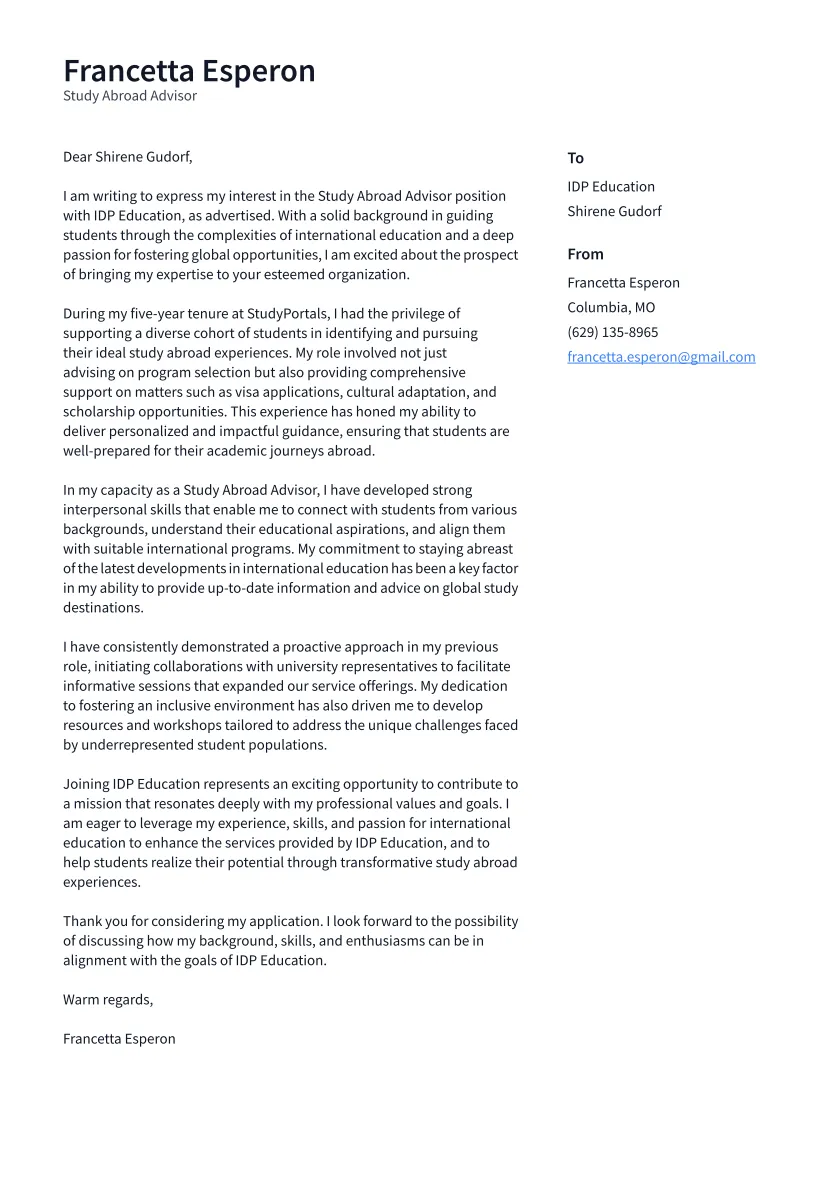
Understanding the Importance of a Study Abroad Advisor Cover Letter
A well-crafted cover letter is your first opportunity to make a strong impression on a potential employer. For a Study Abroad Advisor position, this is especially true. It serves as more than just an introduction; it’s a chance to showcase your personality, enthusiasm for international education, and qualifications that directly align with the job requirements. The cover letter allows you to tell a story beyond your resume, providing context and highlighting why you’re the perfect fit for the role. It demonstrates your communication skills, attention to detail, and understanding of the institution’s mission and values. It’s a critical tool for distinguishing yourself from other applicants and securing an interview.
Key Components to Include in Your Cover Letter
To create a compelling cover letter, several key components are essential. Begin with your contact information and the date, followed by the hiring manager’s details. In the opening statement, express your interest in the position and mention where you found the job posting. Next, highlight your relevant experience and skills, focusing on how they align with the job’s requirements. Demonstrate your passion for study abroad, showcasing your knowledge of different programs and institutions. Always tailor your letter to the specific job description, using action verbs to describe your accomplishments and quantifying your achievements whenever possible. Anticipate and address any potential concerns or questions the employer may have. Finally, conclude professionally, expressing your enthusiasm for the opportunity and inviting them to contact you for an interview.
Your Contact Information and the Date

At the top of your cover letter, include your contact information: your full name, phone number, email address, and LinkedIn profile URL (if applicable). This information ensures the hiring manager can easily reach you. Below your contact details, include the date you are writing the letter. This simple yet crucial step helps to provide context and shows that you have carefully prepared your application. Accuracy in these details is vital. Review them carefully to ensure that they are current and free of errors. An incorrect phone number or email address can lead to missed opportunities and can reflect poorly on your attention to detail. Place this section in the top left corner for easy access.
The Hiring Manager’s Information
Addressing your cover letter to a specific person shows initiative and that you’ve done your research. If possible, find the name and title of the hiring manager or the person who will be reviewing your application. You can often find this information on the job posting, the institution’s website, or LinkedIn. If you are unable to find a name, it’s acceptable to use a general salutation such as ‘Dear Hiring Committee.’ Always verify the spelling of the person’s name and title. Personalizing your letter in this way demonstrates professionalism and a genuine interest in the position. This small detail can make a significant difference in capturing the hiring manager’s attention from the start.
Opening Statement Make an Impact
Your opening statement is your first chance to capture the reader’s attention. Start with a strong statement that clearly expresses your interest in the Study Abroad Advisor position. Mention where you found the job posting (e.g., the university website, a job board) and briefly highlight why you are excited about the opportunity. Instead of a generic opening, aim for a statement that showcases your understanding of the institution’s mission, or the specific goals of their study abroad programs. Express enthusiasm and convey a sense of purpose that demonstrates your genuine passion for international education. This initial statement sets the tone for the rest of your cover letter and entices the reader to continue reading. The goal is to create a memorable first impression that distinguishes you from other applicants.
Highlighting Your Relevant Experience and Skills

The body of your cover letter should showcase your relevant experience and skills. Analyze the job description carefully and identify the key requirements. Then, provide specific examples from your past experiences that demonstrate how you meet those requirements. Use the STAR method (Situation, Task, Action, Result) to structure your examples. For example, describe a situation where you successfully advised students, the task you had to perform, the actions you took, and the positive results you achieved. Skills to highlight may include advising, program management, cross-cultural communication, and proficiency in specific software or systems. Quantify your achievements whenever possible (e.g., ‘Successfully advised over 50 students per semester’).
Demonstrating Your Passion for Study Abroad
Expressing your passion for study abroad is crucial for a Study Abroad Advisor. Share why you are enthusiastic about international education and helping students have transformative experiences. This could include personal experiences, the impact you’ve witnessed study abroad programs have on students, or your understanding of the benefits of global learning. Show your passion through your writing style by using words that convey excitement and enthusiasm. You can share stories or anecdotes to illustrate your commitment to the field. Mention your involvement in international travel or cross-cultural activities, highlighting your understanding of diverse cultures and the challenges students may face. Your passion will help to create a strong connection with the hiring manager and demonstrate that you are motivated to contribute to the university’s mission.
Showcasing Your Knowledge of Programs and Institutions
A strong cover letter demonstrates knowledge of the specific programs and institutions you’re applying to. Research the university’s study abroad programs and mission statement. Highlight your understanding of their specific goals and how your skills and experience align. Mention specific programs or destinations that you are familiar with or interested in. If you have experience working with international partners or universities, be sure to mention it. Showing that you’ve done your homework shows initiative, interest, and demonstrates that you’re more than just a generic candidate. This will set you apart from candidates who have not researched the institution. Consider mentioning any professional development activities, certifications, or relevant coursework you’ve completed.
Tailoring Your Letter to the Specific Job

Customizing your cover letter for each job application is essential. Generic cover letters rarely make a strong impression. Carefully review the job description and identify the key skills and qualifications the employer is seeking. Then, tailor your letter to address those specific requirements. Use the same keywords and phrases from the job description to demonstrate that you meet their needs. Provide specific examples of how your past experiences align with the job’s responsibilities. Show that you have a good understanding of the role and that you have carefully considered how your skills and experience can contribute to the institution’s goals. If the job description emphasizes advising, then highlight your experience in that area and provide examples of your successes. This approach demonstrates a genuine interest in the position and the organization.
Using Action Verbs to Describe Your Accomplishments
Using strong action verbs is a powerful way to make your accomplishments stand out. Start each sentence describing your accomplishments with a dynamic verb, such as ‘managed’, ‘developed’, ‘coordinated’, ‘advised’, ‘implemented’, or ‘achieved’. These verbs create a sense of energy and emphasize what you accomplished in your previous roles. Instead of saying, ‘Responsible for advising students,’ use ‘Advised students on program selection.’ Or instead of saying ‘Managed the study abroad applications,’ use ‘Managed and streamlined the study abroad application process.’ Using strong verbs helps convey your accomplishments and helps the hiring manager visualize what you did. This will greatly improve the impact and readability of your cover letter.
Quantifying Your Achievements for Impact
Quantifying your achievements adds significant weight to your cover letter. Providing specific numbers and data to back up your claims can make your accomplishments more compelling and memorable. Instead of saying ‘Increased student participation,’ say ‘Increased student participation in study abroad programs by 20% in one year.’ Instead of saying ‘Improved the application process,’ state ‘Improved the application process by reducing processing time by 15%’. Quantify your achievements with numbers, percentages, or specific metrics to provide concrete evidence of your impact. This demonstrates that you are results-oriented and capable of making a meaningful contribution to the role. This will give the hiring manager a clear understanding of your past successes and how you can bring value to their organization.
Addressing Common Concerns and Questions

Proactively addressing potential concerns or questions in your cover letter can show that you have carefully considered the role and its requirements. For example, if there is a gap in your employment history, briefly explain it and highlight what you learned during that time. If you are changing careers, explain your motivations and how your transferable skills align with the Study Abroad Advisor position. Anticipate any potential questions the hiring manager might have about your qualifications or experience and provide clear, concise answers. This demonstrates self-awareness, initiative, and your ability to think strategically. Being proactive in addressing potential concerns can reassure the hiring manager and increase your chances of getting an interview.
Concluding Your Cover Letter Professionally
Your conclusion should reinforce your interest in the position and summarize your key qualifications. Express your enthusiasm for the opportunity and reiterate why you are a good fit for the role. State your willingness to discuss your qualifications further in an interview and thank the hiring manager for their time and consideration. Use a professional closing, such as ‘Sincerely’ or ‘Best regards,’ followed by your typed name. If you are submitting a physical letter, sign it above your typed name. Your conclusion should be clear, concise, and leave the hiring manager with a positive and lasting impression. Ensure that the tone is professional and reflects your interest in the role.
Proofreading and Editing Your Cover Letter
Before submitting your cover letter, proofread and edit it carefully to ensure it is free of errors. Spelling and grammatical errors can undermine your credibility and detract from your qualifications. Read your letter multiple times, slowly and carefully, looking for any mistakes. Use a spell-checker and grammar checker, but also read it aloud to catch any awkward phrasing or unclear sentences. Ask a friend or colleague to review your letter. A fresh pair of eyes can often spot errors that you might miss. Check for consistency in formatting, font, and tone. Ensure that your contact information is correct and that you have followed all instructions in the job posting. A polished and error-free cover letter shows your attention to detail and professionalism.
Seeking Feedback and Making Revisions

Seeking feedback is an essential part of the application process. Once you have drafted your cover letter, ask trusted friends, mentors, or career advisors to review it. Be open to their suggestions and constructive criticism. Ask them to assess the clarity, conciseness, and effectiveness of your letter. Do they feel it effectively conveys your qualifications and passion for the role? Does it make a compelling case for why you are the best candidate? Use their feedback to revise and refine your cover letter. Don’t be afraid to make changes based on the feedback you receive. Continuous improvement is key to crafting a cover letter that stands out. By seeking feedback, you will produce a more polished and effective cover letter. Your attention to detail will increase the likelihood of landing an interview.