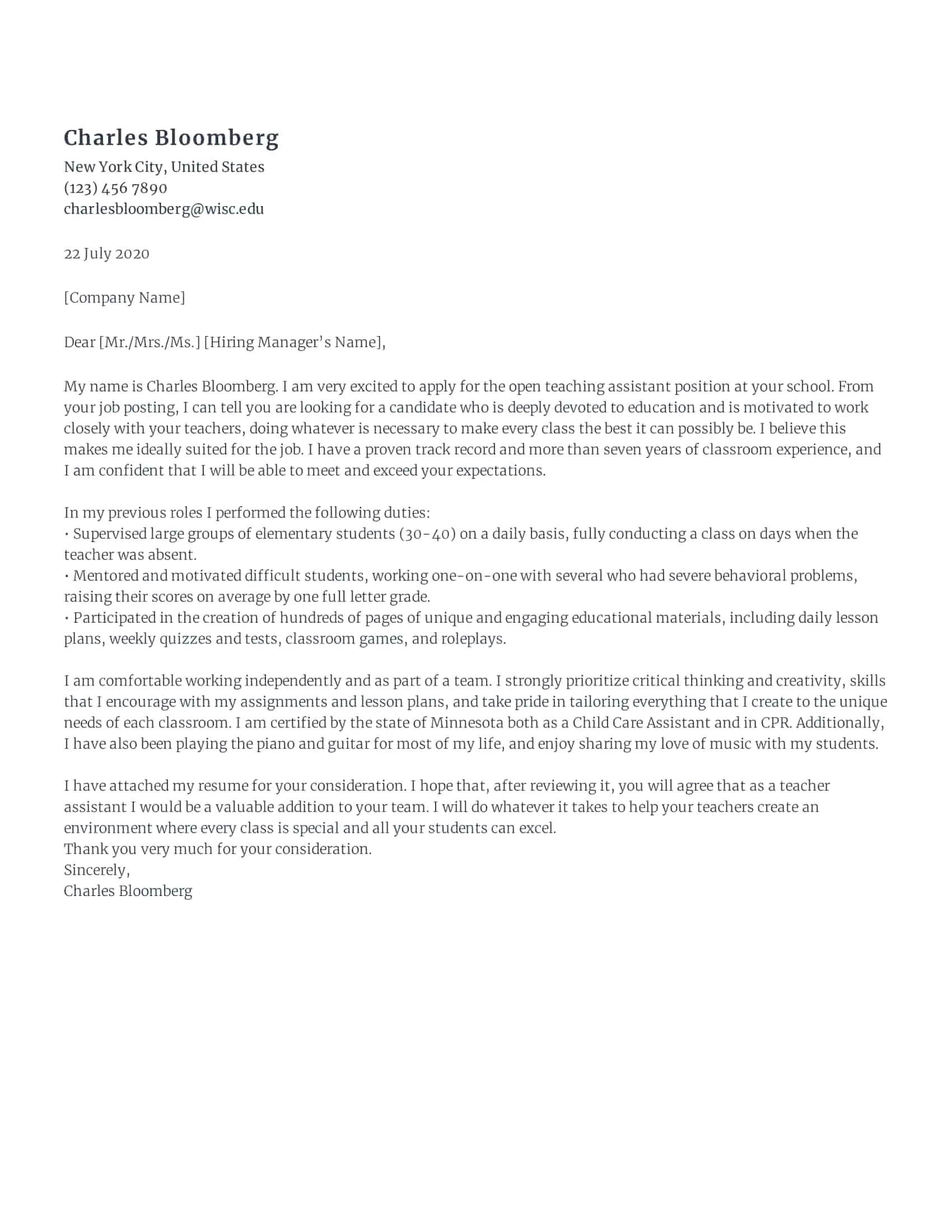
Crafting a Teacher Assistant Cover Letter
A well-crafted teacher assistant cover letter is your initial opportunity to make a positive impression on potential employers. It’s your chance to showcase your skills, experiences, and passion for education in a concise and compelling manner. Unlike a resume, which provides a factual overview of your qualifications, a cover letter allows you to express your personality, explain why you are the ideal candidate, and highlight your genuine interest in the specific position and school. A strong cover letter demonstrates your ability to communicate effectively, a crucial skill for any teacher assistant, setting you apart from other applicants. To stand out, it is essential that you avoid generic templates and focus on personalizing it to each job application, reflecting that you have taken the time to understand their needs.
Understanding the Purpose of a Cover Letter
The primary goal of a cover letter is to convince the hiring manager to read your resume and consider you for an interview. It serves as a bridge between your qualifications and the needs of the school. It provides context to your resume, elaborating on specific experiences and achievements that align with the job requirements. It allows you to articulate your understanding of the school’s values and the specific challenges of the role. In essence, the cover letter humanizes your application, presenting you not just as a list of skills and experiences but as a passionate individual who is dedicated to supporting students and educators.
Highlighting Relevant Skills

The success of your teacher assistant cover letter depends heavily on your ability to highlight relevant skills. It is not enough to simply list your qualifications; you must demonstrate how your skills translate into value for the school and its students. Before you begin writing, carefully review the job description and identify the key skills and qualities the employer is seeking. Then, craft your cover letter to directly address these requirements, providing concrete examples to illustrate how you have successfully used these skills in the past. Make sure to create a balance between soft and hard skills and tailor it to each job description. This targeted approach significantly increases your chances of making a favorable impression.
Key Skills to Showcase
As a teacher assistant, you’ll need a diverse set of skills to succeed. These skills should be highlighted and backed up with tangible experiences. Focus on providing examples that demonstrate a pattern of success, and align with what the job description is looking for.
Communication and Interpersonal Abilities
Effective communication is paramount for a teacher assistant. Highlight your ability to communicate clearly and respectfully with students, teachers, parents, and colleagues. Provide examples of times you successfully explained complex concepts, resolved conflicts, or provided constructive feedback. Showcase your active listening skills and your ability to empathize with students’ needs and concerns. Describe situations where you effectively collaborated with teachers or parents to support students’ learning and development. Emphasize your interpersonal skills, such as building rapport, establishing trust, and creating a positive and inclusive classroom environment.
Classroom Management and Organization

Classroom management and organizational skills are essential for creating a structured and conducive learning environment. Demonstrate your ability to assist with classroom organization, such as setting up learning centers, managing supplies, and maintaining student records. Provide examples of how you have successfully managed student behavior, implemented classroom routines, and created a positive and engaging atmosphere. Highlight your skills in time management, prioritizing tasks, and meeting deadlines. Include examples of any experience you have working with classroom technology or educational software. Illustrate your ability to adapt to changing situations, stay organized, and maintain a calm and professional demeanor in the classroom.
Patience, Empathy and Adaptability
A teacher assistant must embody patience, empathy, and adaptability. Highlight instances where you demonstrated patience while working with students who struggled with specific concepts or tasks. Showcase your empathy by describing how you supported students emotionally or addressed their individual needs. Provide examples of your ability to adapt to different teaching styles, student personalities, and unexpected classroom situations. Emphasize your ability to remain calm under pressure, think on your feet, and find creative solutions to challenges. Demonstrate your genuine care for the students’ well-being and your commitment to supporting their academic and personal growth.
Structuring Your Teacher Assistant Cover Letter
A well-structured cover letter is easy to read and makes a strong impression. A clear structure allows the hiring manager to quickly understand your qualifications and suitability for the role. Here’s a good template you can follow.
Header and Contact Information

Begin with your contact information, including your name, address, phone number, and email address. Place this at the top left or right of the letter. Include the date and the recipient’s contact information (name, title, school name, and address) below your contact information. Ensure that all information is accurate and professional. It is important that you are able to be contacted.
Professional Greeting
Address the hiring manager by name whenever possible. Research the school’s website or use LinkedIn to find the name of the hiring manager. If you can’t find a name, use a professional greeting such as “Dear Hiring Committee” or “Dear [School Name] Hiring Team.” Avoid generic greetings like “To Whom It May Concern.”
Body Paragraphs
The body of your cover letter is where you showcase your skills and experiences. Start with a compelling introduction that states the position you are applying for and how you learned about the opportunity. In the following paragraphs, highlight your most relevant qualifications and experiences, providing specific examples and quantifiable achievements. Explain why you are interested in the position and the school. Use action verbs to describe your accomplishments. Keep your paragraphs concise and easy to read. Conclude with a call to action, expressing your enthusiasm for the position and your availability for an interview.
Tailoring Your Letter to the Job Description

Personalizing your cover letter to match the specific job description is crucial for demonstrating your genuine interest and suitability for the role. It shows the hiring manager that you have taken the time to understand their needs and are genuinely interested in the position. Generic cover letters rarely make a lasting impression. Tailoring your letter ensures that you emphasize the skills and experiences that are most relevant to the specific job requirements, increasing your chances of getting noticed. It is important that you show how you meet the requirements and how your unique skills and experiences align with the school’s values and goals.
Researching the School or Institution
Research the school before writing your cover letter. Visit their website to learn about their mission, values, and teaching philosophy. Identify any special programs or initiatives that align with your interests and skills. If possible, read parent testimonials or reviews. Demonstrate your knowledge of the school’s culture and how you can contribute to its success. This research provides you with valuable insights that you can incorporate into your cover letter, setting you apart from other applicants and demonstrating your genuine interest in the school.
Matching Skills to Requirements
Carefully review the job description and identify the key skills, qualifications, and experiences required for the position. Compare these requirements with your own skills and experiences. In your cover letter, specifically address each requirement, providing examples of how you have demonstrated these skills in the past. Use the same keywords and phrases from the job description, but don’t simply reiterate the requirements. Instead, provide concrete examples of how you have successfully applied these skills in previous roles or experiences. Ensure that your examples are relevant, specific, and quantifiable whenever possible.
Quantifying Your Achievements

Quantifying your achievements adds credibility to your claims and demonstrates the impact you have made in previous roles. When describing your experiences, use numbers, statistics, and data to illustrate your accomplishments. For example, instead of saying “I improved student engagement,” say “I increased student engagement by 20% through the implementation of interactive classroom activities.” Quantifiable achievements make your cover letter more persuasive and demonstrate your ability to deliver results. Whenever possible, back up your claims with data and metrics. This helps hiring managers see the value you bring to the role.
Providing Specific Examples
Specific examples bring your cover letter to life and make your qualifications more memorable. Instead of general statements, provide detailed anecdotes that illustrate your skills, experiences, and accomplishments. Describe specific situations, challenges, and outcomes. Use the STAR method (Situation, Task, Action, Result) to structure your examples. For example, “In a previous role, I observed that students were struggling with reading comprehension. My task was to implement strategies to improve their understanding. I developed and implemented a new reading comprehension program, which resulted in a 15% increase in reading scores.” Provide specific examples that demonstrate your problem-solving skills, your ability to work with others, and your overall suitability for the role.
Using Action Verbs
Use strong action verbs to describe your skills and accomplishments. Action verbs create a dynamic and engaging tone, making your cover letter more impactful. Instead of saying “responsible for,” use action verbs like “managed,” “led,” “implemented,” “developed,” “created,” or “achieved.” When describing your experiences, use action verbs that highlight your initiative, problem-solving skills, and accomplishments. This makes your cover letter more engaging and showcases your proactive approach.
Proofreading and Editing

Before submitting your cover letter, thoroughly proofread and edit it to ensure it is free of errors. Errors can undermine your credibility and make you look unprofessional. Check for grammatical errors, spelling mistakes, and punctuation errors. Read your cover letter aloud to catch any awkward phrasing or sentences. Have a friend or colleague review your letter. Ensure that your cover letter is clear, concise, and well-written. Proofreading demonstrates your attention to detail, which is a crucial skill for a teacher assistant. A polished and error-free cover letter shows your commitment to excellence and professionalism.
Common Mistakes to Avoid
Avoid common mistakes that can negatively impact your cover letter and application. Don’t use generic templates or write a generic cover letter. Always personalize your letter to the specific job and school. Don’t include irrelevant information. Focus on skills and experiences that are relevant to the position. Avoid clichés and jargon. Use clear, concise language. Do not make any typos or grammatical errors. Proofread carefully. Avoid negative language or complaints. Focus on your strengths and enthusiasm for the position.
Formatting and Presentation
Pay attention to the formatting and presentation of your cover letter. Use a professional font, such as Times New Roman, Arial, or Calibri, in a readable size (11-12 points). Use single spacing and leave ample white space. Use bolding for headings and important information. Ensure your cover letter is well-organized and easy to read. Maintain consistency throughout the document. Use a clear and professional layout. Save your cover letter as a PDF file to preserve its formatting and ensure it is accessible to the hiring manager.
Closing Your Cover Letter
End your cover letter with a strong closing that leaves a lasting impression. Thank the hiring manager for their time and consideration. Reiterate your interest in the position and the school. Express your enthusiasm for the opportunity to contribute to their mission. Include a call to action, such as stating that you are available for an interview and providing your contact information. Close with a professional sign-off, such as “Sincerely” or “Best regards.” A strong closing paragraph reinforces your qualifications and demonstrates your genuine interest in the position, increasing your chances of moving forward in the application process.